2025 · Mancebo — Performance of Unmodified Mechanical Ventilators With 2% Hydrogen Gas Mixtures.
Super-Abstract
Can standard, unmodified intensive-care ventilators safely deliver a 2% H₂ gas mixture? This in-vitro bench study tested four clinical ventilator models and found that three (Servo-i, Servo-u, Evita V500) delivered the mixture with acceptable accuracy for both tidal volume and oxygen concentration — while the neonatal Babylog VN500 showed severe inaccuracies in tidal volume delivery and should not be used with H₂ mixtures without modification. (Respiratory Care, 2025.)
Commentary
This is a purely technical, in-vitro bench study — no patients, no animals. Its relevance lies in the practical translation of H₂ inhalation therapy to critical care: one major barrier has been whether existing clinical ventilators can handle H₂ gas without requiring expensive modifications. The study provides concrete guidance — three out of four tested models passed — and identifies a specific failure mechanism in the Babylog VN500 (hot-wire anemometry at higher operating temperature reacts to H₂ differently). This type of device-compatibility data is essential for any future clinical trial of inhaled H₂ in mechanically ventilated patients.
Key quotes
- „Unmodified Servo-i, Servo-u, and Evita V500 ventilators deliver 2% H2 mixtures with acceptable accuracy in VT and FIO2.“ — main positive finding: three ventilators passed
- „The Babylog VN500, which uses hot-wire anometry and a higher set operating temperature, exhibits unacceptably inaccurate delivery of VT with H2 mixtures.“ — key failure finding and its technical cause
- „The provision of 2% H2 through unmodified mechanical ventilators may facilitate the clinical translation of H2 as a therapeutic in critical illness.“ — motivation for the study
Our assessment
This is a device-performance in-vitro study with no data on patient outcomes or H₂ efficacy — it tests hardware compatibility only. The finding that three common adult ventilators can deliver 2% H₂ accurately is an important practical step for future clinical research. However, the study does not address clinical benefit, safety in patients, or optimal H₂ dosing. Clinicians and researchers should take the Babylog VN500 warning seriously for neonatal/paediatric applications. This study tells us about ventilator mechanics, not about therapeutic effects of H₂ in humans.
Study design
- Type: in-vitro bench study · Devices tested: Maquet Servo-i, Servo-u, Dräger Evita Infinity V500, Dräger Evita Babylog VN500 · H₂ delivery: certified premixed gas (air/O₂ + 2% H₂) via standard wall supply
- Endpoints: tidal volume bias (Douglas method), FiO₂ accuracy, delivered H₂ concentration (gas chromatography), pre-use check pass/fail · Result: Servo-i/u and Evita V500 within ±10% bias; Babylog VN500 tidal volume bias −89.2% (unacceptable)
Abstract
Background: Molecular hydrogen (H2) is a breathable gas that has been shown to have anti-oxidative, anti-inflammatory, and anti-apoptotic properties that may positively impact ischemia-reperfusion injury. The provision of 2% H2 through unmodified mechanical ventilators may facilitate the clinical translation of H2 as a therapeutic in critical illness. The effect of 2% H2 on ventilator performance is unknown. Methods: Unmodified Maquet Servo-i, Maquet Servo-u, Dräger Evita Infinity V500, and Dräger Evita Babylog VN500 ventilators from clinical stock were tested in an experimental closed system using certified, premixed air and O2 containing 2% H2 gas. Wall air and O2 supply were used as control. Ventilator settings were varied across the spectrum of neonatal to adult settings. End points included (1) difference between set and delivered tidal volume (VT) (Douglas method), (2) difference between set versus delivered O2 concentration, (3) delivered H2 concentration (gas chromatography), and (4) ventilator pre-use check malfunction. Correlation between set and measured end points were quantified by linear regression analysis and bias by Bland-Altman analysis. Results: During H2 administration, the average bias in measured versus set VT was within ± 10% for all ventilators except for the Babylog VN500, which exhibited an average bias of -89.2% (95% CI -107.0 to -71.3). The average bias in measured FIO2 was within ± 10% of set for all ventilators. Except for the Babylog VN500, all ventilators passed the pre-use check. Conclusions: Unmodified Servo-i, Servo-u, and Evita V500 ventilators deliver 2% H2 mixtures with acceptable accuracy in VT and FIO2. The Babylog VN500, which uses hot-wire anometry and a higher set operating temperature, exhibits unacceptably inaccurate delivery of VT with H2 mixtures.
Source & links
Screenshot of the PubMed page
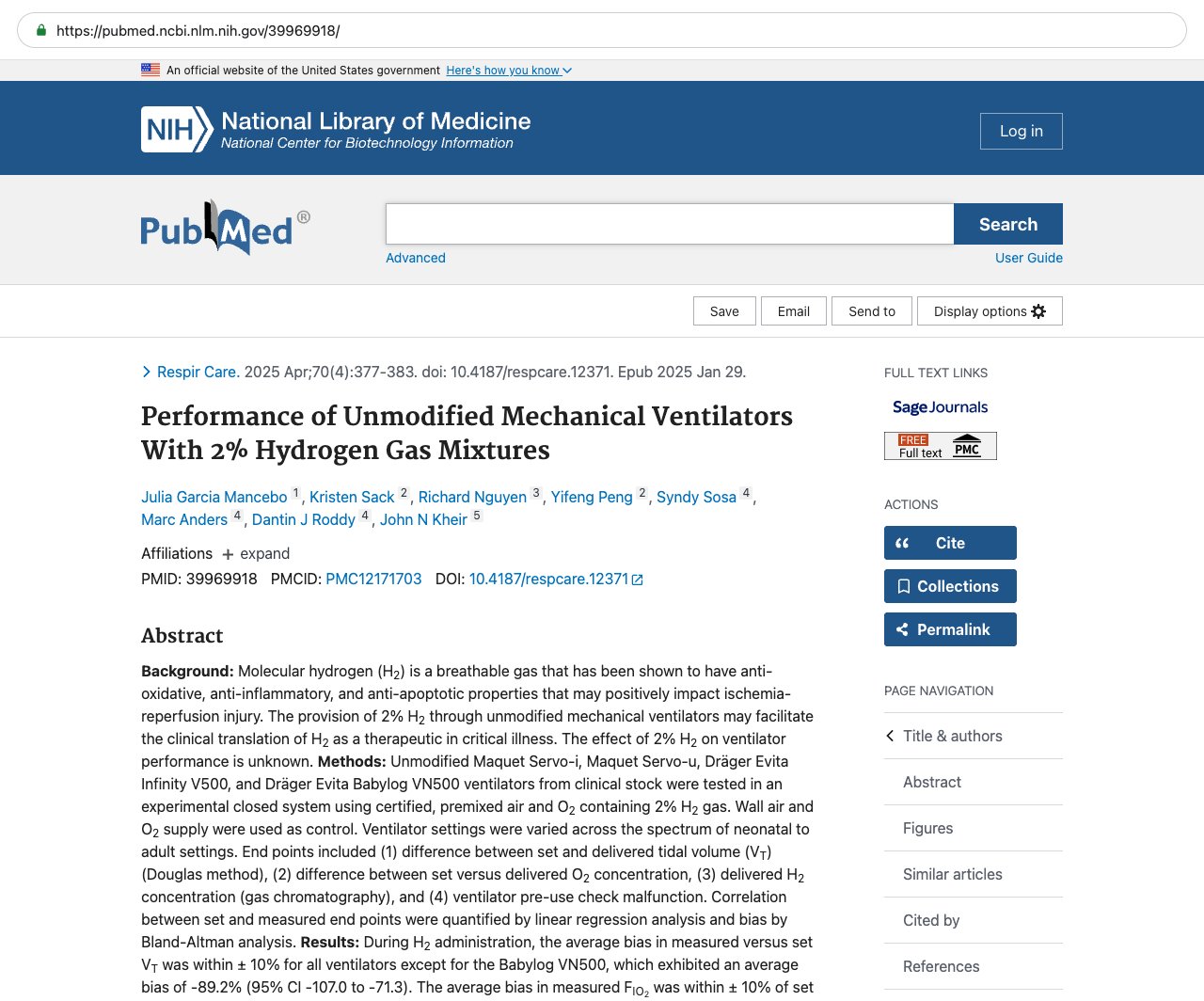
This page mirrors the published abstract (© the authors / publisher) for reference and citation. The canonical source is the PubMed record linked above. This is not medical advice.