2023 · Johnsen et al. — Molecular Hydrogen Therapy — A Review on Clinical Studies and Outcomes
Super-Abstract
This comprehensive review in Molecules analysed 81 identified clinical trials and 64 scientific publications on human studies of molecular hydrogen (H₂) therapy across a broad range of disease areas. Positive signals were found in cardiovascular disease, cancer, respiratory disease, central nervous system disorders, and infections, among others. The review also addresses practical challenges of H₂ administration — including its explosive hazard and low solubility — and asks: could hydrogen gas become a recognised drug substance in future clinical practice?
Commentary
This is one of the more expansive reviews of the human clinical evidence base for H₂ therapy, covering 81 trials and 64 publications. The breadth is notable: the authors surveyed clinical trial registers as well as published literature, providing a snapshot of the field's ambition. Important nuances for critical reading: the review is narrative, not a systematic meta-analysis with pooled effect sizes — the authors cannot weight or directly compare study quality in a quantitative way. The question of whether H₂ will become a „new drug substance“ is posed openly, not resolved. The administration challenge is honestly addressed: H₂ is flammable above 4% concentration, has low aqueous solubility, and requires careful delivery system engineering. The review's value is as a landscape map of the human evidence base, not as proof of efficacy for any specific indication. Readers should note that many of the referenced clinical trials are small, unblinded, or preliminary.
Key quotes
- „Positive indications have been found in major disease areas including cardiovascular diseases, cancer, respiratory diseases, central nervous system disorders, infections and many more.“ — the breadth of preliminary positive signals — across diverse indications in human studies
- „A simple search of 'hydrogen gas' in various medical databases resulted in more than 2000 publications related to hydrogen gas as a potential new drug substance.“ — the sheer scale of the emerging research field as of 2023
- „will hydrogen gas be a new drug substance in future clinical practice?“ — the open clinical question the authors pose — not yet answered definitively
Our assessment
A valuable landscape review covering 81 clinical trials and 64 human publications on H₂ therapy — one of the most comprehensive such surveys available. Its strength is breadth; its limitation is that it is a narrative review, not a systematic meta-analysis. Effect sizes are not pooled, study quality is not formally graded. The honest verdict from the authors themselves: H₂ therapy shows promising signals across many disease areas, but whether it will achieve drug status remains an open question requiring larger, controlled trials. This is a review, not new experimental evidence.
Study design
- Type: narrative review · Scope: 81 identified clinical trials + 64 human study publications · H₂ delivery: inhalation and other routes (reviewed comprehensively)
- Disease areas covered: cardiovascular, cancer, respiratory, CNS, infections, and others · Result: positive preliminary signals across multiple domains; no pooled effect sizes; administration challenges (flammability, solubility) discussed; regulatory and future-direction analysis included
Abstract
With its antioxidant properties, hydrogen gas (H2) has been evaluated in vitro, in animal studies and in human studies for a broad range of therapeutic indications. A simple search of "hydrogen gas" in various medical databases resulted in more than 2000 publications related to hydrogen gas as a potential new drug substance. A parallel search in clinical trial registers also generated many hits, reflecting the diversity in ongoing clinical trials involving hydrogen therapy. This review aims to assess and discuss the current findings about hydrogen therapy in the 81 identified clinical trials and 64 scientific publications on human studies. Positive indications have been found in major disease areas including cardiovascular diseases, cancer, respiratory diseases, central nervous system disorders, infections and many more. The available administration methods, which can pose challenges due to hydrogens' explosive hazards and low solubility, as well as possible future innovative technologies to mitigate these challenges, have been reviewed. Finally, an elaboration to discuss the findings is included with the aim of addressing the following questions: will hydrogen gas be a new drug substance in future clinical practice? If so, what might be the administration form and the clinical indications?
Source & links
Screenshot of the PubMed page
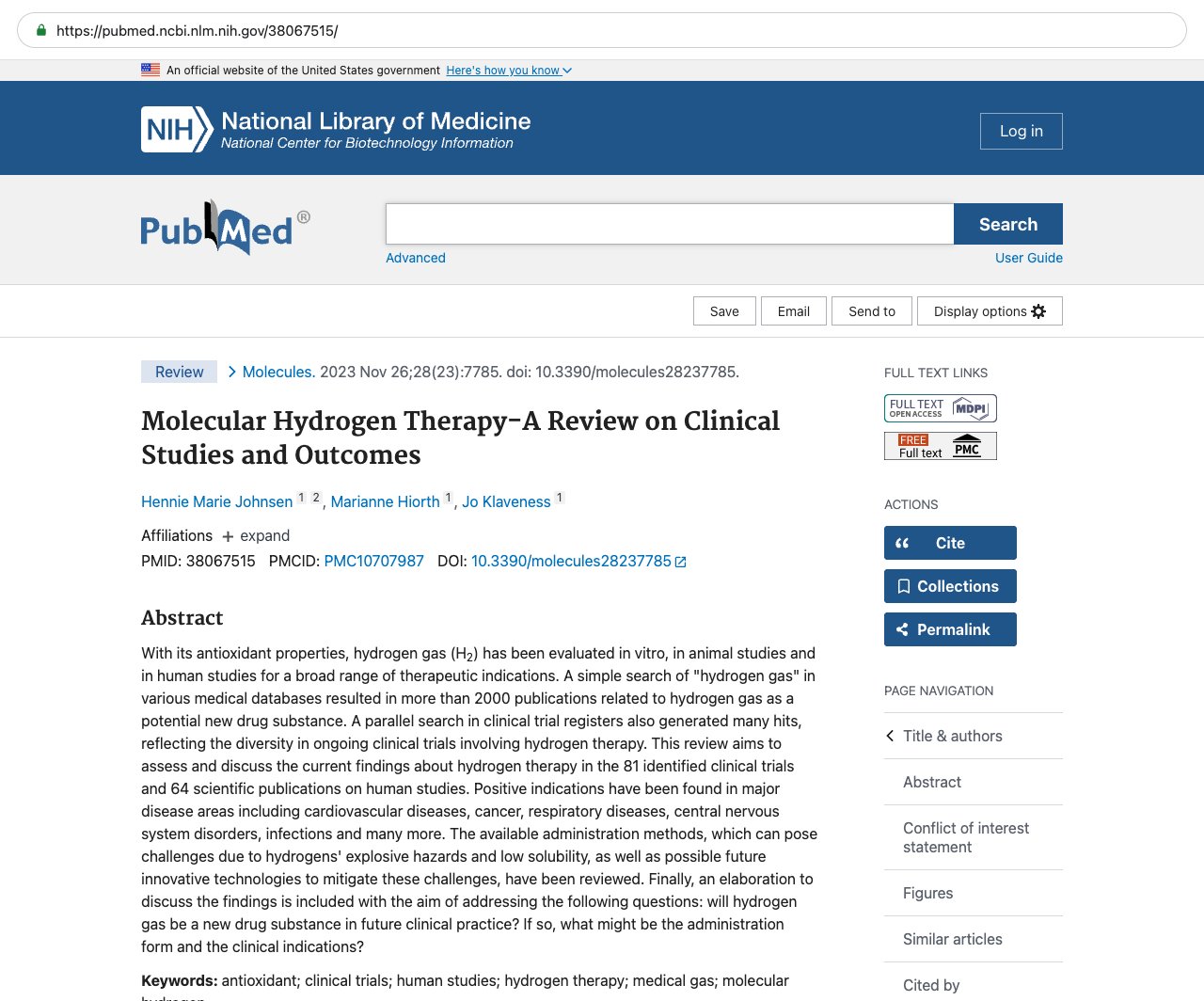
This page mirrors the published abstract (© the authors / publisher) for reference and citation. The canonical source is the PubMed record linked above. This is not medical advice.