2019 · Yu — Hydrogen gas reduces HMGB1 release in lung tissues of septic mice in an Nrf2/HO-1-dependent pathway.
Super-Abstract
In septic mice (CLP model), 2 % hydrogen (H₂) gas inhalation reduced lung injury, improved survival, and decreased the release of HMGB1 — a late-phase danger signal in sepsis — through a pathway requiring the Nrf2 transcription factor and the enzyme HO-1. When Nrf2 was genetically knocked out, H₂ lost its protective effects, confirming the Nrf2/HO-1 axis as essential to H₂'s mechanism of action in this model. (International Immunopharmacology, 2019.)
Commentary
HMGB1 (high-mobility group box 1) is a nuclear protein that, when released into the circulation during sepsis, acts as a late inflammatory mediator and amplifies organ damage. It has been proposed as a therapeutic target in sepsis. Nrf2/HO-1 signaling is a well-established cellular stress-response pathway that counteracts oxidative and inflammatory injury. This study builds on previous work from the same group and adds the mechanistic link between H₂, Nrf2/HO-1 activation, and HMGB1 suppression, using Nrf2-knockout mice as a clean genetic tool to prove pathway dependency. This is a methodologically rigorous approach. However, the study is exclusively in mice; H₂ was applied at 2 % concentration for 60-minute sessions, and all animals were male ICR mice — none of these parameters are directly transposable to a clinical ICU context. HMGB1 levels have not yet been successfully targeted in human sepsis trials despite decades of preclinical optimism.
Key quotes
- „2% H2 gas treatment increased the survival rates, decreased the W/D weight ratio and the lung injury score, alleviated the injuries caused by oxidative stress and inflammation, and induced HO-1 level but reduced HMGB1 level in WT but not Nrf2-KO mice.“ — core finding: H₂ protection depends on Nrf2 — lost in knockout mice
- „H2 gas could suppress lung injury in septic mice through regulation of HO-1 and HMGB1 expression and that Nrf2 plays a main role in the protective effects of H2 gas on lung damage caused by sepsis.“ — the identified molecular pathway: H₂ → Nrf2 → HO-1 ↑ → HMGB1 ↓ → lung protection
- „The aim of this research was to investigate the effects of 2% H2 gas inhalation on sepsis-induced lung injury and its underlying mechanisms.“ — study objective: mechanistic clarification, not clinical efficacy
Our assessment
A mechanistically rigorous preclinical animal study — not clinical evidence for humans. The use of Nrf2 knockout mice to establish pathway dependency is a strength. However, the entire dataset is from a single species (male ICR mice), a specific surgical sepsis model, and a fixed H₂ inhalation protocol that may not be clinically achievable. HMGB1 suppression through Nrf2/HO-1 is a promising mechanistic pathway, but no H₂ study has yet shown benefit in human sepsis. Results should not be extrapolated beyond the animal model.
Study design
- Type: preclinical mechanistic animal study · Model: male wild-type (WT) and Nrf2-knockout (Nrf2-KO) ICR mice, CLP sepsis model · H₂ delivery: 2 % H₂ gas inhalation for 60 min at 1 h and 6 h post-CLP
- Result: H₂ improved 7-day survival, reduced W/D lung ratio and injury score, reduced oxidative stress (MDA ↓, SOD/CAT ↑), reduced HMGB1 and TNF-α/IL-6, increased IL-10 and HO-1 — all in WT mice only; Nrf2-KO mice showed no H₂ benefit, confirming Nrf2 dependency
Abstract
BACKGROUND: Lung injury is a vital contributor of mortality in septic patients. Our previous studies have found that molecular hydrogen (H2), which has anti-oxidant, anti-inflammatory, and anti-apoptosis effects, had a therapeutic effect on a septic animal model through increasing expression of nuclear factor-erythroid 2-related factor 2 (Nrf2). The aim of this research was to investigate the effects of 2% H2 gas inhalation on sepsis-induced lung injury and its underlying mechanisms. METHODS: Male wild-type (WT) and Nrf2-knockout (Nrf2-KO) ICR mice underwent sham or cecal ligation and puncture (CLP) operation. Two percent of H2 gas was inhaled for 60 min beginning at both 1 h and 6 h after sham or CLP surgery. To assess the severity of septic lung injury, the 7-day survival rate, wet/dry (W/D) weight ratio of lung tissue, lung histopathologic score, pro-inflammatory cytokines (tumor necrosis factor alpha (TNF-α), interleukin 6 (IL-6), high-mobility group box 1 (HMGB1)), anti-inflammatory cytokine (interleukin 10 (IL-10)), antioxidant enzymes (superoxide dismutase (SOD), catalase (CAT), and heme oxygenase 1 (HO-1)), and an oxidative product (malondialdehyde (MDA)) were detected after sham or CLP operation. The histopathologic changes were observed in lung tissues by hematoxylin and eosin (HE) staining, and pro-inflammatory cytokines (TNF-α and IL-6), anti-inflammatory cytokine (IL-10), antioxidant enzymes (SOD and CAT), and MDA were detected in lung tissues by an enzyme-linked immunosorbent assay (ELISA). RESULTS: The results indicated that 2% H2 gas treatment increased the survival rates, decreased the W/D weight ratio and the lung injury score, alleviated the injuries caused by oxidative stress and inflammation, and induced HO-1 level but reduced HMGB1 level in WT but not Krf2-KO mice. These data reveal that H2 gas could suppress lung injury in septic mice through regulation of HO-1 and HMGB1 expression and that Nrf2 plays a main role in the protective effects of H2 gas on lung damage caused by sepsis.
Source & links
Screenshot of the PubMed page
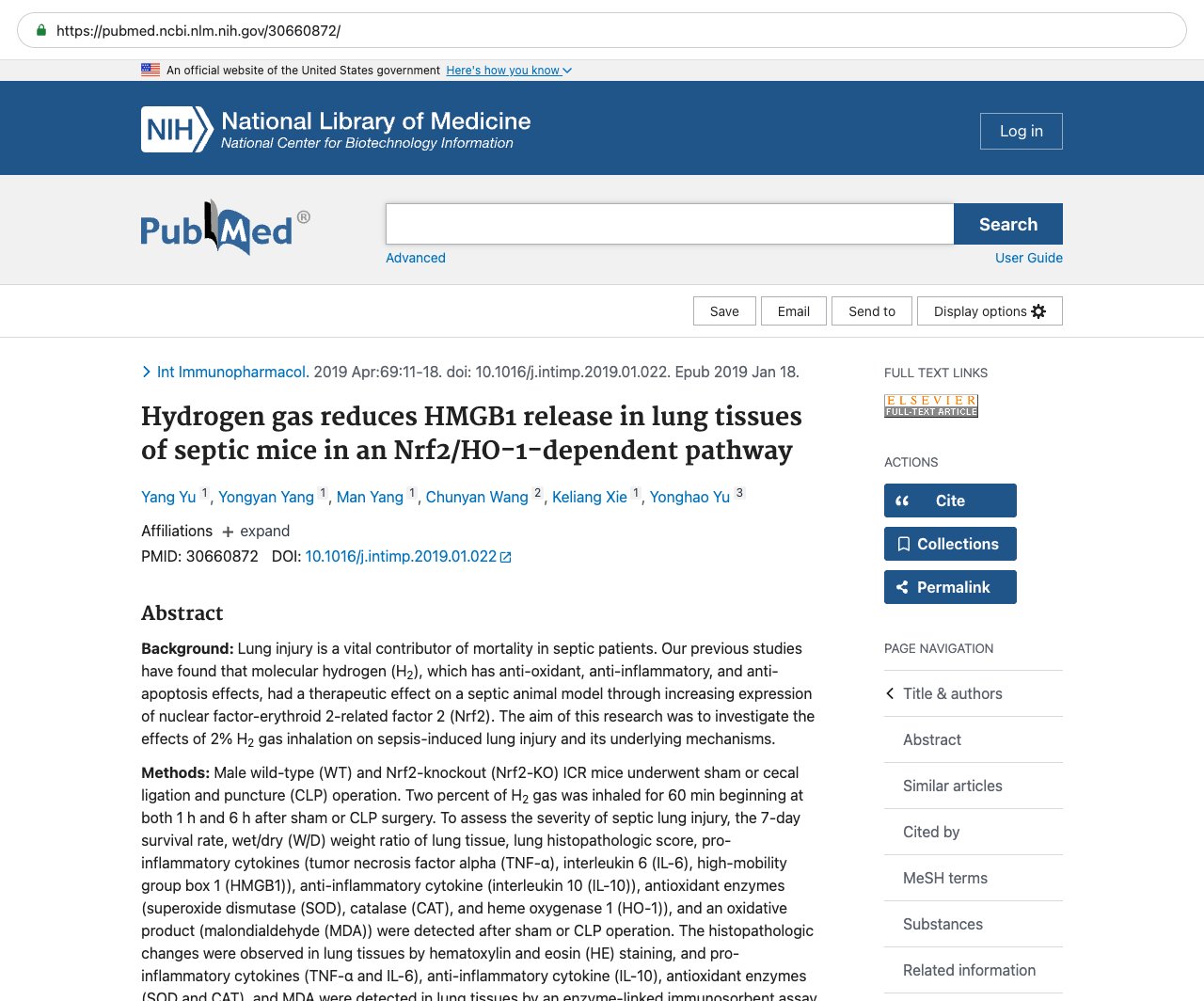
This page mirrors the published abstract (© the authors / publisher) for reference and citation. The canonical source is the PubMed record linked above. This is not medical advice.