2012 · Kato et al. — Hydrogen-rich electrolyzed warm water represses wrinkle formation against UVA ray together with type-I collagen production and oxidative-stress diminishment in fibroblasts and cell-injury prevention in keratinocytes.
Super-Abstract
UVA radiation from sunlight damages skin cells, promotes wrinkle formation, and reduces collagen production — primarily via oxidative stress from reactive oxygen species. This study found that hydrogen-rich warm water (prepared at 41°C via electrolysis) significantly increased type-I collagen production in skin fibroblasts, reduced UVA-induced cell death and DNA damage in keratinocytes, and suppressed intracellular superoxide radical generation. A small pilot bathing trial in six Japanese subjects showed wrinkle improvement in four participants. This is a predominantly cell-culture study with a very small pilot human observation — not a clinical trial.
Commentary
The cell-culture findings are mechanistically consistent with H₂'s known antioxidant action: reduction of superoxide radicals leads to less UVA-induced oxidative damage, better cell survival, and upregulated collagen synthesis. The experimental design with both fibroblasts and keratinocytes — the two main skin cell types — gives a more complete cellular picture. The collagen increase (1.85–2.03-fold) is notable quantitatively. However, the human pilot observation (6 subjects, no control group, no blinding) is far too small and uncontrolled to draw clinical conclusions. The bathing H₂ concentration used (0.2–0.4 ppm) is at the lower end of the therapeutic range seen in other H₂ studies. Wrinkle assessment method and variability between subjects were not rigorously described. This study provides useful mechanistic preclinical data but requires proper randomized controlled trials before any clinical efficacy claims can be made.
Key quotes
- „Type-I collagen was synthesized 1.85- to 2.03-fold more abundantly by HW application for 3-5 days than RW in OUMS-36 fibroblasts.“ — the collagen production benefit in skin fibroblast cells
- „HW application significantly prevented cell death and DNA damages such as nuclear condensation and fragmentation in UVA-irradiated HaCaT keratinocytes.“ — cellular protection against UV damage in skin surface cells
- „HW-bathing significantly improved wrinkle in four subjects on the back of neck on 90th day as compared to 0 day.“ — the human pilot observation — promising but with n=4/6, uncontrolled
Our assessment
This is primarily a preclinical in-vitro study on skin cells, with a very small and uncontrolled human pilot observation (6 subjects, no control group). The cell culture data are mechanistically plausible and show meaningful collagen and protective effects. However, the human observation cannot be considered clinical evidence — the sample is far too small and lacks controls. Proper randomized clinical trials are needed. The data are interesting for basic science and provide a mechanistic rationale for H₂ in skin aging, but skin care claims require a much higher evidence standard.
Study design
- Type: in-vitro cell study (OUMS-36 fibroblasts + HaCaT keratinocytes) + uncontrolled pilot human observation · n: cell lines (multiple replicates); 6 human subjects for bathing pilot · H₂ delivery: electrolyzed warm water at 41°C (DH ~1.13 ppm for cells; ~0.2–0.4 ppm for bathing)
- Result: 1.85–2.03-fold collagen increase in fibroblasts; reduced UVA-induced cell death and DNA damage in keratinocytes; suppressed superoxide radicals in both cell types; wrinkle improvement in 4/6 subjects after 90-day bathing (uncontrolled)
Abstract
Hydrogen-rich electrolyzed warm water (HW) was prepared at 41°C and exhibited dissolved hydrogen (DH) of 1.13 ppm and an oxidation-reduction potential (ORP) of -741 mV in contrast to below 0.01 ppm and+184 mV for regular warm water (RW). Fibroblasts OUMS-36 and keratinocytes HaCaT were used to examine effects of HW against UVA-ray irradiation. Type-I collagen was synthesized 1.85- to 2.03-fold more abundantly by HW application for 3-5 days than RW in OUMS-36 fibroblasts, and localized preferentially around the nuclei as shown by immunostain. HW application significantly prevented cell death and DNA damages such as nuclear condensation and fragmentation in UVA-irradiated HaCaT keratinocytes as estimated by WST-1 and Hoechst 33342 assays. HW significantly suppressed UVA-induced generation of intracellular superoxide anion radicals in both the cell lines according to NBT assay. Wrinkle repression was clinically assessed using a HW-bathing. Six Japanese subjects were enrolled in a trial of HW-bathing (DH, 0.2-0.4 ppm) every day for 3 months. HW-bathing significantly improved wrinkle in four subjects on the back of neck on 90th day as compared to 0 day. Thus, HW may serve as daily skin care to repress UVA-induced skin damages by ROS-scavenging and promotion of type-I collagen synthesis in dermis.
Source & links
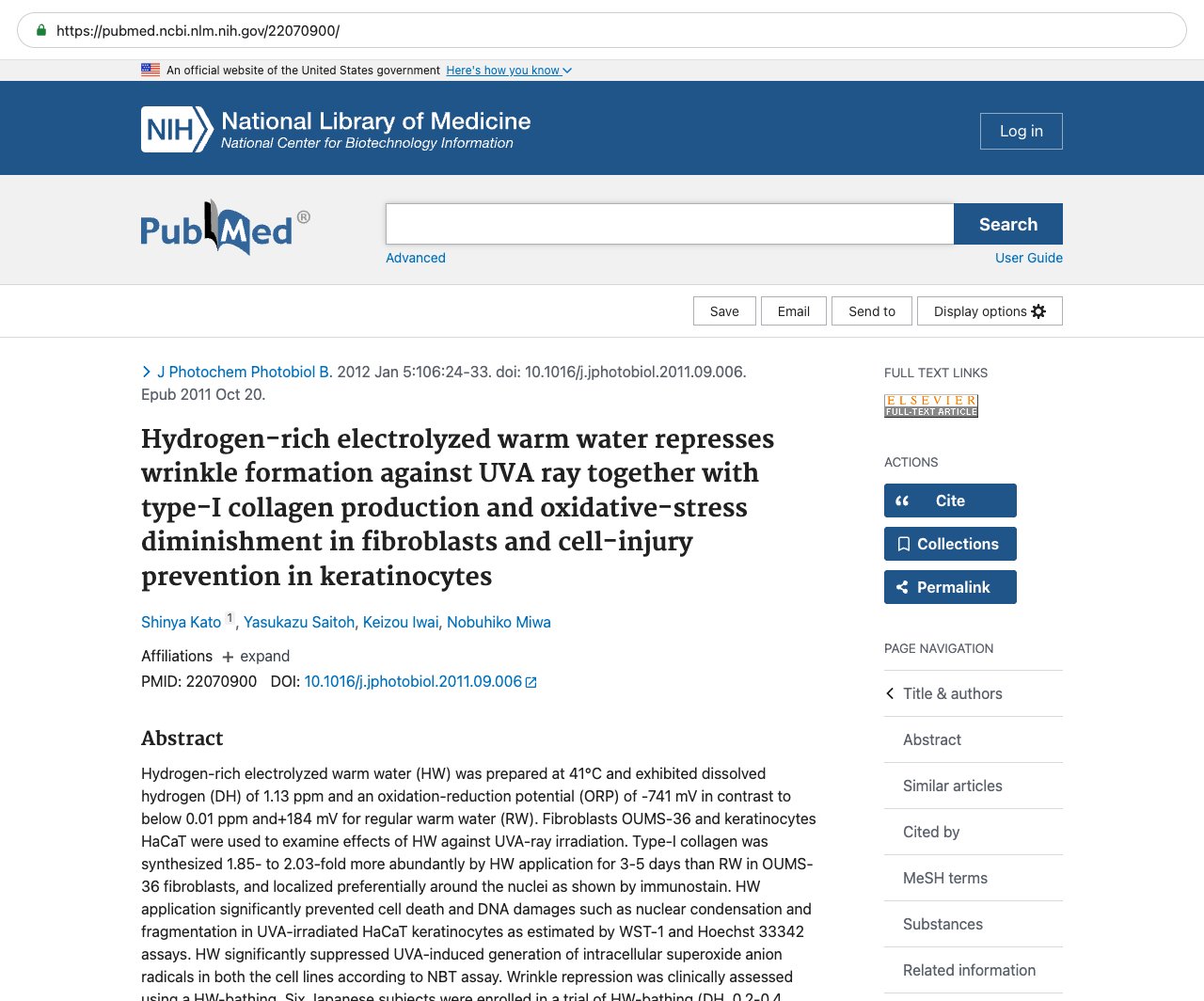
Screenshot of the PubMed page
This page mirrors the published abstract (© the authors / publisher) for reference and citation. The canonical source is the PubMed record linked above. This is not medical advice.