2023 · Sahoo — Hydrogen-producing Photocatalyst at Sunscreen for Athletes in Preventing and Healing Muscle-nerve-skin Injuries
Super-Abstract
A theoretical concept paper proposes embedding a UV-absorbing photocatalyst into a hydrogel sunscreen that would continuously split sweat into H₂ — allowing athletes to absorb H₂ through the skin during sun exposure. The idea is conceptually creative, but this is a purely theoretical in-vitro paper: no human or animal experiments have been performed, and no clinical efficacy data exist. Results cannot be transferred to any real-world application.
Commentary
This paper is best classified as a concept/theory study presenting a speculative delivery system. The proposed mechanism is that a photocatalyst (a semiconductor that absorbs UV light) embedded in a skin-applied hydrogel would use sunlight to split water from sweat into H₂, which would then diffuse through the skin. The author extrapolates broad therapeutic claims — muscle injuries, nerve damage, cancer, Parkinson's disease — but provides no experimental evidence for any of these effects via the proposed route. The primary literature on transdermal H₂ absorption is sparse, and the efficiency of photocatalytic water splitting under body conditions (sweat pH, temperature, UV availability under different light conditions) remains entirely unvalidated. This is a creative engineering proposal, not a study that demonstrates efficacy.
Key quotes
- „Once a photocatalyst that absorbs a harmful UV band from sunlight and can split water is doped inside a hydrogel will produce hydrogen in the presence of sunlight.“ — the core concept: UV-driven H₂ production within a skin-applied gel
- „Hydrogen can be absorbed through the skin and diffused in the body to heal wound-prone or injured muscles, and nerves.“ — the therapeutic hypothesis — stated without experimental evidence
- „such photocatalyst-doped hydrogel can be used as a sunscreen to protect against sunlight and can use that spectrum of light for producing hydrogen from sweat continuously.“ — the dual-function claim: UV protection and H₂ generation simultaneously
Our assessment
This is a purely theoretical concept paper — no experiments were performed, no animal or human data exist, and the therapeutic claims are speculative. Nothing here constitutes evidence of efficacy for any health condition. The photocatalytic H₂ production concept is interesting from an engineering standpoint, but the leap from the idea to actual transdermal H₂ delivery and clinical benefit is enormous and entirely unvalidated. Readers should treat this as a creative hypothesis paper, not as evidence that such a sunscreen product could or does provide any therapeutic effect.
Study design
- Type: theoretical/concept paper (in-vitro classification) · n: n/a (no experiments performed) · H₂ delivery: proposed photocatalytic hydrogel sunscreen (hypothetical, not tested)
- Result: no experimental results — concept only; claims of potential applications in sports injuries, cancer, neurological disease are theoretical extrapolations without supporting data
Abstract
Physical injuries in sports are unavoidable, but they can be mitigated and even treated by using molecular hydrogen, which can be administered via a specially formulated sunscreen. The photocatalysts are a special class of semiconductors that can absorb a specific spectrum of light to promote its electron from the valance band (VB) to the conduction band (CB). This creates positively charged holes at VB and negatively charged electrons at CB in generating photochemical reaction centres. Once a photocatalyst that absorbs a harmful UV band from sunlight and can split water is doped inside a hydrogel will produce hydrogen in the presence of sunlight. If we employ such photocatalyst-doped hydrogel over naked skin, the hydrogel will act as a continuous source of water, which will absorb water from sweet, store it inside the hydrogel matrix and deliver it to the photocatalyst for splitting it further into the hydrogen. As a result, such photocatalyst-doped hydrogel can be used as a sunscreen to protect against sunlight and can use that spectrum of light for producing hydrogen from sweat continuously. Hydrogen can be absorbed through the skin and diffused in the body to heal wound-prone or injured muscles, and nerves. Because hydrogen may travel throughout the body, the catalyst-doped hydrogel can be used as a topical gel to treat various ailments such as muscle-nerve skin injuries, cancer, Parkinson's disease, and others. Besides common people, even athletes can use it as sunscreen during sports, which is not feasible for other hydrogen administrating systems.
Source & links
Screenshot of the PubMed page
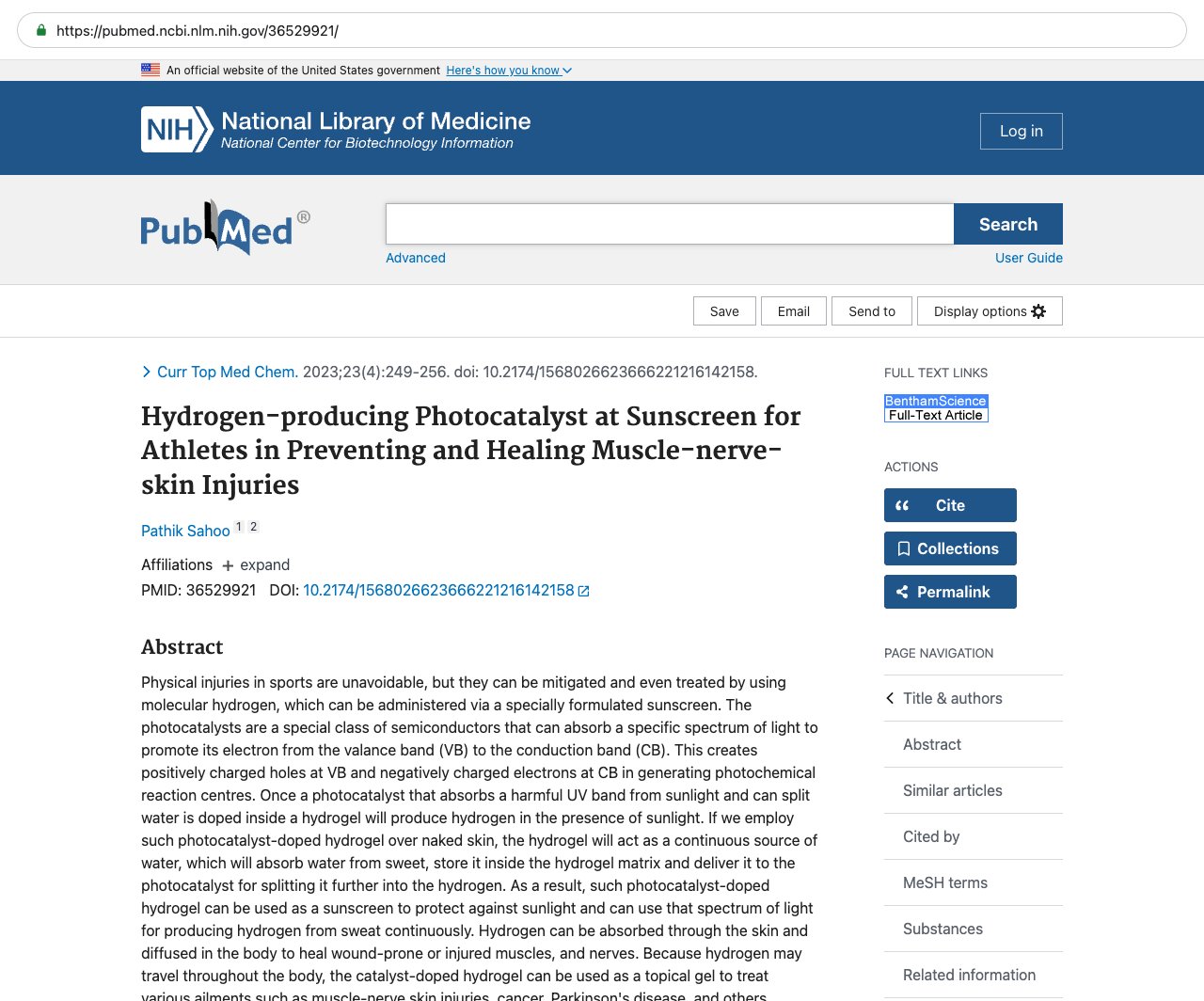
This page mirrors the published abstract (© the authors / publisher) for reference and citation. The canonical source is the PubMed record linked above. This is not medical advice.