2025 Journal of controlled release : official journal of the Controlled Release Society Mechanism / Preclinical Bath / Topical
2025 · Zhu — Transdermal Hydrogen Therapy for Psoriasis Using Cavity-embedded Double-conical Microneedles
Super-Abstract
A new microneedle patch delivers hydrogen directly through the skin into psoriatic tissue, where sustained H₂ release significantly outperformed a standard topical therapy (calcipotriol cream) in reducing oxidative damage, inflammation, and the hallmark skin thickening of psoriasis. This is an animal study in mice; no human data are available. (Journal of Controlled Release, 2025.)
Commentary
Psoriasis is a chronic inflammatory skin disease driven by a self-reinforcing cycle of oxidative stress, immune cell infiltration, and keratinocyte hyperproliferation. Current topical treatments (corticosteroids, vitamin D analogues) are limited by poor skin penetration and systemic side effects. Zhu et al. take an engineering approach: double-conical microneedles with internal cavities loaded with magnesium hydride (MgH₂) powder, which reacts with water in the skin to release H₂ continuously. The head-to-head comparison with calcipotriol cream — a standard of care — is methodologically notable, with the H₂ microneedle group showing superior reductions in cytokine levels, immune cell infiltration, and keratinocyte hyperproliferation in mouse skin. The mechanistic investigation into psoriasis pathogenesis is a genuine side contribution. The translation gap remains large: mouse skin models of psoriasis are imperfect analogues for the human disease, and the safety of MgH₂ in skin tissue requires thorough investigation.
Key quotes
- „This minimally invasive, self-administrable treatment significantly outperformed calcipotriol cream, a current standard topical therapy.“ — direct comparison with a clinical standard of care — in mice
- „The transdermal hydrogen therapy greatly relieved oxidative damages, pro-inflammatory cytokine expression, immune cell infiltration, and ultimately mitigated keratinocyte hyperproliferation and systemic symptoms.“ — the range of psoriasis-relevant outcomes improved by the treatment
- „This study demonstrates a new solution for treating inflammatory skin diseases and a new strategy for microneedle-based transdermal therapeutic delivery.“ — the authors' broader claim about the platform's potential
Our assessment
This is an animal (mouse) study of an experimental drug-delivery device. The results cannot be applied to humans. The comparison with calcipotriol is an important design element, but mouse psoriasis models have well-known limitations in predicting human outcomes. MgH₂ in skin tissue is a novel material application that requires dedicated safety characterisation. The study makes a scientifically interesting engineering and mechanistic contribution; clinical relevance awaits controlled human trials.
Study design
- Type: animal study (mouse psoriasis model) · Model: psoriatic mice (imiquimod-induced) · H₂ delivery: MgH₂ powder loaded in double-conical cavity microneedle patch (transdermal sustained H₂ release)
- Result: significantly better reduction in oxidative damage, pro-inflammatory cytokines, and keratinocyte hyperproliferation vs. calcipotriol cream; reduced immune cell infiltration; mechanistic investigation revealed insights into psoriasis pathogenesis via the oxidative stress–inflammation coupling
Abstract
Psoriasis remains clinically incurable due to its complex etiology. Topical immunosuppressive therapies offer limited effectiveness partly because of poor skin permeability, and can cause severe side effects. To address these challenges, we developed a novel transdermal hydrogen therapy that targets the mutually-reinforcing coupling between oxidative stress and inflammation in psoriasis. Specifically, we designed a double-conical microneedle with high loading capacity and effective skin penetration to efficiently deliver MgH2 powders, enabling the sustained release of molecular hydrogen within the skin tissue. This minimally invasive, self-administrable treatment significantly outperformed calcipotriol cream, a current standard topical therapy. The transdermal hydrogen therapy greatly relieved oxidative damages, pro-inflammatory cytokine expression, immune cell infiltration, and ultimately mitigated keratinocyte hyperproliferation and systemic symptoms. Furthermore, the mechanistic investigations provide valuable insights into psoriasis pathogenesis. More broadly, this study demonstrates a new solution for treating inflammatory skin diseases and a new strategy for microneedle-based transdermal therapeutic delivery.
Source & links
Screenshot of the PubMed page
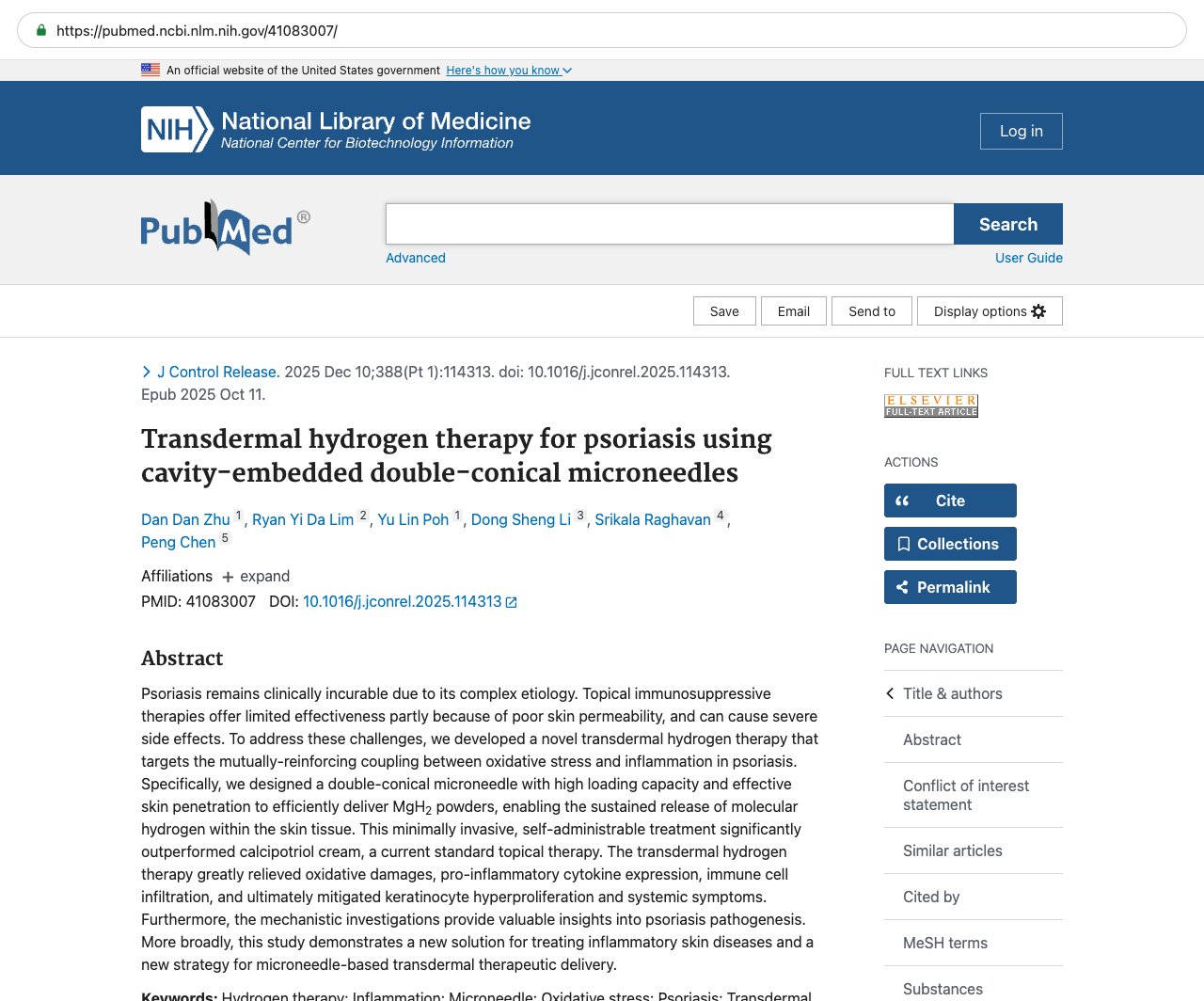
This page mirrors the published abstract (© the authors / publisher) for reference and citation. The canonical source is the PubMed record linked above. This is not medical advice.