2020 · Kato — Hydrogen-bubbled Platinum-colloid Suppresses Human Esophagus- or Tongue-carcinoma Cells with Intracellular Platinum-uptake and the Diminished Normal-cell Mortality
Super-Abstract
In cell culture experiments, a combination of hydrogen nano-bubbles and platinum-polyvinylpyrrolidone colloid (PVP-Pt) more strongly suppressed the growth of human esophageal and tongue cancer cells than either agent alone — while showing comparatively less harm to non-malignant epithelial cells. This is an in-vitro study only; no animal or human data are presented. (Human Cell, 2020.)
Commentary
This in-vitro study explores a synergistic approach combining molecular hydrogen nano-bubbles with platinum nanoparticles (PVP-Pt) against human carcinoma cell lines. The key mechanistic finding is that hydrogen intensifies the anti-tumour activity of PVP-Pt, but only when co-administered simultaneously — two-step sequential administration did not replicate the effect, indicating a direct interaction between H₂ nano-bubbles and Pt particles in the medium rather than independent parallel actions. The selectivity for malignant versus pre-malignant cells (HSC-4 vs. DOK) demonstrated by ICP-MS platinum uptake measurements is noteworthy. However, all results are from cell culture and cannot be extrapolated to human cancer therapy without extensive preclinical and clinical validation.
Key quotes
- „Human esophagus-derived carcinoma cells KYSE70 were repressed for cell proliferation with nano-H/PVP-Pt more markedly than with nano-H, indicating the hydrogen-intensification for PVP-Pt-alone-carcinostasis.“ — the key synergy finding: H₂ enhances platinum's anti-cancer effect in cell culture
- „no intensified carcinostasis was shown in two-step separate administration of nano-H and PVP-Pt.“ — co-administration required — sequential dosing did not replicate the effect
- „PVP-Pt is able to adsorb hydrogen nano-bubbles on Pt and applicable for cancer therapy by diminishing the side-effects to normal cells.“ — proposed mechanism and forward-looking conclusion — speculative at this stage
Our assessment
This is an in-vitro cell culture study — it does not constitute evidence of efficacy in humans or animals. The synergistic anti-tumour effect of H₂ nano-bubbles plus PVP-Pt is an interesting cell-biology finding, but the jump to „applicable for cancer therapy“ in the conclusion is a substantial extrapolation. No conclusions about therapeutic benefit in human cancer patients can be drawn. Further steps would require animal models, toxicology studies, and ultimately clinical trials. The requirement for simultaneous co-administration also adds complexity to any potential clinical translation.
Study design
- Type: in-vitro cell culture study · Cell lines: KYSE70 (esophageal carcinoma), HSC-4 (tongue carcinoma), DOK (pre-malignant tongue epithelium) · H₂ delivery: hydrogen nano-bubbles generated by microporous gas emittance terminal into culture medium
- Result: nano-H/PVP-Pt combination > nano-H or PVP-Pt alone for cell proliferation suppression; synergy requires simultaneous co-administration; greater intracellular Pt uptake in malignant HSC-4 vs. pre-malignant DOK cells (ICP-MS)
Abstract
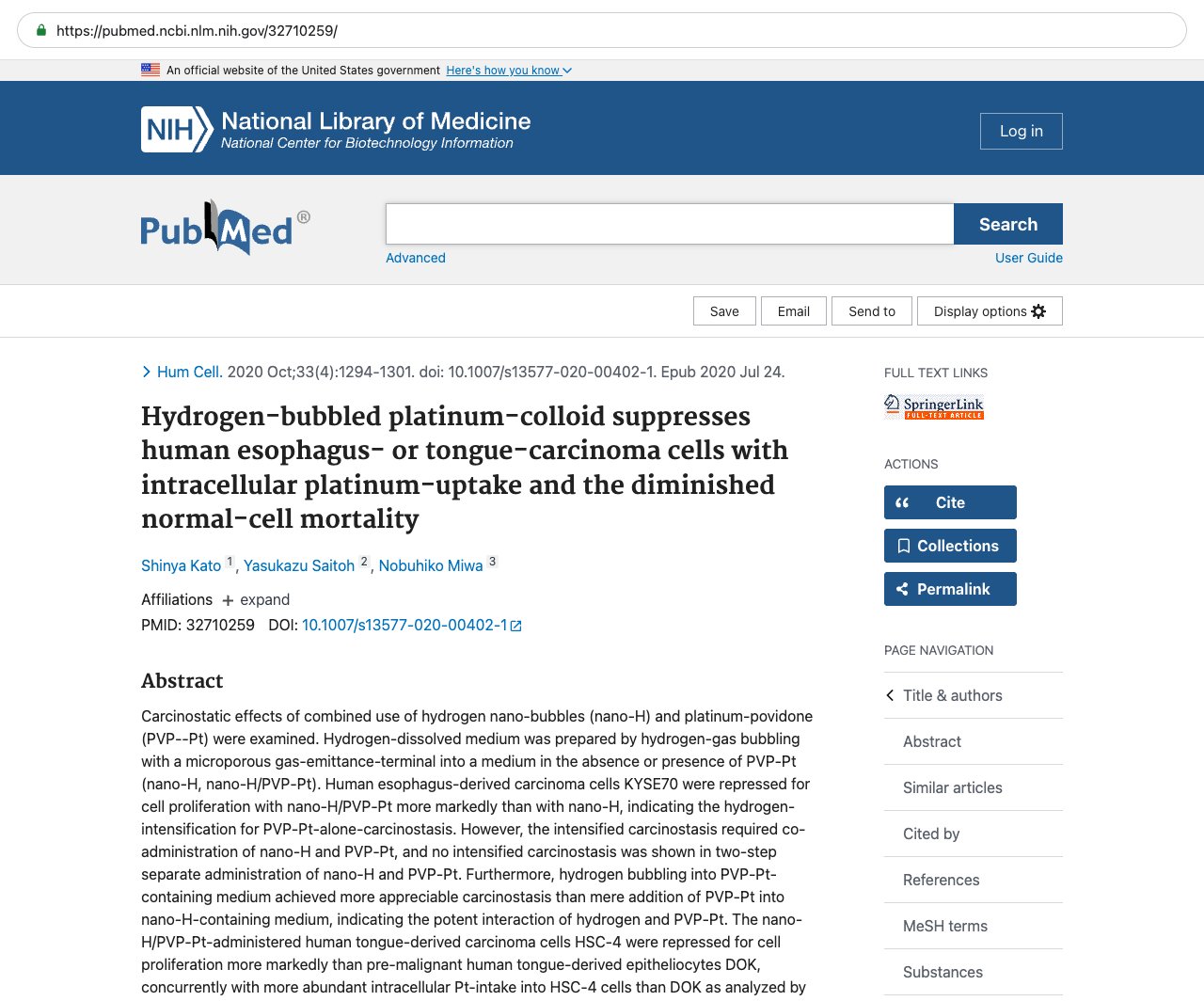
Carcinostatic effects of combined use of hydrogen nano-bubbles (nano-H) and platinum-povidone (PVP--Pt) were examined. Hydrogen-dissolved medium was prepared by hydrogen-gas bubbling with a microporous gas-emittance-terminal into a medium in the absence or presence of PVP-Pt (nano-H, nano-H/PVP-Pt). Human esophagus-derived carcinoma cells KYSE70 were repressed for cell proliferation with nano-H/PVP-Pt more markedly than with nano-H, indicating the hydrogen-intensification for PVP-Pt-alone-carcinostasis. However, the intensified carcinostasis required co-administration of nano-H and PVP-Pt, and no intensified carcinostasis was shown in two-step separate administration of nano-H and PVP-Pt. Furthermore, hydrogen bubbling into PVP-Pt-containing medium achieved more appreciable carcinostasis than mere addition of PVP-Pt into nano-H-containing medium, indicating the potent interaction of hydrogen and PVP-Pt. The nano-H/PVP-Pt-administered human tongue-derived carcinoma cells HSC-4 were repressed for cell proliferation more markedly than pre-malignant human tongue-derived epitheliocytes DOK, concurrently with more abundant intracellular Pt-intake into HSC-4 cells than DOK as analyzed by ICP-MS. Thus, PVP-Pt is able to adsorb hydrogen nano-bubbles on Pt and applicable for cancer therapy by diminishing the side-effects to normal cells.
Source & links
Screenshot of the PubMed page
This page mirrors the published abstract (© the authors / publisher) for reference and citation. The canonical source is the PubMed record linked above. This is not medical advice.