2017 Circulation journal : official journal of the Japanese Circulation Society Pilot / Observational Human H₂ therapy Inhalation
2017 · Katsumata et al. — The Effects of Hydrogen Gas Inhalation on Adverse Left Ventricular Remodeling After Percutaneous Coronary Intervention for ST-Elevated Myocardial Infarction — First Pilot Study in Humans.
Super-Abstract
In this first-in-human pilot study with 20 STEMI patients undergoing PCI, inhaling 1.3% H₂ gas during and after the procedure was safe and showed a numerical trend toward better left ventricular recovery at 6 months — but the primary endpoint (cardiac salvage index at 7 days) did not reach statistical significance. The study was explicitly underpowered for efficacy. (Circulation Journal, 2017.)
Commentary
When a heart attack occurs and the blocked artery is reopened by PCI, the resulting reperfusion itself triggers additional oxidative injury. H₂ as an antioxidant administered at the moment of reperfusion is a mechanistically appealing concept — and this is exactly when the H₂ inhalation was given in this study. The pilot found no safety problems and a numerically interesting improvement in left ventricular stroke volume index at 6 months (p=0.03), but the primary imaging endpoint at day 7 was not significant (p=0.43). This is textbook pilot study territory: the direction is promising, the effect size at 6 months is hypothesis-generating, but the study was not designed to prove efficacy. A large-scale RCT was explicitly called for and would be needed before any clinical translation.
Key quotes
- „There were no HI-related severe adverse events.“ — safety established: H₂ inhalation during PCI caused no serious problems
- „the cardiac salvage index as evaluated using cardiac magnetic resonance imaging at 7 days after primary percutaneous coronary intervention, showed no significant between-group difference.“ — honest null result: primary endpoint not met at day 7
- „The first clinical study has shown that HI during PCI is feasible and safe and may also promote LV reverse remodeling at 6 months after STEMI. The study was not powered to test efficacy and a further large-scale trial is warranted.“ — authors state clearly: feasibility shown, efficacy unproven, larger trial needed
Our assessment
An important first-in-human safety and feasibility study — exactly what this phase of research needs. The honest reporting of a null primary endpoint alongside a secondary 6-month signal is methodologically clean. Limitations: n=20 is very small (10 per group); open-label design (24% O₂ control vs. 1.3% H₂ + 26% O₂ in treatment group creates gas composition differences beyond H₂); the 6-month LV stroke volume improvement (p=0.03) is a secondary endpoint and should be interpreted with caution. The primary finding is safety and feasibility — the efficacy question remains open.
Study design
- Type: Prospective, open-label, rater-blinded pilot RCT · n: 20 (10 H₂ inhalation, 10 control) · H₂ delivery: inhalation of 1.3% H₂ + 26% O₂ during PCI and for 6 h post-procedure
- Population: ST-elevated myocardial infarction (STEMI) undergoing primary PCI
- Result: Primary endpoint (cardiac salvage index at 7 days): not significant (p=0.43). Secondary endpoint (LV stroke volume index improvement at 6 months): H₂ group better (p=0.03). LV ejection fraction trend favored H₂ (p=0.11). No serious adverse events.
Abstract
BACKGROUND: Hydrogen gas inhalation (HI) reduced infarct size and mitigated adverse left ventricular (LV) remodeling in a rat model of acute myocardial infarction (AMI). We designed a prospective, open-label, rater-blinded clinical pilot study in patients experiencing ST-elevated MI (STEMI). METHODS AND RESULTS: The 20 patients with an initial diagnosis of STEMI were assigned to either an HI group (1.3% H2with 26% oxygen) or a control group (26% oxygen). There were no HI-related severe adverse events. In the full analysis set, the cardiac salvage index as evaluated using cardiac magnetic resonance imaging at 7 days after primary percutaneous coronary intervention (PCI), showed no significant between-group difference (HI: 50.0±24.3%; control: 60.1±20.1%; P=0.43). However, the improvement from day 7 in the HI group was numerically greater than that in the control group in some of the surrogate outcomes at 6-month follow-up, including the LV stroke volume index (HI: 9.2±7.1 mL/m2; control: -1.4±7.2 mL/m2; P=0.03) and the LV ejection fraction (HI: 11.0%±9.3%; control: 1.7%±8.3%; P=0.11). CONCLUSIONS: The first clinical study has shown that HI during PCI is feasible and safe and may also promote LV reverse remodeling at 6 months after STEMI. The study was not powered to test efficacy and a further large-scale trial is warranted. (Clinical trials registration: UMIN00006825).
Source & links
Screenshot of the PubMed page
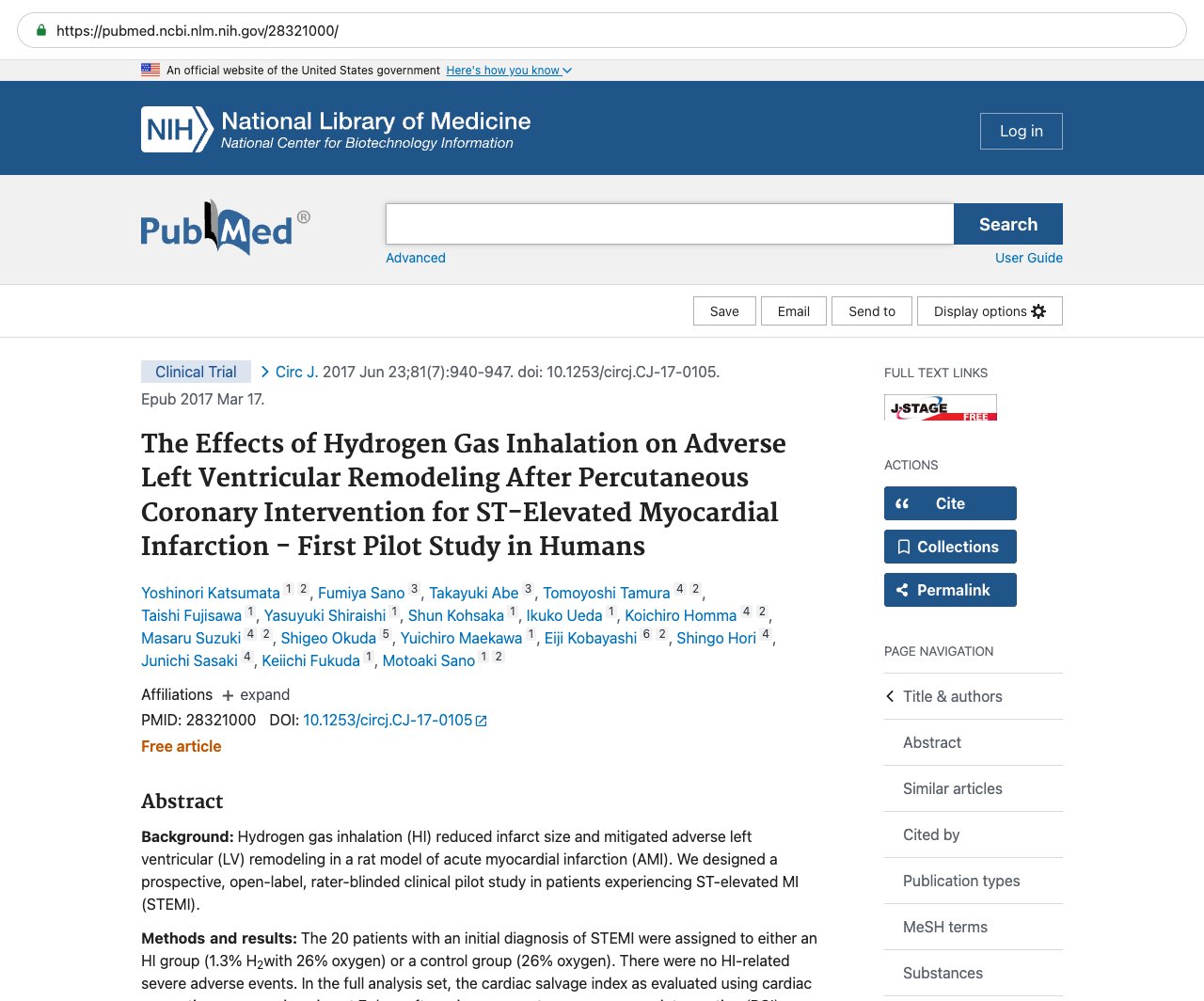
This page mirrors the published abstract (© the authors / publisher) for reference and citation. The canonical source is the PubMed record linked above. This is not medical advice.