2019 · Liu — Molecular Hydrogen Suppresses Glioblastoma Growth via Inducing the Glioma Stem-Like Cell Differentiation
Super-Abstract
In rat and mouse glioblastoma (GBM) models, daily inhalation of 67% hydrogen gas suppressed tumor growth, prolonged survival, and induced differentiation of cancer stem-like cells — reducing their self-renewal, proliferation, and invasive capacity. The findings suggest that H₂ may work against GBM in part by pushing stem-like cancer cells toward a more differentiated, less aggressive state. These are animal and cell-culture results; human clinical applicability requires further investigation. (Stem Cell Research and Therapy, 2019.)
Commentary
Glioblastoma multiforme is the most aggressive primary brain cancer, with a median survival of about 15 months despite surgery and chemoradiation. Cancer stem cells (CSCs) — which maintain self-renewal, treatment resistance, and tumor re-initiation capacity — are a key therapeutic target. Liu et al. test whether H₂ inhalation (67%, 1 h twice daily) affects GBM in rat orthotopic and mouse subcutaneous models. MRI confirmed reduced tumor volumes; immunohistochemistry showed downregulation of stemness markers (CD133, Nestin), proliferation marker (ki67), and angiogenesis marker (CD34), plus upregulation of differentiation marker GFAP. In-vitro, sphere-forming, migration, invasion, and colony assays consistently supported the in-vivo findings. The proposed mechanism — H₂ drives CSC differentiation — is mechanistically novel and potentially important. The H₂ concentration used (67%) is very high and far exceeds what is achievable with H₂-rich water; inhalation at these concentrations is not a standard consumer application.
Key quotes
- „hydrogen inhalation could effectively suppress GBM tumor growth and prolong the survival of mice with GBM“ — primary in-vivo result: H₂ inhalation improved survival in GBM-bearing mice
- „hydrogen treatment markedly downregulated the expression of markers involved in stemness (CD133, Nestin), proliferation (ki67), and angiogenesis (CD34) and also upregulated GFAP expression, a marker of differentiation“ — molecular evidence: H₂ shifts GBM cells from stem-like to differentiated state
- „molecular hydrogen may serve as a potential anti-tumor agent in the treatment of GBM“ — authors' conclusion — presented as potential, not established therapy
Our assessment
An interesting animal study exploring a novel mechanism (CSC differentiation) by which H₂ might act against GBM. The multi-model approach (orthotopic rat + subcutaneous mouse + in-vitro) adds robustness. Honest limitations: (1) animal GBM models do not recapitulate the full complexity of human glioblastoma; (2) 67% H₂ inhalation is not a consumer-accessible intervention and carries safety considerations at such concentrations; (3) no human data exist; (4) survival benefit, while shown, is in an experimental transplant model — not reflective of the multifactorial human disease course. This is hypothesis-generating preclinical research that warrants further investigation but should not be presented as evidence of efficacy in human GBM patients.
Study design
- Type: animal study (in vivo) + in-vitro cell assays · Models: rat orthotopic glioma model; mouse subcutaneous xenograft; glioma cell lines · H₂ delivery: 67% H₂ gas inhalation, 1 h × 2/day
- In-vivo endpoints: MRI tumor volume, survival, IHC for CD133, Nestin, ki67, CD34, GFAP
- In-vitro endpoints: sphere formation (CSC self-renewal), migration, invasion, colony formation
- Result: H₂ suppressed tumor growth and prolonged survival; downregulated stemness/proliferation/angiogenesis markers; upregulated differentiation marker; reduced self-renewal, migration, invasion, colony formation in vitro
Abstract
BACKGROUND: Glioblastoma (GBM) is the most common type of primary malignant brain tumor. Molecular hydrogen has been considered a preventive and therapeutic medical gas in many diseases including cancer. In our study, we sought to assess the potential role of molecular hydrogen on GBM. METHODS: The in vivo studies were performed using a rat orthotopic glioma model and a mouse subcutaneous xenograft model. Animals inhaled hydrogen gas (67%) 1 h two times per day. MR imaging studies were performed to determine the tumor volume. Immunohistochemistry (IHC), immunofluorescence staining, and flow cytometry analysis were conducted to determine the expression of surface markers. Sphere formation assay was performed to assess the cancer stem cell self-renewal capacity. Assays for cell migration, invasion, and colony formation were conducted. RESULTS: The in vivo study showed that hydrogen inhalation could effectively suppress GBM tumor growth and prolong the survival of mice with GBM. IHC and immunofluorescence staining demonstrated that hydrogen treatment markedly downregulated the expression of markers involved in stemness (CD133, Nestin), proliferation (ki67), and angiogenesis (CD34) and also upregulated GFAP expression, a marker of differentiation. Similar results were obtained in the in vitro studies. The sphere-forming ability of glioma cells was also suppressed by hydrogen treatment. Moreover, hydrogen treatment also suppressed the migration, invasion, and colony-forming ability of glioma cells. CONCLUSIONS: Together, these results indicated that molecular hydrogen may serve as a potential anti-tumor agent in the treatment of GBM.
Source & links
Screenshot of the PubMed page
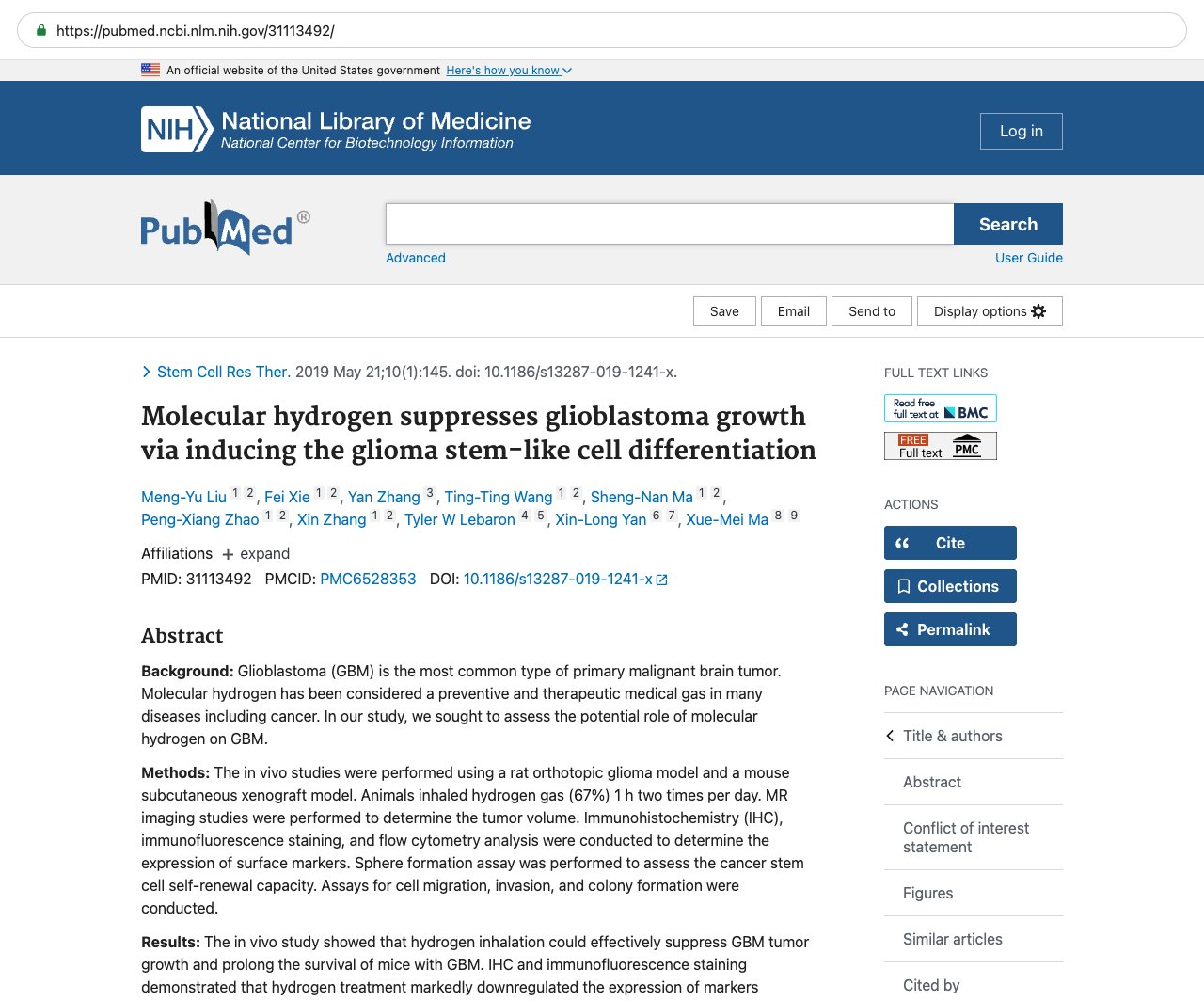
This page mirrors the published abstract (© the authors / publisher) for reference and citation. The canonical source is the PubMed record linked above. This is not medical advice.