2024 · Khan — Catalytic innovations: Improving wastewater treatment and hydrogen generation technologies.
Super-Abstract
Nanomaterials as catalysts can both clean wastewater of toxic organic pollutants and simultaneously generate hydrogen gas — a dual benefit reviewed here. NaBH₄ methanolysis using nanocatalysts is highlighted as a particularly efficient route. The review evaluates catalyst performance across key parameters including size, reaction rate, activation energy, and durability. (Journal of Environmental Management, 2024.)
Commentary
This comprehensive review surveys recent research on nanomaterial catalysts capable of reducing hazardous pollutants such as nitrophenols and dyes in wastewater while also generating molecular hydrogen (H₂) as a useful energy by-product. The authors compare a broad range of catalysts used in NaBH₄ methanolysis — a chemical route that simultaneously degrades organic pollutants and releases H₂. The review provides a structured framework for comparing catalyst effectiveness and discusses both advantages and limitations of nanocatalyst approaches. It is relevant background for understanding the intersection of environmental remediation and hydrogen generation technology.
Key quotes
- „The utilization of nanomaterials as catalysts for chemical reduction exhibits a promising alternative owing to their distinguished catalytic activity and substantial surface area.“ — the core advantage of nanocatalysts in pollutant reduction and H₂ generation
- „NaBH4 has been utilized as a useful source for it because it reduces the pollutants quiet efficiently and it also releases hydrogen gas as well which can be used as a source of energy.“ — NaBH₄ as dual-purpose reagent: pollutant reduction and H₂ generation
- „The comparison of different catalysts is based on size of catalyst, reaction time, rate of reaction, hydrogen generation rate, activation energy, and durability.“ — the criteria used for systematic catalyst comparison
Our assessment
This is a technical review with no original experimental data — it synthesises existing literature on nanocatalytic systems for combined wastewater treatment and H₂ generation. Important context: this paper concerns industrial/environmental hydrogen production and pollutant remediation, not therapeutic or health-related hydrogen use in humans or animals. The H₂ discussed here is an energy carrier by-product, not a medicinal agent. The review is a useful resource for researchers in materials science and environmental engineering, but does not provide evidence for any health benefit of H₂ in biological systems.
Study design
- Type: comprehensive literature review · n: n/a (no original experiment) · H₂ delivery: NaBH₄ methanolysis as catalytic H₂ generation method
- Result: narrative synthesis comparing nanocatalyst types on reaction time, H₂ generation rate, activation energy, and durability; no pooled effect sizes; no human or animal subjects
Abstract
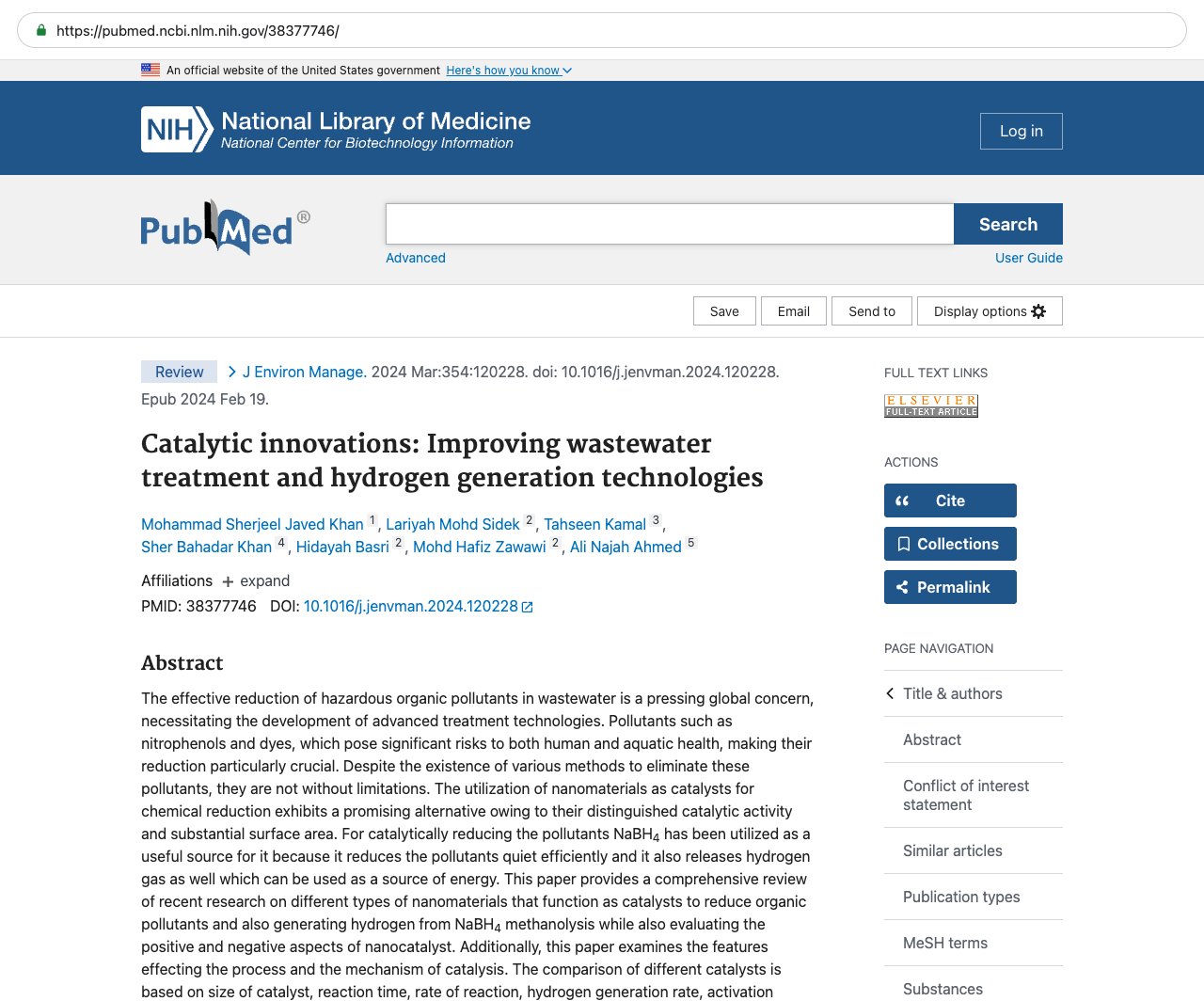
The effective reduction of hazardous organic pollutants in wastewater is a pressing global concern, necessitating the development of advanced treatment technologies. Pollutants such as nitrophenols and dyes, which pose significant risks to both human and aquatic health, making their reduction particularly crucial. Despite the existence of various methods to eliminate these pollutants, they are not without limitations. The utilization of nanomaterials as catalysts for chemical reduction exhibits a promising alternative owing to their distinguished catalytic activity and substantial surface area. For catalytically reducing the pollutants NaBH4 has been utilized as a useful source for it because it reduces the pollutants quiet efficiently and it also releases hydrogen gas as well which can be used as a source of energy. This paper provides a comprehensive review of recent research on different types of nanomaterials that function as catalysts to reduce organic pollutants and also generating hydrogen from NaBH4 methanolysis while also evaluating the positive and negative aspects of nanocatalyst. Additionally, this paper examines the features effecting the process and the mechanism of catalysis. The comparison of different catalysts is based on size of catalyst, reaction time, rate of reaction, hydrogen generation rate, activation energy, and durability. The information obtained from this paper can be used to steer the development of new catalysts for reducing organic pollutants and generation hydrogen by NaBH4 methanolysis.
Source & links
Screenshot of the PubMed page
This page mirrors the published abstract (© the authors / publisher) for reference and citation. The canonical source is the PubMed record linked above. This is not medical advice.