2023 · Kiyoi — Intermittent environmental exposure to hydrogen prevents skin photoaging through reduction of oxidative stress
Super-Abstract
In a mouse model, nightly exposure to 1.3 % hydrogen gas for 6 weeks reduced UVA-induced skin aging: fewer senescent cells, less epidermal thickening, reduced melanogenesis, and less collagen degradation in the dermis. DNA damage in skin cells was also attenuated. This is an animal study; results cannot yet be generalised to human skin aging.
Commentary
Ultraviolet A (UVA) radiation penetrates deep into the dermis and generates reactive oxygen species that damage collagen, DNA, and melanocytes — collectively producing what is called photoaging. This study mimics a realistic exposure scenario: UVA during the day (simulating outdoor activity), H₂ inhalation at night (simulating indoor environmental exposure). The 1.3 % H₂ concentration used is below the flammability threshold and therefore practically safe. Improvements were seen in both epidermal (hyperplasia, melanogenesis, senescent cells) and dermal (collagen) markers. The indirect DNA damage measurement (presumably 8-OHdG or similar) further supports an antioxidant mechanism. Limitations: murine skin differs from human skin in thickness, hair follicle density, and UV sensitivity. Whether a home H₂ inhalation device delivering comparable doses is feasible and effective in humans is unknown.
Key quotes
- „Intermittent administration of hydrogen gas by our system prevented UVA-induced epidermal signs, such as hyperplasia, melanogenesis and appearance of senescence cells, and UVA-induced dermal signs, such as collagen degradation.“ — both epidermal and dermal photoaging markers were reduced
- „We detected attenuation of DNA damage in the hydrogen exposure group as indirect evidence that intermittent exposure to hydrogen gas reduced oxidative stress.“ — antioxidant mechanism evidenced by lower DNA damage
- „Long-term, intermittent environmental exposure to hydrogen gas in daily life has a beneficial effect on UVA-induced photoaging.“ — authors' conclusion — based on mouse data only
Our assessment
This is an animal study (mouse photoaging model). The daily-cycle exposure design is an interesting attempt to simulate real-world use, and the multi-layer outcome measurement is a strength. However, mouse skin is not human skin, and the study does not provide any clinical evidence. There are no human safety or efficacy data for long-term environmental H₂ inhalation in the context of skin aging. The results are biologically plausible but remain a starting point for future research.
Study design
- Type: controlled animal experiment · Model: mouse UVA-photoaging model (6-week cycle) · H₂ delivery: environmental inhalation 1.3 % H₂ for 16 h/day (night cycle)
- Result: reduced epidermal hyperplasia, melanogenesis, senescent cells; reduced dermal collagen degradation; attenuated skin DNA damage; all effects attributed to H₂-mediated oxidative stress reduction
Abstract
AIM: Molecular hydrogen is not only expected to be used as an energy-generating resource, but also to have preventive effects on a variety of clinical manifestations related to oxidative stress through scavenging radicals or regulating gene expression. In the current study, we investigated the influence of intermittent environmental exposure to hydrogen gas at a safe concentration (1.3%) on photoaging using an ultraviolet A (UVA)-irradiated murine model. METHODS: To mimic the expected human daily activity cycle, UVA exposure in the daytime and hydrogen exposure in the night-time, an original design, UVA-transmission, hydrogen-exposure system was established. Mice were bred under experimental conditions of UVA irradiation and normal air for 8 h (outdoor time 09.00-17.00 hours), and UVA non-irradiation and inhalation of hydrogen gas for 16 h (indoor time 17.00-09.00 hours), and the daily cycle was continued for up to 6 weeks. The progression of photoaging, including morphological changes, collagen degradation and UVA-related DNA damage, was evaluated. RESULTS: Intermittent administration of hydrogen gas by our system prevented UVA-induced epidermal signs, such as hyperplasia, melanogenesis and appearance of senescence cells, and UVA-induced dermal signs, such as collagen degradation. In addition, we detected attenuation of DNA damage in the hydrogen exposure group as indirect evidence that intermittent exposure to hydrogen gas reduced oxidative stress. CONCLUSIONS: Our findings support the notion that long-term, intermittent environmental exposure to hydrogen gas in daily life has a beneficial effect on UVA-induced photoaging. Geriatr Gerontol Int 2023; 23: 304-312.
Source & links
Screenshot of the PubMed page
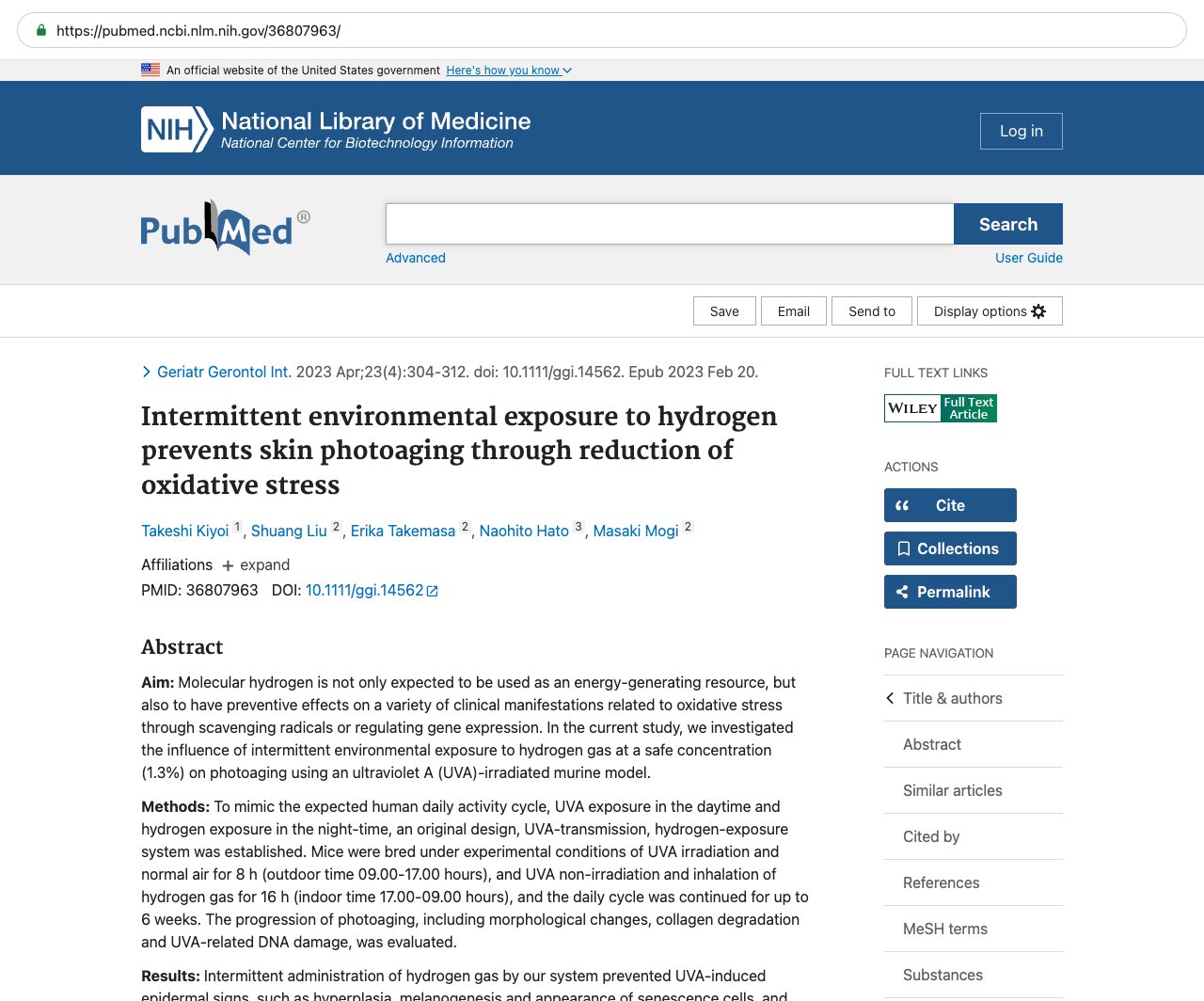
This page mirrors the published abstract (© the authors / publisher) for reference and citation. The canonical source is the PubMed record linked above. This is not medical advice.