2015 · Shi et al. — Hydrogen Therapy Reduces Oxidative Stress-associated Risks Following Acute and Chronic Exposure to High-altitude Environment.
Super-Abstract
This theoretical paper proposes that inhaling low-dose H₂ gas or drinking hydrogen-saturated water could prevent and treat mountain sickness by counteracting the oxidative stress caused by high-altitude low-oxygen and high-UV conditions. The authors argue that H₂'s selective free-radical scavenging and anti-inflammatory properties make it a novel and practical candidate for altitude medicine. No experiments were conducted — this is a reasoned hypothesis.
Commentary
High-altitude environments impose a triple oxidative burden: hypoxia (low oxygen yet paradoxically increased ROS from mitochondrial dysfunction), low barometric pressure, and intense ultraviolet radiation. Together, these can overwhelm the body's antioxidant defences and trigger acute mountain sickness (AMS), chronic mountain sickness, or UV-related skin damage. Shi and colleagues argue that molecular H₂ — which freely diffuses across biological membranes due to its small size and non-polarity — is uniquely suited to address this multi-pronged oxidative stress. Unlike conventional antioxidants (vitamin C, E), H₂ is selective: it neutralises only the most reactive ROS (hydroxyl radical, peroxynitrite) without disturbing normal redox signalling. The paper proposes both inhalation and H₂-rich water as practical delivery methods at altitude. This is a hypothesis paper with no original experimental data; it reasons from existing H₂ biology literature. No clinical or animal trials for altitude-specific H₂ therapy are cited as completed.
Key quotes
- „hydrogen gas with a good permeability in biological membranes can treat various disorders by exerting its selective anti-oxidation and anti-inflammatory effects, indicating that hydrogen therapy plays a role in scavenging free radicals and in balancing oxidation and anti-oxidation systems of cells.“ — the rationale: H₂ biology properties that support the altitude hypothesis
- „we hypothesize that inhaling low-dose hydrogen or drinking hydrogen-saturated water is a novel and simple method to prevent and treat oxidative stress injury caused by low pressure, low oxygen concentration and intense UV radiation in plateaus.“ — the central hypothesis: H₂ as a practical altitude-medicine intervention
- „Low pressure, low oxygen concentration, and intense ultraviolet (UV) radiation in high-altitude environments, can cause oxidative stress which can trigger mountain sickness.“ — the problem statement: why altitude creates oxidative stress and disease risk
Our assessment
This is a theoretical hypothesis paper with no original experimental data. The underlying biological reasoning is sound — H₂ is a selective antioxidant, high altitude generates ROS, and H₂ is easily deliverable — but the specific hypothesis (H₂ prevents altitude sickness) has not been tested in controlled trials. Until properly designed human or animal altitude studies are conducted, this remains an educated conjecture. The paper's value is as a rationale for future research, not as evidence of efficacy. No clinical recommendations can be derived from it.
Study design
- Type: theoretical hypothesis paper · Experimental basis: none (literature reasoning only) · H₂ relevance: central — H₂ proposed as an antioxidant intervention for altitude-induced oxidative stress
- Proposed delivery routes: inhalation of low-dose H₂ gas; drinking hydrogen-saturated water · Target conditions: acute mountain sickness, chronic mountain sickness, UV-induced skin damage at altitude · Status: unvalidated hypothesis
Abstract
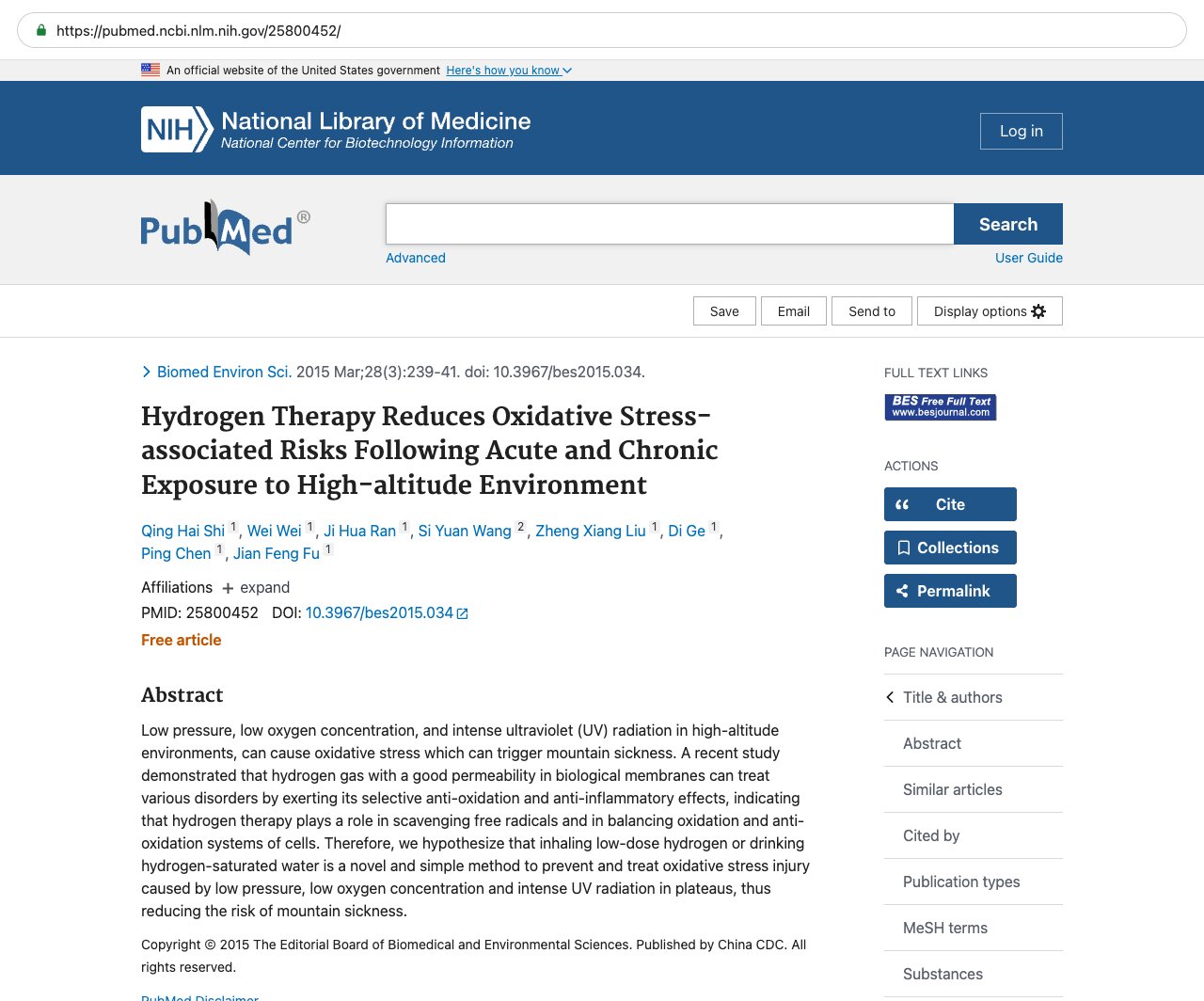
Low pressure, low oxygen concentration, and intense ultraviolet (UV) radiation in high-altitude environments, can cause oxidative stress which can trigger mountain sickness. A recent study demonstrated that hydrogen gas with a good permeability in biological membranes can treat various disorders by exerting its selective anti-oxidation and anti-inflammatory effects, indicating that hydrogen therapy plays a role in scavenging free radicals and in balancing oxidation and anti-oxidation systems of cells. Therefore, we hypothesize that inhaling low-dose hydrogen or drinking hydrogen-saturated water is a novel and simple method to prevent and treat oxidative stress injury caused by low pressure, low oxygen concentration and intense UV radiation in plateaus, thus reducing the risk of mountain sickness.
Source & links
Screenshot of the PubMed page
This page mirrors the published abstract (© the authors / publisher) for reference and citation. The canonical source is the PubMed record linked above. This is not medical advice.