2026 · Kiyoi — Transcriptome-Based Evaluation of Hydrogen Gas Effects for Preventing UVA-Induced Photoaging Using an Artificial Skin Model
Super-Abstract
Hydrogen gas inhalation may protect skin against UV-A induced photoaging — not just by scavenging free radicals, but by modulating specific gene expression pathways including NRF2-mediated antioxidant defence and the p53-mediated senescence pathway. Using an artificial skin model (a 3D in-vitro tissue construct) exposed to UV-A and then incubated with 1.3 % H₂ gas, this study found that hydrogen suppressed photoaging-related transcriptomic changes that were invisible at the histological level. This is an in-vitro model study — no human subjects were involved. (Geriatrics & Gerontology International, 2026.)
Commentary
This study's methodological value lies in using a validated artificial skin model as an alternative to animal experiments, while applying transcriptomic analysis (gene expression profiling) rather than relying solely on visible tissue morphology. The finding that UV-A at 7 J/cm²/day induces photoaging-related gene changes without obvious histological damage is particularly notable — it suggests transcriptomics can detect early photoaging signals missed by conventional histology. H₂ modulated NRF2 and NFκB1-RelA pathways (known players in oxidative stress and inflammation) and suppressed p53-mediated senescence. These are biologically meaningful targets. The authors are appropriately cautious, calling results „preliminary evidence“ that may inform translational research. No conclusion about anti-aging efficacy in living humans can be drawn.
Key quotes
- „hydrogen modulated UVA-induced biological processes and signaling pathways, including the NRF2-mediated and the NFκB1-RelA-mediated responses, and suppressed the p53-mediated senescence pathway.“ — the specific molecular pathways H₂ modulated in the artificial skin model
- „hydrogen may have a protective effect against UVA-induced cellular stress and senescence, via diffusion through the skin surface, suggesting its potential effectiveness in preventing photoaging.“ — the authors' cautious interpretation — in-vitro model only
- „This study provides preliminary evidence that may contribute to the development of future translational research on the utility of molecular hydrogen in UVA-induced photoaging.“ — honest framing — preliminary in-vitro evidence, not clinical proof
Our assessment
This is an in-vitro study using a 3D artificial skin model — no human subjects were involved. Results are at the level of gene expression in a tissue construct; they cannot be extrapolated to clinical anti-aging effects in real skin. This is preliminary mechanistic evidence only. The transcriptomic findings are interesting and biologically plausible, but human trials would be needed to confirm any photoprotective effect of H₂ inhalation on actual skin aging.
Study design
- Type: in-vitro study · Model: 3D artificial skin (EpiDerm or equivalent) · H₂ delivery: 1.3 % H₂ gas in CO₂ incubator; UV-A irradiation at 0 / 7 / 10.5 J/cm²/day × 3 cycles
- Analysis: transcriptomics + histology · Key pathways modulated: NRF2, NFκB1-RelA (antioxidant/anti-inflammatory), p53 senescence (suppressed by H₂)
- Conclusion: H₂ attenuated UV-A-induced transcriptomic photoaging signature in artificial skin at 7 J/cm²/day; histological changes minimal at that dose; 10.5 J/cm²/day caused epidermal hypoplasia with excessive apoptosis
Abstract
AIM: Intermittent hydrogen gas inhalation has the potential to prevent UVA-induced photoaging by reducing oxidative stress, although the underlying molecular mechanisms remain unclear. Additionally, alternatives to animal experiments are recommended for studies not primarily focused on pathogenesis. This study aimed to evaluate the preventive effects of hydrogen gas on UVA-induced photoaging using a short-term in vitro system with artificial skin. METHODS: Artificial skin was irradiated with UVA at 0, 7, or 10.5 J/cm2/day and incubated for 1 day in a CO2 incubator with or without 1.3% hydrogen gas. This cycle was repeated three times, followed by one-day incubation. Transcriptomic and histological analyses were then performed. RESULTS: UVA at 7 J/cm2/day induced minimal epidermal morphological changes but marked photoaging-related transcriptomic alterations, whereas 10.5 J/cm2/day caused epidermal hypoplasia with excessive apoptosis and only limited transcriptomic changes. In comparisons between the 7 J/cm2/day groups with and without hydrogen, hydrogen modulated UVA-induced biological processes and signaling pathways, including the NRF2-mediated and the NFκB1-RelA-mediated responses, and suppressed the p53-mediated senescence pathway. CONCLUSIONS: This study demonstrated that photoaging-related transcriptomic changes were detectable in artificial skin under a relatively low UVA dose (7 J/cm2/day; total 21 J/cm2) with minimal histological alterations. Furthermore, hydrogen may have a protective effect against UVA-induced cellular stress and senescence, via diffusion through the skin surface, suggesting its potential effectiveness in preventing photoaging. This study provides preliminary evidence that may contribute to the development of future translational research on the utility of molecular hydrogen in UVA-induced photoaging.
Source & links
Screenshot of the PubMed page
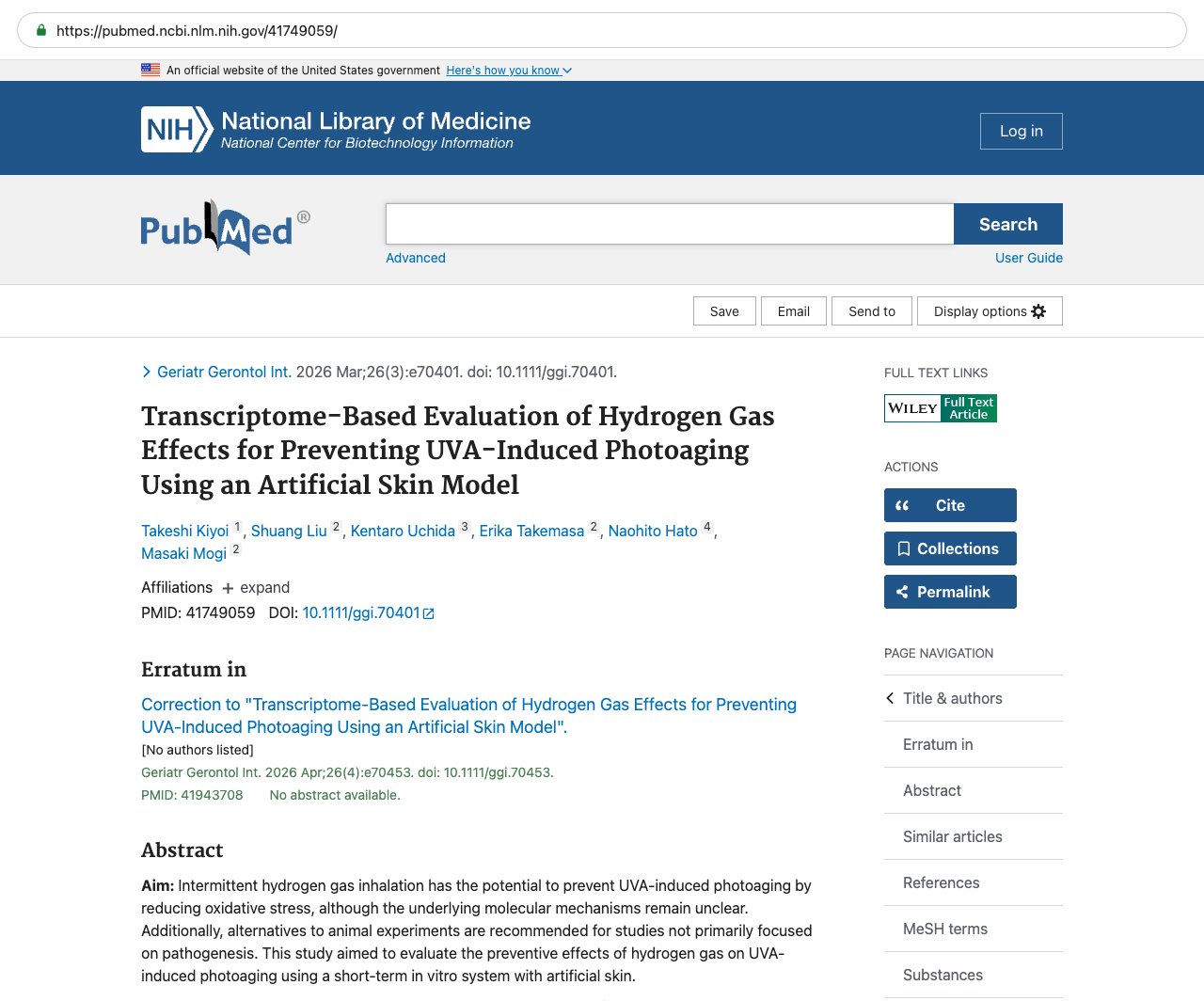
This page mirrors the published abstract (© the authors / publisher) for reference and citation. The canonical source is the PubMed record linked above. This is not medical advice.