2008 Applied radiation and isotopes : including data, instrumentation and methods for use in agriculture, industry and medicine Mechanism / Preclinical Inhalation
2008 · Kniess et al. — Practical experiences with the synthesis of [¹¹C]CH₃I through gas phase iodination using a TRACERlabFXC synthesis module
Super-Abstract
This in-vitro chemistry study optimises the synthesis of the radiotracer [¹¹C]CH₃I — a carbon-11-labelled compound used in PET imaging — by testing several nickel catalysts for the intermediate hydrogen-reduction step. Nanosize nickel proved superior, achieving the best yields. The study has no direct relevance to molecular hydrogen as a health or therapeutic agent.
Commentary
This paper sits firmly within radiopharmaceutical chemistry. The role of hydrogen gas (H₂) here is purely as a reducing agent in an industrial synthesis chain: [¹¹C]CO₂ from a cyclotron is first reduced to [¹¹C]CH₄ using H₂ over a nickel catalyst, then iodinated to [¹¹C]CH₃I for use as a PET methylation agent. The study evaluates catalyst types, furnace temperatures, flow rates, and reduction times to improve radiochemical yield and specific activity. The H₂ gas used is a reagent in an automated synthesis box — not a biological or nutritional intervention. No animal model, no cell culture, no human subject is involved. The low specific activity observed is attributed to carbon contamination from long copper tubing between the cyclotron and the lab.
Key quotes
- „Nickel catalyst nanosize was found to be superior compared with other Ni catalysts tested.“ — main finding: nanosize Ni gives best yield in the H₂-reduction step
- „reduction of [(11)C]CO(2) proceeded in 28-83% yield depending on the nickel catalyst and temperature.“ — H₂ gas acts as reductant; yield is catalyst- and temperature-dependent
- „The relatively low specific activity may be mainly due to carbon contaminations originating from the long copper tubing (500 m) between the cyclotron and the radiochemistry facility.“ — key limitation identified by the authors
Our assessment
This is a technical radiochemistry paper with no bearing on molecular hydrogen as a dietary supplement, antioxidant, or therapeutic agent. H₂ appears only as an industrial reductant in a radiopharmaceutical synthesis workflow. The study is methodologically sound within its domain, but it is not a biological H₂ study and provides no evidence — positive or negative — regarding H₂ health effects.
Study design
- Type: in-vitro / technical chemistry study · Model: automated synthesis module (TRACERlabFX(C)) · H₂ delivery: H₂ gas as chemical reductant (not biological exposure)
- Result: nanosize Ni catalyst achieved best [¹¹C]CO₂-to-[¹¹C]CH₄ reduction yields; gas phase iodination gave 31–62% [¹¹C]CH₃I; specific activity 20–30 GBq/µmol at end-of-synthesis
Abstract
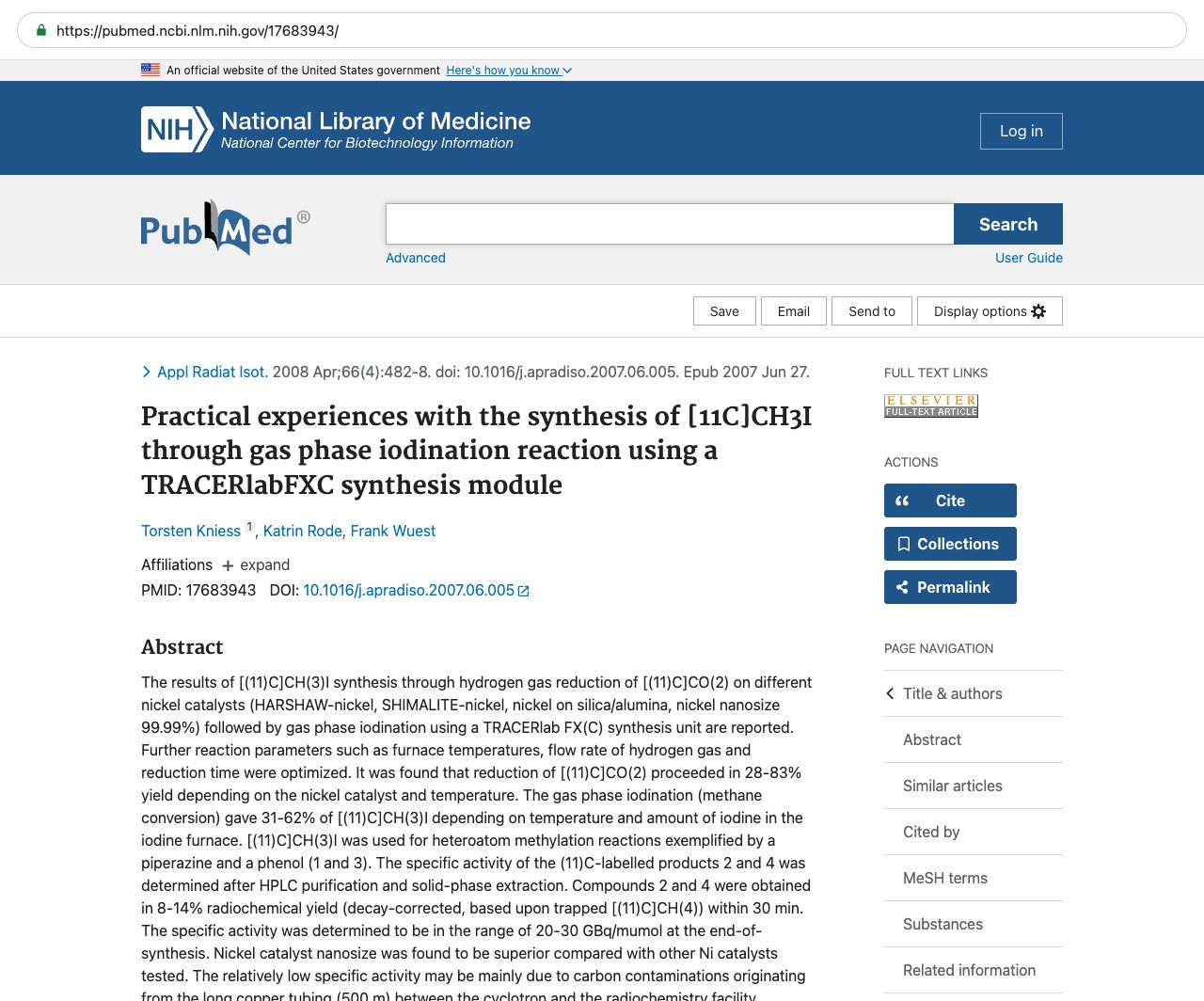
The results of [(11)C]CH(3)I synthesis through hydrogen gas reduction of [(11)C]CO(2) on different nickel catalysts (HARSHAW-nickel, SHIMALITE-nickel, nickel on silica/alumina, nickel nanosize 99.99%) followed by gas phase iodination using a TRACERlab FX(C) synthesis unit are reported. Further reaction parameters such as furnace temperatures, flow rate of hydrogen gas and reduction time were optimized. It was found that reduction of [(11)C]CO(2) proceeded in 28-83% yield depending on the nickel catalyst and temperature. The gas phase iodination (methane conversion) gave 31-62% of [(11)C]CH(3)I depending on temperature and amount of iodine in the iodine furnace. [(11)C]CH(3)I was used for heteroatom methylation reactions exemplified by a piperazine and a phenol (1 and 3). The specific activity of the (11)C-labelled products 2 and 4 was determined after HPLC purification and solid-phase extraction. Compounds 2 and 4 were obtained in 8-14% radiochemical yield (decay-corrected, based upon trapped [(11)C]CH(4)) within 30 min. The specific activity was determined to be in the range of 20-30 GBq/mumol at the end-of-synthesis. Nickel catalyst nanosize was found to be superior compared with other Ni catalysts tested. The relatively low specific activity may be mainly due to carbon contaminations originating from the long copper tubing (500 m) between the cyclotron and the radiochemistry facility.
Source & links
Screenshot of the PubMed page
This page mirrors the published abstract (© the authors / publisher) for reference and citation. The canonical source is the PubMed record linked above. This is not medical advice.