2019 · Korovljev et al. — Hydrogen-rich water reduces liver fat accumulation and improves liver enzyme profiles in patients with non-alcoholic fatty liver disease: a randomized controlled pilot trial.
Super-Abstract
In a double-blind crossover trial with 12 overweight NAFLD patients, 28 days of 1 L/day hydrogen-rich water significantly reduced liver fat measured by MRI (from 284 to 256.5 mM, –2.9 %) and tended to lower aspartate transaminase by 10 %, compared to placebo. Body weight and body composition were not significantly altered. The authors carefully frame this as a preliminary pilot warranting follow-up trials. (Clinics and Research in Hepatology and Gastroenterology, 2019.)
Commentary
Non-alcoholic fatty liver disease is one of the most prevalent chronic liver conditions worldwide, and effective pharmacological treatment remains an unmet need. This small but methodologically solid crossover trial uses dual-echo MRI — a validated method for liver fat quantification — as its primary outcome. The finding of a modest but statistically significant reduction in liver fat across multiple regions of interest is the study's main contribution. The aspartate transaminase reduction (–10 %) did not reach statistical significance (95 % CI including zero on the lower bound), suggesting a trend rather than a confirmed effect. The null result for body composition is important: the liver-specific signal appears independent of weight change, which would be mechanistically interesting if replicated in larger studies.
Key quotes
- „Dual-echo MRI revealed that HRW significantly reduced liver fat accumulation in individual liver regions-of-interest at 28-day follow-up, as compared to placebo administration (P < 0.05).“ — the primary finding — MRI-confirmed liver fat reduction vs. placebo
- „Serum aspartate transaminase levels dropped by 10.0% (95% CI; from -23.2 to 3.4) after hydrogen treatment at 28-day follow-up.“ — AST trend — not statistically significant; CI crosses zero
- „Although preliminary, the results of this trial perhaps nominate HRW as an adjuvant treatment for mild-to-moderate NAFLD.“ — authors' measured conclusion — appropriately cautious given pilot scale
Our assessment
This is a carefully conducted small pilot with a clinically meaningful endpoint (MRI liver fat). The double-blind crossover design with an objective primary outcome is a significant methodological strength. Limitations: n = 12 — severely underpowered for definitive conclusions; crossover design in a chronic disease (NAFLD) carries carryover risk even with washout; the AST reduction did not reach significance; no liver biopsy (histology); no long-term follow-up. The study is an appropriate basis for a larger randomised trial — it cannot stand alone as evidence of benefit.
Study design
- Type: double-blind, placebo-controlled, randomized crossover · n: 12 overweight NAFLD patients (7 women, 5 men; mean BMI 37.7 kg/m²; mean age 56.2 years) · H₂ delivery: 1 L/day hydrogen-rich water for 28 days (registered NCT03625362)
- Primary outcome: liver fat content by dual-echo MRI — significantly reduced (284 → 256.5 mM, –2.9 %; P < 0.05)
- Secondary outcomes: AST –10 % (trend, not significant); no significant change in body weight or composition
Abstract
BACKGROUND AND AIMS: While non-alcoholic fatty liver disease (NAFLD) is rapidly becoming the most common liver disease worldwide, its treatment remains elusive. Since metabolic impairment plays a major role in NAFLD pathogenesis, any pharmaceuticals, such as molecular hydrogen (H2), that advance lipid and glucose metabolism could be appropriate to tackle this complex condition. The aim of this study was to analyze the effects of 28-day hydrogen-rich water intake on liver fat deposition, body composition and lab chemistry profiles in overweight patients suffering from mild-to-moderate NAFLD. METHODS: Twelve overweight outpatients with NAFLD (age 56.2 ± 10.0 years; body mass index 37.7 ± 5.3 kg/m2; 7 women and 5 men) voluntarily participated in this double-blind, placebo-controlled, crossover trial. All patients were allocated to receive either 1 L per day of hydrogen-rich water (HRW) or placebo water for 28 days. The study was registered at ClinicalTrials.gov (ID NCT03625362). RESULTS: Dual-echo MRI revealed that HRW significantly reduced liver fat accumulation in individual liver regions-of-interest at 28-day follow-up, as compared to placebo administration (P < 0.05). Baseline liver fat content was reduced from 284.0 ± 118.1 mM to 256.5 ± 108.3 mM after hydrogen treatment at 28-day follow-up (percent change 2.9%; 95% CI from 0.5 to 5.5). Serum aspartate transaminase levels dropped by 10.0% (95% CI; from -23.2 to 3.4) after hydrogen treatment at 28-day follow-up. No significant differences were observed between treatment groups in either weight or body composition among participants. CONCLUSIONS: Although preliminary, the results of this trial perhaps nominate HRW as an adjuvant treatment for mild-to-moderate NAFLD. These observations provide a rationale for further clinical trials to establish safety and efficacy of molecular hydrogen in NAFLD.
Source & links
Screenshot of the PubMed page
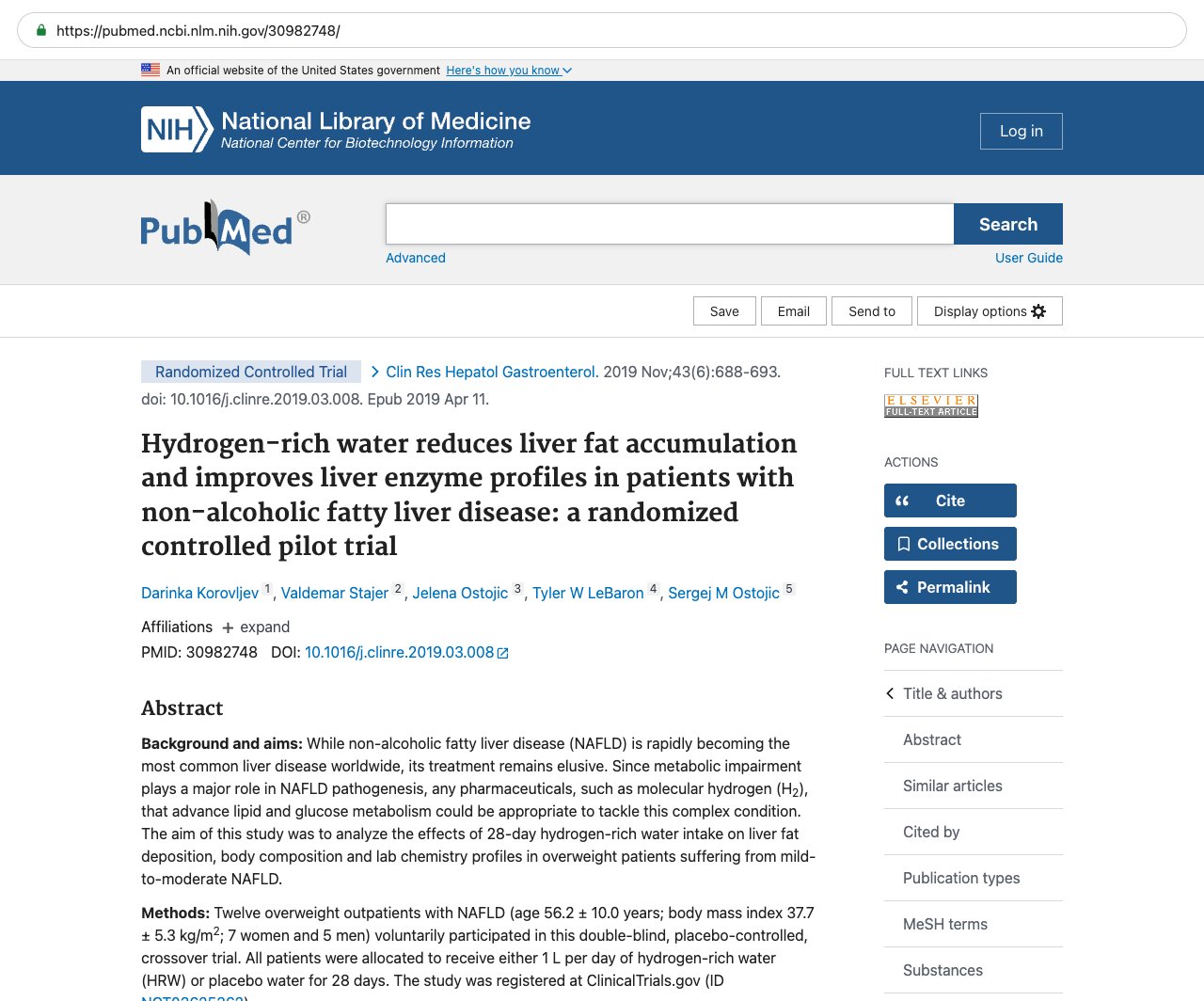
This page mirrors the published abstract (© the authors / publisher) for reference and citation. The canonical source is the PubMed record linked above. This is not medical advice.