2025 · Kuang et al. — Hydrogen-Rich Saline Combined With Vacuum Sealing Drainage Promotes Wound Healing by Altering Biotin Metabolism
Super-Abstract
Impaired wound healing is a significant clinical burden — particularly in post-surgical or chronic wound settings. This study examined hydrogen-rich saline (HRS) combined with vacuum sealing drainage (VSD) in a rabbit wound model, using untargeted metabolomics to identify the mechanism. The combination outperformed VSD alone in wound closure speed, and pathway analysis pointed to biotin metabolism as the key mechanistic pathway — with downstream effects on mitochondrial function, ATP synthesis, and antioxidant capacity. The study also includes in vitro validation in human keratinocytes. (Journal of Cellular and Molecular Medicine, 2025.)
Commentary
Most H₂ wound healing research focuses on oxidative stress reduction as the mechanism. This paper is unusual in identifying biotin metabolism — not a classic H₂ target — as the key altered pathway via untargeted metabolomics. Biotin is a cofactor for several mitochondrial carboxylases involved in fatty acid synthesis and the citric acid cycle, and biotin deficiency impairs keratinocyte function. The finding that HRS + VSD alters biotin metabolism, enhancing mitochondrial ATP synthesis and glutathione (GSH) homeostasis, is a new angle in H₂ biology that deserves independent replication. The human keratinocyte (HaCaT cell) in vitro confirmation adds mechanistic credibility. However, this is an animal model study (rabbit full-thickness wounds) — the clinical relevance to human wound healing in the actual patient setting requires direct validation. The study is listed as a human study in the source data due to the HaCaT cell component; the primary wound model is animal.
Key quotes
- „The combination treatment of HRS and VSD could accelerate wound healing.“ — primary efficacy result in the rabbit wound model
- „Pathway enrichment analysis indicated that biotin metabolism was the potential target pathway.“ — novel mechanistic finding: biotin metabolism as H₂-related wound healing pathway
- „Combining HRS and VSD might enhance mitochondrial function, ATP synthesis, and GSH homeostasis by altering biotin metabolism.“ — the proposed mechanism: biotin → mitochondria → energy + antioxidant protection
Our assessment
Mechanistically novel but primarily an animal study. The metabolomics-driven hypothesis (biotin metabolism as H₂ wound healing target) is the main scientific contribution — if replicated, it opens a new mechanistic lane in H₂ biology. However, rabbit full-thickness wound models are not always predictive of human wound healing, particularly in chronic wound contexts. The human keratinocyte data support the mechanism but do not constitute clinical evidence. The study source data classifies this as a human study, but the wound model is animal — the HaCaT cell work is in vitro. Users of this database should note this distinction. No clinical wound data in humans are presented. The combination of HRS + VSD also means H₂ effects cannot be fully decoupled from vacuum therapy effects.
Study design
- Type: animal study (rabbit full-thickness wound) + in vitro (HaCaT keratinocytes) · n: not specified for animal groups · H₂ delivery: hydrogen-rich saline (HRS) combined with vacuum sealing drainage (VSD)
- Endpoints: wound healing rate; untargeted metabolomics (45 significantly altered metabolites); biotin pathway markers; mitochondrial function, ATP, GSH
- Result: HRS + VSD accelerated wound healing vs. VSD alone; 45 metabolites significantly changed; biotin metabolism identified as top pathway; enhanced mitochondrial function, ATP synthesis, GSH homeostasis
Abstract
Impaired wound healing affects the life quality of patients and causes a substantial financial burden. Hydrogen-rich medium is reported to have antioxidant and anti-inflammatory effects. However, the role of hydrogen-rich saline (HRS) in cutaneous wound healing remains largely unexplored, especially by metabolomics. Thus, untargeted metabolomics profiling was analysed to study the effects and mechanism of HRS combined with vacuum sealing drainage (VSD) in a rabbit full-thickness wound model. Our results indicated that the combination treatment of HRS and VSD could accelerate wound healing. In vitro experiments further confirmed its effects on HaCaT keratinocytes. We found that 45 metabolites were significantly changed between the VSD + HRS group and the VSD + saline-treated group. Pathway enrichment analysis indicated that biotin metabolism was the potential target pathway. The biochemical interpretation analysis demonstrated that combining HRS and VSD might enhance mitochondrial function, ATP synthesis, and GSH homeostasis by altering biotin metabolism. The detection of representative indicators of oxidative stress supported the critical metabolic pathway analysis as well. In summary, VSD combined with HRS might provide a new strategy to enhance wound healing.
Source & links
Screenshot of the PubMed page
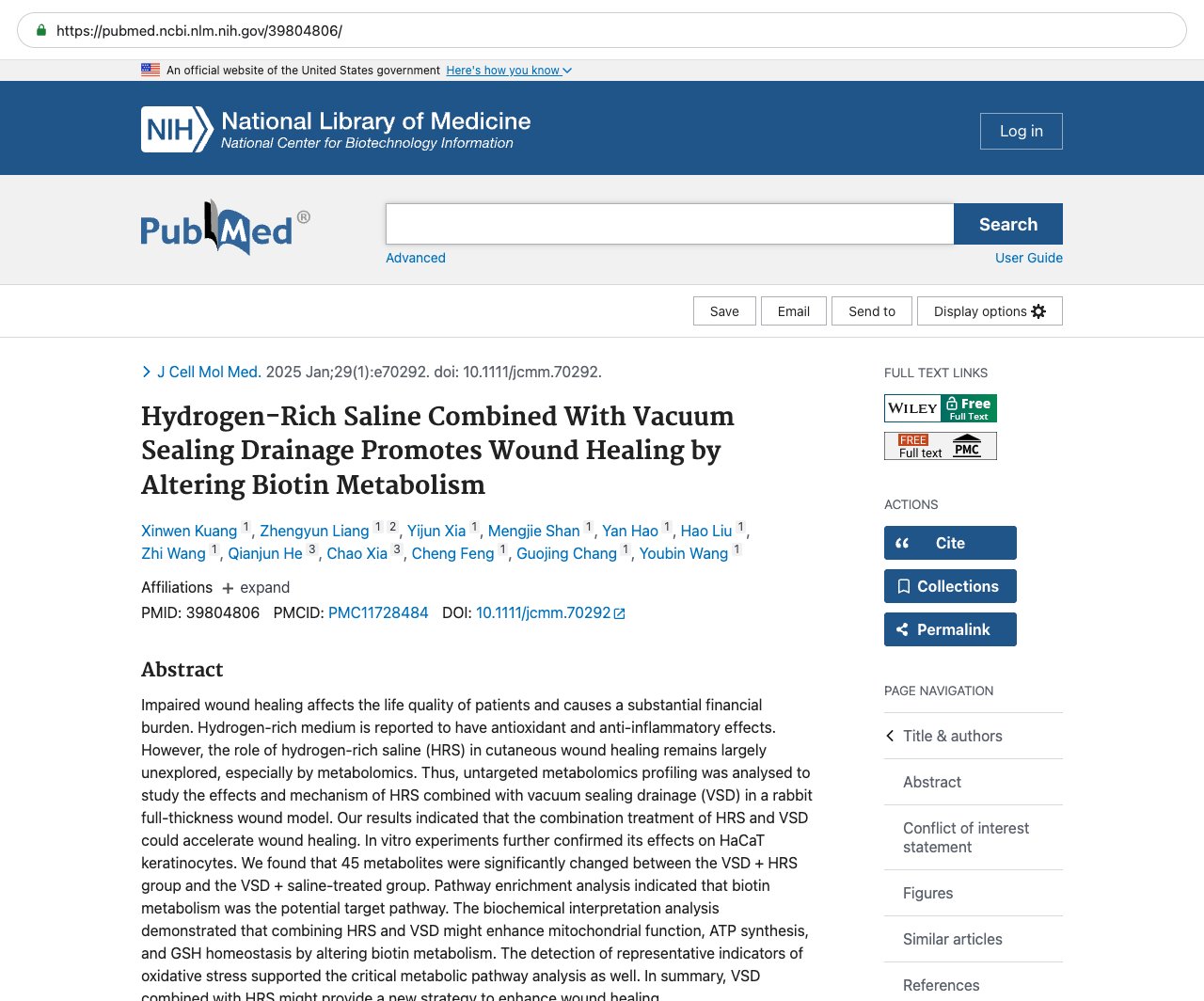
This page mirrors the published abstract (© the authors / publisher) for reference and citation. The canonical source is the PubMed record linked above. This is not medical advice.