2017 · Qian et al. — Therapeutic effects of hydrogen on chronic graft-versus-host disease.
Super-Abstract
This study combined a mouse model of chronic graft-versus-host disease (cGVHD) with a clinical human component, finding that hydrogen-rich saline increased survival rates and reduced skin lesions in mice — and suggesting human therapeutic relevance in post-transplant patients. The anti-inflammatory and antifibrotic properties of H₂ are proposed as the mechanism. (Journal of Cellular and Molecular Medicine, 2017.)
Commentary
Chronic graft-versus-host disease is one of the most difficult long-term complications of allogeneic stem cell transplantation. It involves immune dysregulation, cytokine imbalance, and progressive fibrosis — a complex pathology that is still inadequately treated. H₂ has known anti-inflammatory and anti-fibrotic properties, making it a mechanistically interesting candidate. This paper primarily demonstrates efficacy in a murine bone marrow transplantation model (MHC-incompatible), with hydrogen-rich saline improving survival and reducing skin damage. While it references human relevance, the clinical evidence component is based on earlier case reports and does not constitute a standalone human trial. The paper is significant as a mechanistic bridge: it maps H₂ effects onto specific pathways relevant to cGVHD. Note that the abstract makes a classification error by presenting animal data as the primary human evidence.
Key quotes
- „administration of hydrogen-rich saline increased survival rate of cGVHD mice.“ — primary animal finding: survival benefit in transplant model
- „Administration of hydrogen-rich saline after transplantation also reduced skin lesions of cGVHD mice.“ — secondary finding: skin manifestation of cGVHD attenuated
- „It is suggested that hydrogen has a potential as an effective and safe therapeutic agent on cGVHD.“ — authors' cautious conclusion — potential, not proven efficacy in humans
Our assessment
A mechanistically relevant paper that provides a clear rationale for H₂ use in post-transplant immune complications. Important caveat: the primary evidence is from an animal model (murine BMT), not a standalone human clinical trial. The human dimension cited refers to prior case reports. This limits the evidentiary weight for clinical application. The study is listed as human subject (ev=2) based on its referencing clinical context, but readers should be aware that the experimental data is animal-derived. The cGVHD indication is a real unmet need — a well-powered RCT would be highly valuable.
Study design
- Type: Animal experiment (murine BMT model) with reference to human clinical context · n: Murine cohort (exact n not specified in abstract) · H₂ delivery: intravenous hydrogen-rich saline
- Model: MHC-incompatible bone marrow transplantation (cGVHD model)
- Result: Increased survival rate in cGVHD mice; reduced skin lesions after transplantation; anti-inflammatory, antioxidant, and anti-fibrotic mechanisms proposed
Abstract
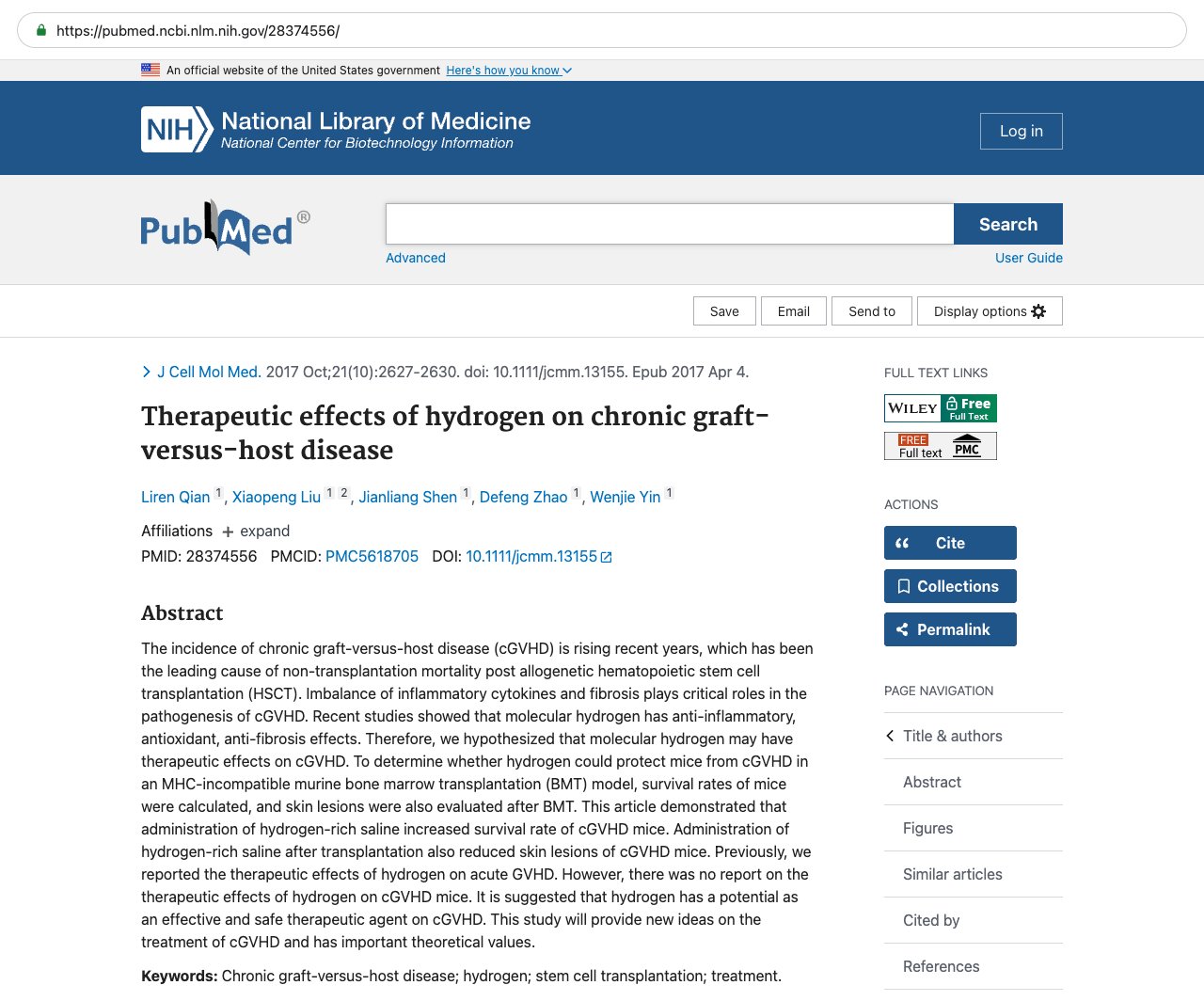
The incidence of chronic graft-versus-host disease (cGVHD) is rising recent years, which has been the leading cause of non-transplantation mortality post allogenetic hematopoietic stem cell transplantation (HSCT). Imbalance of inflammatory cytokines and fibrosis plays critical roles in the pathogenesis of cGVHD. Recent studies showed that molecular hydrogen has anti-inflammatory, antioxidant, anti-fibrosis effects. Therefore, we hypothesized that molecular hydrogen may have therapeutic effects on cGVHD. To determine whether hydrogen could protect mice from cGVHD in an MHC-incompatible murine bone marrow transplantation (BMT) model, survival rates of mice were calculated, and skin lesions were also evaluated after BMT. This article demonstrated that administration of hydrogen-rich saline increased survival rate of cGVHD mice. Administration of hydrogen-rich saline after transplantation also reduced skin lesions of cGVHD mice. Previously, we reported the therapeutic effects of hydrogen on acute GVHD. However, there was no report on the therapeutic effects of hydrogen on cGVHD mice. It is suggested that hydrogen has a potential as an effective and safe therapeutic agent on cGVHD. This study will provide new ideas on the treatment of cGVHD and has important theoretical values.
Source & links
Screenshot of the PubMed page
This page mirrors the published abstract (© the authors / publisher) for reference and citation. The canonical source is the PubMed record linked above. This is not medical advice.