2020 · Kwon — Antioxidant Activity of Hydrogen Water Mask Pack Composed of Gel-Type Emulsion and Hydrogen Generation Powder
Super-Abstract
A cosmetic mask pack containing zinc carbonate-derived hydrogen-generating powder was tested in vitro for antioxidant activity and in a small clinical pilot for skin density effects. After 4 weeks, participants using the hydrogen mask pack showed an 18.4 % increase in skin density versus 9.9 % in the control group. This is an in-vitro and preliminary clinical pilot study — not a controlled clinical trial. (International Journal of Molecular Sciences, 2020.)
Commentary
This paper sits at the intersection of materials chemistry and cosmetic science. The primary content is characterisation of zinc carbonate-derived H₂-generating powder at various sintering temperatures, dissolved hydrogen measurement, and antioxidant assays (Oyaizu method, hydroxyl-radical scavenging, FRAP). The clinical component — a mask pack applied to human volunteers — is brief and methodologically thin: participant numbers are not clearly stated in the abstract, no randomisation or blinding details are given, and the endpoint (skin density) is an indirect surrogate. The antioxidant effects are plausible given H₂ chemistry, but the jump from in-vitro radical scavenging to meaningful skin anti-aging requires considerably more evidence.
Key quotes
- „The skin densities of the participants in the experimental group and the control group increased by 18.41% and 9.93% after 4 weeks, respectively.“ — the headline result of the pilot clinical test
- „The improved skin density of the participants who used the hydrogen mask pack in the experimental group, might be attributed to the recovery effect of the hydrogen molecule in the mask pack on the denatured thick skin layer.“ — proposed mechanism — speculative, not proven
- „the antioxidant activity of the samples was evaluated based on the Oyaizu's method, removal rate of ·OH radicals, and ferric reducing antioxidant power.“ — the in-vitro assay panel used to characterise the powder
Our assessment
This is an in-vitro and small pilot study, not a controlled clinical trial. The antioxidant measurements are standard and credible at the bench level, but the clinical component lacks detail on sample size, blinding, and randomisation. The skin density result is intriguing but cannot be considered robust evidence. This study does not provide proof that hydrogen mask packs meaningfully improve skin aging in humans. It is best read as a proof-of-concept showing that a hydrogen-generating powder can be formulated into a cosmetic matrix and releases detectable H₂ — the clinical relevance remains to be established in properly powered trials.
Study design
- Type: in-vitro materials characterisation + preliminary clinical pilot · Model: H₂-generating powder (zinc carbonate precursor, 400–700 °C), gel-emulsion matrix, human volunteers (n not specified) · H₂ delivery: topical mask pack with dissolved H₂ from ZnCO₃-derived powder
- Result: in vitro: dose-dependent H₂ release confirmed; antioxidant activity demonstrated (Oyaizu, ·OH scavenging, FRAP); pilot clinical: skin density +18.4 % (experimental) vs. +9.9 % (control) after 4 weeks
Abstract
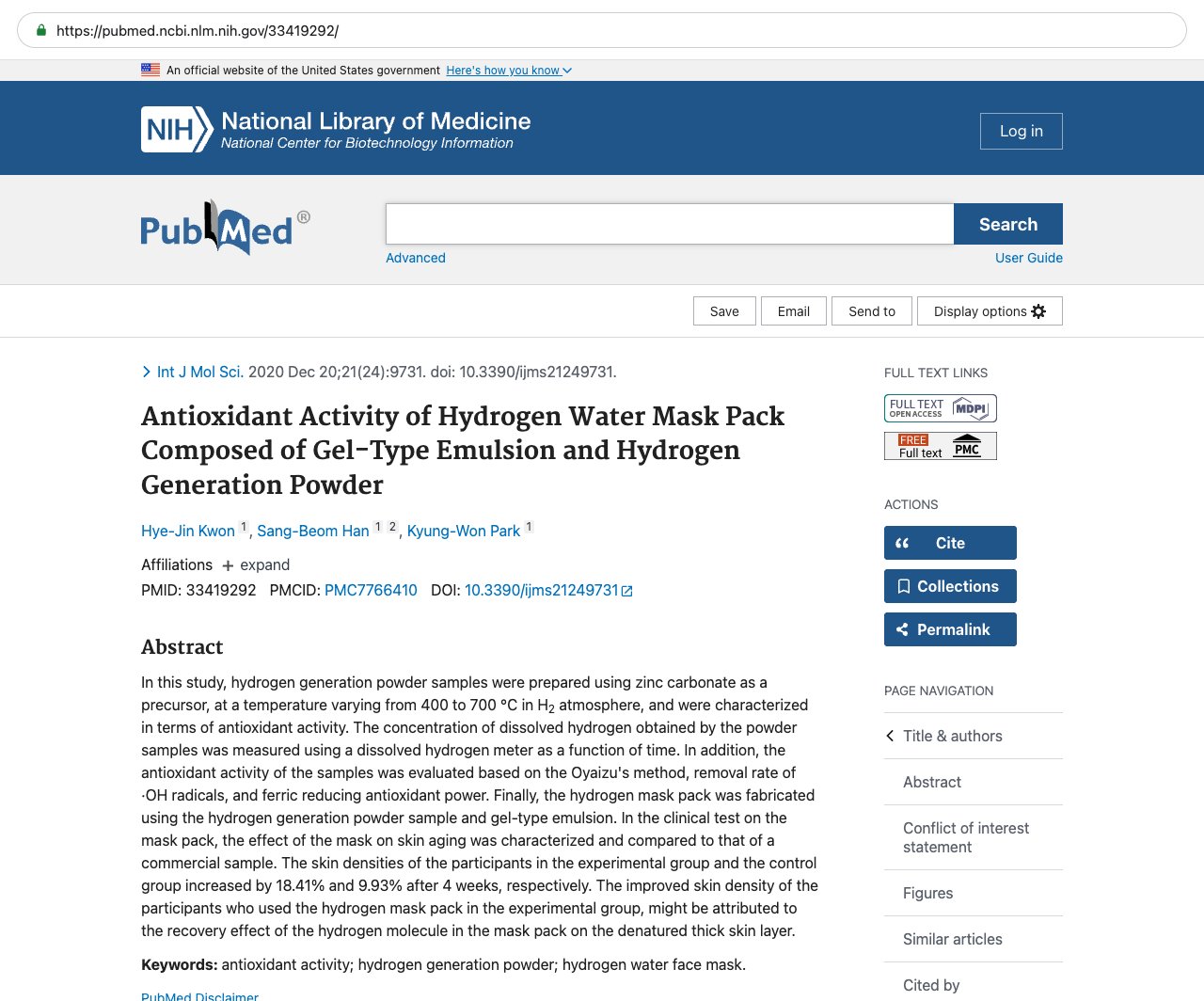
In this study, hydrogen generation powder samples were prepared using zinc carbonate as a precursor, at a temperature varying from 400 to 700 °C in H2 atmosphere, and were characterized in terms of antioxidant activity. The concentration of dissolved hydrogen obtained by the powder samples was measured using a dissolved hydrogen meter as a function of time. In addition, the antioxidant activity of the samples was evaluated based on the Oyaizu's method, removal rate of ·OH radicals, and ferric reducing antioxidant power. Finally, the hydrogen mask pack was fabricated using the hydrogen generation powder sample and gel-type emulsion. In the clinical test on the mask pack, the effect of the mask on skin aging was characterized and compared to that of a commercial sample. The skin densities of the participants in the experimental group and the control group increased by 18.41% and 9.93% after 4 weeks, respectively. The improved skin density of the participants who used the hydrogen mask pack in the experimental group, might be attributed to the recovery effect of the hydrogen molecule in the mask pack on the denatured thick skin layer.
Source & links
Screenshot of the PubMed page
This page mirrors the published abstract (© the authors / publisher) for reference and citation. The canonical source is the PubMed record linked above. This is not medical advice.