1987 · Leung et al. — Gastroduodenal Mucosal Hemodynamics by Endoscopic Reflectance Spectrophotometry
Super-Abstract
Endoscopic reflectance spectrophotometry — validated against hydrogen gas clearance as the reference standard — can non-invasively measure gastric and duodenal mucosal haemoglobin and oxygen saturation during routine endoscopy. The study found that portal hypertension does not significantly alter gastric mucosal blood flow, while active duodenal ulcers show increased blood flow at their margins. (Gastrointestinal Endoscopy, 1987.)
Commentary
This paper develops an endoscopic optical method to assess mucosal perfusion during gastroscopy. The hydrogen gas clearance technique serves as the reference standard for validation — H₂ is inhaled and its clearance from gastric mucosa is measured by electrode to establish true blood flow values, against which the spectrophotometric optical index is calibrated. This involves both animal (dog) model validation and human clinical measurements. Clinical findings: experimentally induced portal hypertension in animals did not affect gastric mucosal flow (confirmed by H₂ clearance), and duodenal ulcers showed elevated local blood flow at their edges. H₂ is not a therapeutic intervention here — it is purely a calibration and reference measurement tool.
Key quotes
- „The reflectance spectrophotometric finding that experimentally induced prehepatic portal hypertension did not affect gastric mucosal blood flow was confirmed by hydrogen gas clearance measurements.“ — H₂ clearance confirming the optical method's null finding in portal hypertension
- „Endoscopic studies in patients with active duodenal ulcer disease revealed a higher index of mucosal hemoglobin concentration and a normal index of oxygen saturation (i.e., an increase in blood flow) at the margin of the ulcer compared with the adjacent normal appearing mucosa.“ — the clinical finding in duodenal ulcer: increased perfusion at ulcer margin
Our assessment
Important note on scope: This is a gastroenterology diagnostic methodology study. H₂ gas clearance is used purely as a calibration reference standard — it is not a therapeutic intervention. The study involves both animal experiments (dog) and human clinical endoscopy. Clinical findings on portal hypertension and duodenal ulcers are potentially relevant to gastroenterology but carry no H₂ therapy implications. Limitations: mixed animal/human design; sample sizes not specified for human cohort in abstract; H₂ used only as reference tool.
Study design
- Type: diagnostic technique development and validation study (dog model + human clinical endoscopy) · n: not specified for human cohort · H₂ delivery: inhalation as reference calibration standard only — not therapeutic
- Result: reflectance spectrophotometry validated against H₂ clearance; portal hypertension did not alter gastric mucosal flow; active duodenal ulcer margins showed increased perfusion · H₂ therapy relevance: none
Abstract
The reflectance spectrophotometric technique measures an index of mucosal hemoglobin concentration and an index of oxygen saturation by spectral analysis of light reflected from the mucosal surface. Using a commercially available unit, a technique for obtaining reproducible endoscopic measurements with acceptable intraobserver and interobserver variability was developed in the anesthetized dogs. The reflectance spectrophotometric finding that experimentally induced prehepatic portal hypertension did not affect gastric mucosal blood flow was confirmed by hydrogen gas clearance measurements. Endoscopic studies in patients with active duodenal ulcer disease revealed a higher index of mucosal hemoglobin concentration and a normal index of oxygen saturation (i.e., an increase in blood flow) at the margin of the ulcer compared with the adjacent normal appearing mucosa.
Source & links
Screenshot of the PubMed page
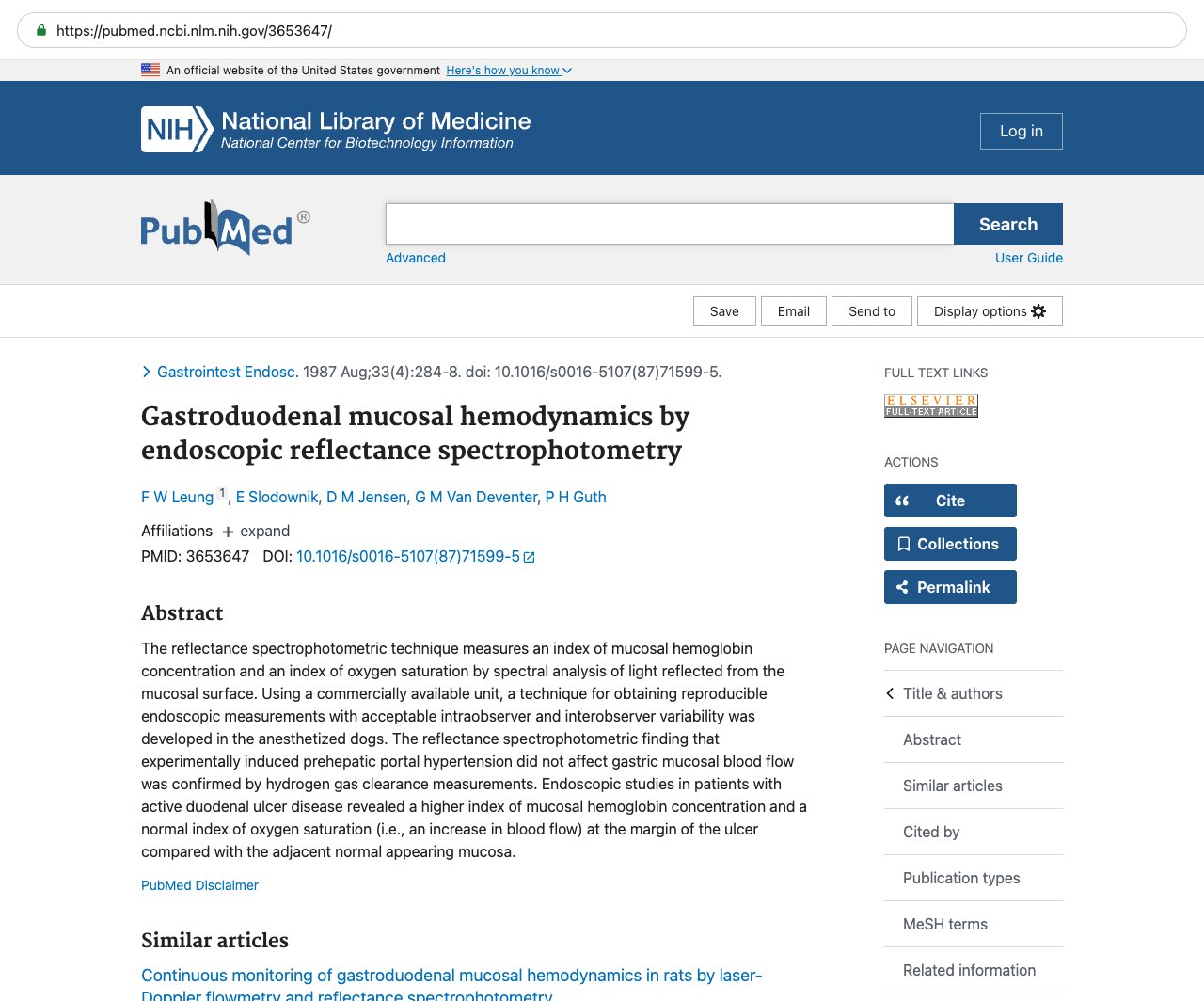
This page mirrors the published abstract (© the authors / publisher) for reference and citation. The canonical source is the PubMed record linked above. This is not medical advice.