2014 · Mano et al. — Maternal molecular hydrogen administration ameliorates rat fetal hippocampal damage caused by in utero ischemia-reperfusion.
Super-Abstract
In this rat study, pregnant mothers that drank hydrogen-saturated water passed measurable H₂ to the placenta, which protected fetal hippocampal neurons from ischemia-reperfusion injury — and improved the learning and memory of the offspring at 8 weeks of age. These are promising neuroprotective findings in an animal model of pregnancy-related brain injury, but no human data exist.
Commentary
Fetal brain injury from ischemia-reperfusion during pregnancy is a significant cause of neonatal neurodevelopmental impairment. This study demonstrates an elegant delivery pathway: maternal oral consumption of hydrogen-saturated water leads to measurable H₂ in the placenta, suggesting transplacental transfer. The study used a surgically induced bilateral utero-ovarian artery occlusion model on day 16 of rat pregnancy. Key findings: reduced oxidative stress markers (8-oxo-dG, 4-HNE) in hippocampal CA1 and CA3 areas; improved growth outcomes in neonates; and — most compellingly — significantly better Morris water maze performance at 8 weeks, indicating sustained cognitive benefit. The neonatal neurological endpoint (reference memory) is unusually strong for a preclinical study. However, this is a rat model of a very specific surgical injury; translation to human pregnancy neuroprotection remains many steps away.
Key quotes
- „We observed a significant increase in the concentration of H2 in the placenta after the oral administration of hydrogen-saturated water to the mothers, with less placental oxidative damage after IR in the presence of H2.“ — proof of transplacental H₂ delivery and placental protection
- „Maternal H2 administration improved the reference memory of the offspring to the sham level after IR injury during pregnancy.“ — the strongest finding: offspring showed normal learning ability despite prenatal brain injury
- „Both oxidative stress markers were significantly increased in the IR group, which was again ameliorated by the H2 intake.“ — hippocampal oxidative damage reversed by maternal H₂ intake
Our assessment
This is a well-designed preclinical animal study with an unusually strong functional endpoint (Morris water maze at 8 weeks), but all work is in rats. The demonstration of transplacental H₂ transfer and offspring cognitive protection is scientifically noteworthy. Limitations: surgically induced ischemia is an extreme model; the rat placenta differs structurally from the human placenta; no safety data on H₂ consumption during human pregnancy are available. Results cannot be applied to human obstetric practice.
Study design
- Type: animal study (preclinical) · Model: Wistar rat pregnancy, bilateral utero-ovarian artery occlusion on day 16 · H₂ delivery: hydrogen-saturated water ad libitum (maternal oral, from day 14 until vaginal delivery)
- Result: measurable H₂ in placenta; reduced placental and hippocampal oxidative damage (8-oxo-dG, 4-HNE); improved neonatal growth; Morris water maze reference memory normalised at 8 weeks post-birth
Abstract
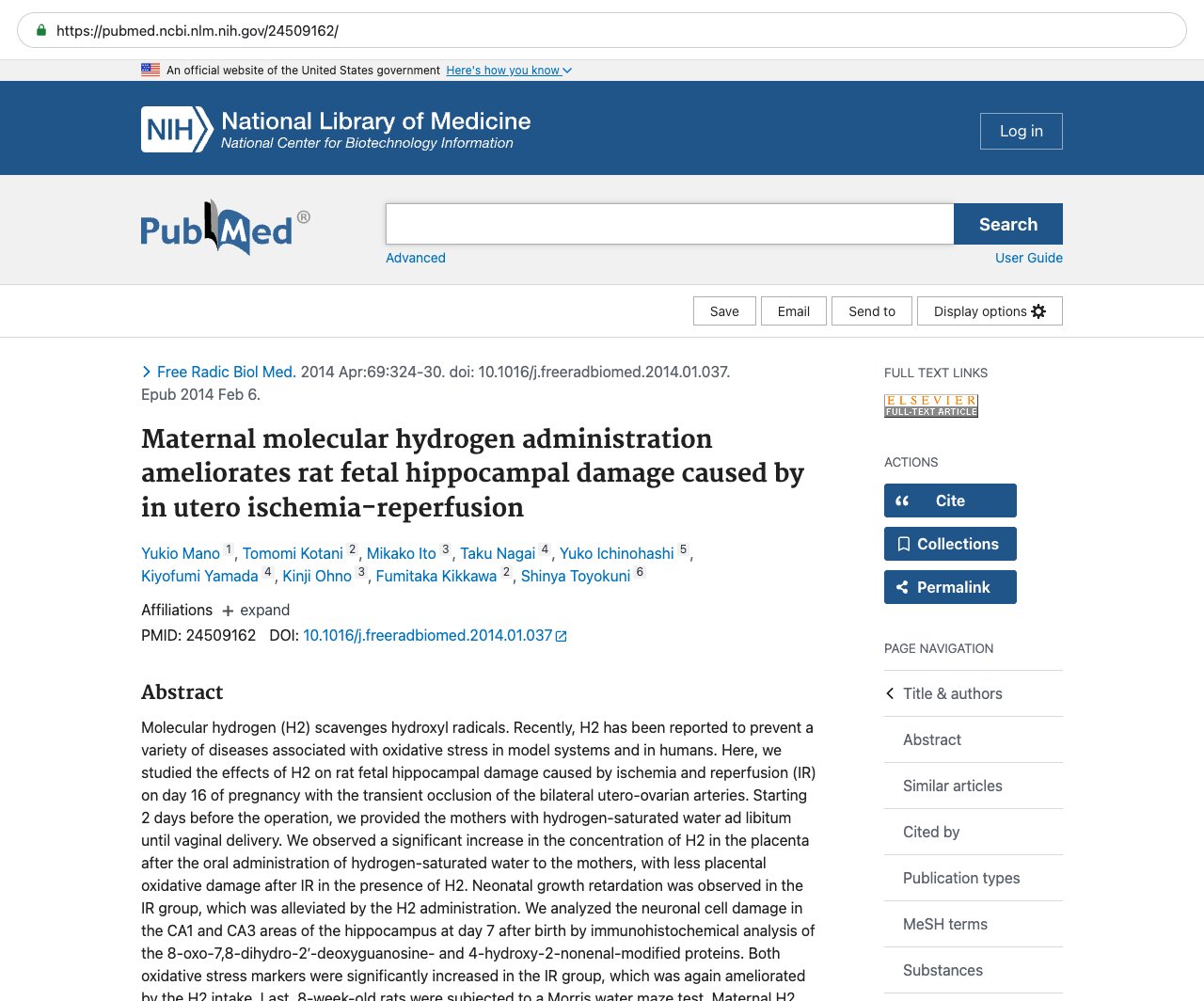
Molecular hydrogen (H2) scavenges hydroxyl radicals. Recently, H2 has been reported to prevent a variety of diseases associated with oxidative stress in model systems and in humans. Here, we studied the effects of H2 on rat fetal hippocampal damage caused by ischemia and reperfusion (IR) on day 16 of pregnancy with the transient occlusion of the bilateral utero-ovarian arteries. Starting 2 days before the operation, we provided the mothers with hydrogen-saturated water ad libitum until vaginal delivery. We observed a significant increase in the concentration of H2 in the placenta after the oral administration of hydrogen-saturated water to the mothers, with less placental oxidative damage after IR in the presence of H2. Neonatal growth retardation was observed in the IR group, which was alleviated by the H2 administration. We analyzed the neuronal cell damage in the CA1 and CA3 areas of the hippocampus at day 7 after birth by immunohistochemical analysis of the 8-oxo-7,8-dihydro-2׳-deoxyguanosine- and 4-hydroxy-2-nonenal-modified proteins. Both oxidative stress markers were significantly increased in the IR group, which was again ameliorated by the H2 intake. Last, 8-week-old rats were subjected to a Morris water maze test. Maternal H2 administration improved the reference memory of the offspring to the sham level after IR injury during pregnancy. Overall, the present results support the idea that maternal H2 intake helps prevent the hippocampal impairment of offspring induced by IR during pregnancy.
Source & links
Screenshot of the PubMed page
This page mirrors the published abstract (© the authors / publisher) for reference and citation. The canonical source is the PubMed record linked above. This is not medical advice.