2019 · Li et al. — Hydrogen as a complementary therapy against ischemic stroke: A review of the evidence.
Super-Abstract
Hydrogen gas inhalation has been studied as a complementary treatment for ischemic stroke, targeting the damaging cascade of free radicals and inflammation that unfolds after a blood vessel in the brain is blocked. This 2019 review by Li and colleagues surveys experimental and clinical trial data, finding that H₂ therapy shows anti-oxidative, anti-inflammatory, and anti-apoptotic effects relevant to stroke recovery.
Commentary
Ischemic stroke remains one of the world's leading causes of death and disability, and the therapeutic window for reperfusion treatment is narrow. H₂ gas — delivered by inhalation — can diffuse rapidly across the blood-brain barrier and neutralise hydroxyl radicals and peroxynitrite, the most damaging free radicals produced during cerebral ischemia-reperfusion. The review covers animal models and clinical trials, examining both laboratory methodology and clinical outcomes. The framing as a „complementary“ therapy is important and honest: H₂ is not proposed here as a replacement for reperfusion (thrombolysis/thrombectomy) but as an adjunct that might extend the therapeutic window or reduce secondary damage.
Key quotes
- „Hydrogen gas has been found to eliminate hydroxyl free radical and peroxynitrite anions as well as producing therapeutic effect in patients with ischemic stroke.“ — the mechanism and early clinical signal described in the reviewed literature
- „Many studies have been published illustrating its anti-oxidative, anti-inflammatory and anti-apoptotic effects.“ — three consistent mechanistic themes across the reviewed evidence
- „We conclude this review with a discussion on future investigations of hydrogen therapy to treat ischemic stroke.“ — the paper explicitly positions itself as a roadmap for further research, not final proof
Our assessment
This is a literature review covering both animal experiments and clinical trial data on H₂ for ischemic stroke. The honest framing — „complementary therapy“, „future investigations“ — reflects the still-emerging nature of the clinical evidence. Limitations: the number of controlled clinical trials in stroke is small; animal models of stroke often overestimate efficacy translatable to humans; delivery logistics for H₂ inhalation in acute stroke settings are complex. The review does not pool effect sizes and cannot establish efficacy. It should be read as a synthesis of promising early signals requiring larger, well-designed trials.
Study design
- Type: narrative review · n: n/a (animal studies and clinical trials synthesised) · H₂ delivery: inhalation (focus of the review)
- Scope: cerebral ischemia-reperfusion injury, ischemic stroke · Mechanisms reviewed: hydroxyl radical and peroxynitrite scavenging, anti-inflammatory, anti-apoptotic pathways
Abstract
Ischemic stroke is one of the most common sources of mortality in the world. Researchers have been trying to find a complementary therapy to treat ischemic stroke in order to improve its prognosis and expand the therapeutic window for reperfusion treatment. For this reason, many experimental and clinical trials studying the effects of hydrogen against ischemic stroke have been published. Hydrogen gas has been found to eliminate hydroxyl free radical and peroxynitrite anions as well as producing therapeutic effect in patients with ischemic stroke. Many studies have been published illustrating its anti-oxidative, anti-inflammatory and anti-apoptotic effects. The purpose of this article is to review the literature concerning treatment of cerebral I/R injury or ischemic stroke with hydrogen therapy. Specifically, we will examine the appropriate laboratory methods, mechanisms of hydrogen therapy, and outcomes of relevant clinical trials. We conclude this review with a discussion on future investigations of hydrogen therapy to treat ischemic stroke.
Source & links
Screenshot of the PubMed page
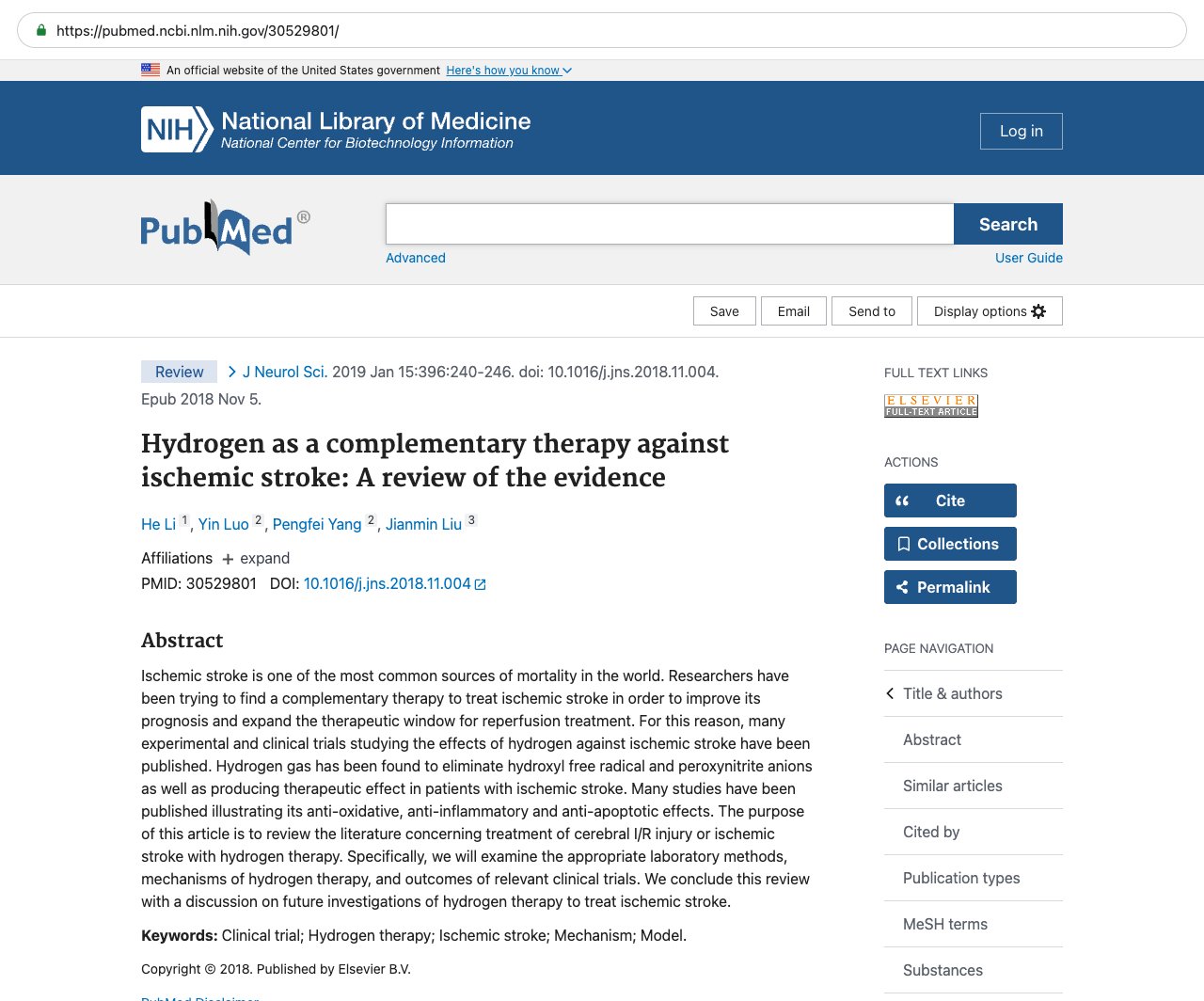
This page mirrors the published abstract (© the authors / publisher) for reference and citation. The canonical source is the PubMed record linked above. This is not medical advice.