2015 · Lin et al. — Hydrogen-rich water attenuates amyloid β-induced cytotoxicity through upregulation of Sirt1-FoxO3a by stimulation of AMP-activated protein kinase in SK-N-MC cells.
Super-Abstract
In neuronal cell culture, hydrogen-rich water (HRW) protected cells against amyloid beta (Aβ) — the peptide linked to Alzheimer's disease — both by directly neutralizing reactive oxygen species and by activating a protective cell-signaling cascade (AMPK → Sirt1 → FoxO3a). This is an in-vitro study; results have not been confirmed in animals or humans. (Chemico-Biological Interactions, 2015.)
Commentary
Lin and colleagues used SK-N-MC neuronal cells — a human neuroblastoma line — to model Aβ-induced toxicity and test HRW as a protective agent. The study is notable for identifying a specific intracellular signaling pathway through which HRW acts beyond simple radical scavenging: AMPK activation leading to Sirt1-dependent FoxO3a upregulation, which in turn promotes antioxidant gene expression and reduces mitochondrial dysfunction. This mechanistic detail adds depth to understanding how H₂ may protect neurons. However, all results are from cell culture — no animal or human translation has been demonstrated in this study.
Key quotes
- „HRW directly counteracts oxidative damage by neutralizing excessive ROS, leading to the alleviation of Aβ-induced cell death.“ — the direct antioxidant mechanism — ROS scavenging in neuronal cells
- „HRW also stimulated AMP-activated protein kinase (AMPK) in a sirtuin 1 (Sirt1)-dependent pathway, which upregulates forkhead box protein O3a (FoxO3a) downstream antioxidant response.“ — the indirect mechanism — a signaling cascade activated by HRW beyond direct scavenging
- „Our findings suggest that HRW may have potential therapeutic value to inhibit Aβ-induced neurotoxicity.“ — the authors' own careful language — „may have potential“, not „has been shown to treat“
Our assessment
A mechanistically interesting in-vitro study that identifies the AMPK–Sirt1–FoxO3a pathway as a potential mediator of HRW's neuroprotective effects against Aβ toxicity. These are cell culture findings only — they cannot be extrapolated to Alzheimer's disease in humans. The neuroblastoma cell model is a useful but simplified system; the complexity of Alzheimer's pathology in vivo involves many factors not captured in this setup. The study provides a hypothesis and molecular targets for future preclinical and eventually clinical investigation — nothing more at this stage.
Study design
- Type: in-vitro study · Model: SK-N-MC human neuroblastoma cells treated with amyloid-β peptide · H₂ delivery: hydrogen-rich water (HRW) applied to cell culture medium
- Result: HRW reduced Aβ-induced ROS accumulation, restored mitochondrial membrane potential, and decreased apoptotic cell death; AMPK–Sirt1–FoxO3a signaling cascade identified as a second protective mechanism beyond direct scavenging
Abstract
Amyloid β (Aβ) peptides are identified in cause of neurodegenerative diseases such as Alzheimer's disease (AD). Previous evidence suggests Aβ-induced neurotoxicity is linked to the stimulation of reactive oxygen species (ROS) production. The accumulation of Aβ-induced ROS leads to increased mitochondrial dysfunction and triggers apoptotic cell death. This suggests antioxidant therapies may be beneficial for preventing ROS-related diseases such as AD. Recently, hydrogen-rich water (HRW) has been proven effective in treating oxidative stress-induced disorders because of its ROS-scavenging abilities. However, the precise molecular mechanisms whereby HRW prevents neuronal death are still unclear. In the present study, we evaluated the putative pathways by which HRW protects against Aβ-induced cytotoxicity. Our results indicated that HRW directly counteracts oxidative damage by neutralizing excessive ROS, leading to the alleviation of Aβ-induced cell death. In addition, HRW also stimulated AMP-activated protein kinase (AMPK) in a sirtuin 1 (Sirt1)-dependent pathway, which upregulates forkhead box protein O3a (FoxO3a) downstream antioxidant response and diminishes Aβ-induced mitochondrial potential loss and oxidative stress. Taken together, our findings suggest that HRW may have potential therapeutic value to inhibit Aβ-induced neurotoxicity.
Source & links
Screenshot of the PubMed page
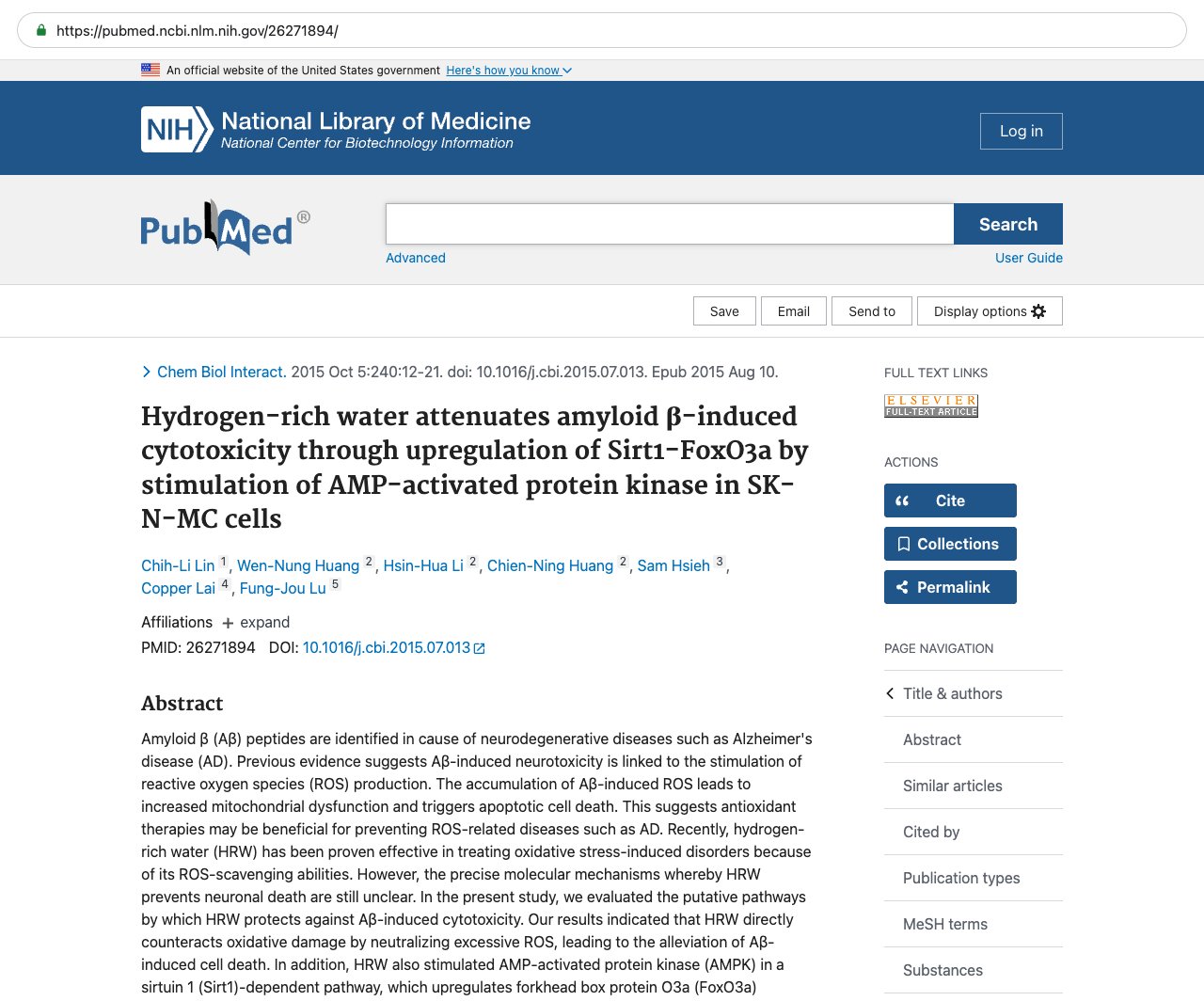
This page mirrors the published abstract (© the authors / publisher) for reference and citation. The canonical source is the PubMed record linked above. This is not medical advice.