2017 · Nakayama et al. — Possible clinical effects of molecular hydrogen (H₂) delivery during hemodialysis in chronic dialysis patients: Interim analysis in a 12 month observation.
Super-Abstract
In a 12-month prospective observation with 262 chronic dialysis patients, H₂-enriched dialysis solution was associated with lower antihypertensive drug use and fewer complaints of severe fatigue and pruritus — without detectable differences in standard dialysis parameters. This interim analysis from a larger Japanese trial suggests quality-of-life benefits beyond what conventional hemodialysis offers. (PLoS ONE, 2017.)
Commentary
Chronic dialysis patients suffer under a double burden: the kidneys are already failing, and the dialysis procedure itself generates massive oxidative stress and inflammation with every session. This Japanese study tested a modified dialysis machine (E-HD) that delivers H₂-enriched dialysate (30–80 ppb) rather than conventional dialysate — a route that bypasses the oral delivery problem entirely. Over 12 months, the most notable differences were not in lab values but in patient-reported outcomes: less severe fatigue, less itching, and reduced need for antihypertensive drugs. These are clinically meaningful quality-of-life endpoints. However, this is an observational interim analysis, not a randomized trial — group assignment was not randomized, and confounders cannot be fully excluded. The H₂ concentration in the dialysate (30–80 ppb) is also relatively low.
Key quotes
- „there were differences in the defined daily dose of anti-hypertensive agents, and subjective symptoms, such as severe fatigue, and pruritus, which were all less in the E-HD group.“ — key finding: not lab markers but patient-reported symptoms improved
- „Multivariate analysis revealed E-HD was an independent significant factor for the reduced use of anti-hypertensive agents as well as the absence of severe fatigue and pruritus at 12 months after adjusting for confounding factors.“ — effect held up in multivariate adjustment — stronger than unadjusted comparison
- „the data indicates E-HD could have substantial clinical benefits beyond conventional HD therapy, and support the rationale to conduct clinical trials of H2 application to HD treatment.“ — authors call for full RCT — this is still an observational signal
Our assessment
An interesting clinical signal from a large real-world cohort. The fact that benefits appear in patient-reported outcomes (fatigue, pruritus, blood pressure control) rather than lab values is both meaningful and expected — oxidative burden in dialysis is notoriously hard to capture in standard panels. Limitations: non-randomized design; self-selection bias in group assignment cannot be excluded; H₂ concentrations are on the lower end; the full primary trial (UMIN000004857) results are not yet reported here. Useful as hypothesis-generating evidence, not proof of efficacy.
Study design
- Type: Prospective observational interim analysis (non-randomized) · n: 262 (140 E-HD, 122 conventional HD) · H₂ delivery: H₂-enriched dialysate at 30–80 ppb throughout dialysis sessions
- Duration: 12 months continuous observation without hospitalization
- Result: No significant differences in standard dialysis parameters; E-HD group showed lower antihypertensive drug use, less severe fatigue, less pruritus — all confirmed as independent factors in multivariate analysis
Abstract
BACKGROUND AND AIM: It is supposed that enhanced oxidative stress and inflammation are involved with the poor clinical outcomes in patients on chronic dialysis treatment. Recent studies have shown that molecular hydrogen (H2) is biologically active as an anti-inflammatory agent. Thus, we developed a novel hemodialysis (E-HD) system which delivers H2 (30 to 80 ppb)-enriched dialysis solution, to conduct a prospective observational study (UMIN000004857) in order to compare the long-term outcomes between E-HD and conventional-HD (C-HD) in Japan. The present interim analysis aimed to look at potential clinical effects of E-HD during the first 12 months observation. SUBJECTS AND METHOD: 262 patients (140, E-HD; 122, C-HD) were subjected for analysis for comprehensive clinical profiles. They were all participating in the above mentioned study, and they had been under the respective HD treatment for 12 consecutive months without hospitalization. Collected data, such as, physical and laboratory examinations, medications, and self-assessment questionnaires on subjective symptoms (i.e., fatigue and pruritus) were compared between the two groups. RESULTS: In a 12-month period, no clinical relevant differences were found in dialysis-related parameters between the two groups. However, there were differences in the defined daily dose of anti-hypertensive agents, and subjective symptoms, such as severe fatigue, and pruritus, which were all less in the E-HD group. Multivariate analysis revealed E-HD was an independent significant factor for the reduced use of anti-hypertensive agents as well as the absence of severe fatigue and pruritus at 12 months after adjusting for confounding factors. CONCLUSION: The data indicates E-HD could have substantial clinical benefits beyond conventional HD therapy, and support the rationale to conduct clinical trials of H2 application to HD treatment.
Source & links
Screenshot of the PubMed page
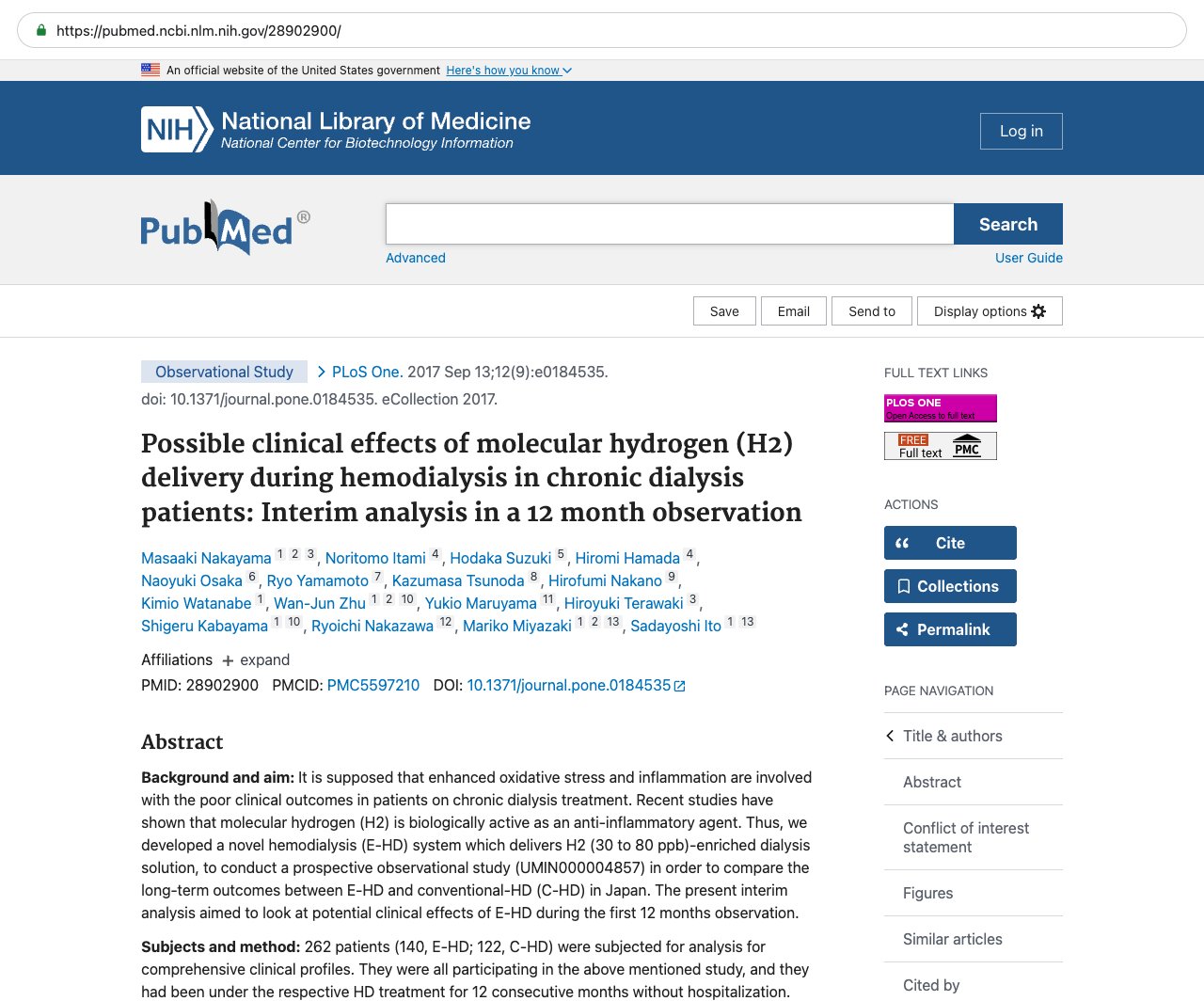
This page mirrors the published abstract (© the authors / publisher) for reference and citation. The canonical source is the PubMed record linked above. This is not medical advice.