2025 · Lin et al. — Molecular Hydrogen as an Adjuvant Therapy in Severe Lupus Serositis With Heart Failure: A Case Report on Immune Modulation and Fatigue Reduction
Super-Abstract
SLE with cardiac complications is managed with steroids and immunomodulators — but prolonged use causes serious side effects. This case documents a 51-year-old woman with SLE and acute decompensated heart failure who, after adding molecular hydrogen therapy to her regimen, showed improved cardiac function, reduced autoantibody levels, favorable immune shifts, and significant fatigue reduction — while successfully tapering off steroids. (In Vivo, 2025.)
Commentary
Lupus serositis — inflammation of the membranes lining the heart and other organs — is a serious manifestation of SLE and can precipitate or worsen heart failure. The conventional approach doubles down on immunosuppression, but each dose of steroid comes at metabolic and cardiovascular cost. This case is interesting for the steroid taper achieved: reducing anti-dsDNA and anti-Ro52 autoantibodies while lowering Pro-BNP (a cardiac stress marker) and tapering steroids simultaneously is a clinically meaningful narrative if verified. The immune phenotyping adds depth — T and B cell subset shifts are documented. The fatigue improvement (a high-priority patient-reported outcome in SLE) is notable. However, as with all case reports, regression to the mean, natural SLE flare-remission cycles, and the ongoing background immunosuppression must be considered. The interaction of H₂ with background immunotherapy cannot be untangled.
Key quotes
- „Her cardiac function showed notable improvement, evidenced by reductions in anti-dsDNA and anti-Ro52 antibody levels, and Pro-BNP levels, as well as favorable shifts in T and B cell subsets.“ — multi-marker improvement across cardiac, immune, and autoantibody domains
- „The patient experienced a significant reduction in fatigue.“ — patient-reported fatigue — a key quality-of-life endpoint in SLE
- „She successfully tapered off steroids while maintaining disease stability with ongoing molecular hydrogen therapy.“ — steroid taper achieved — clinically meaningful if replicated
Our assessment
A single case report with background immunomodulator therapy ongoing throughout. The documented improvements (autoantibody reduction, Pro-BNP reduction, steroid taper, fatigue improvement) are clinically meaningful outcomes — but each can occur during natural SLE remission cycles, as a delayed response to prior therapy, or due to the background immunomodulator itself. H₂ cannot be credited or debited independently. The value of this case lies in illustrating the safety of H₂ as a concurrent therapy and in generating hypotheses about H₂'s potential steroid-sparing role in SLE — a question that merits a dedicated randomized trial. The authors themselves call for further studies.
Study design
- Type: single case report · n: 1 (51-year-old female, SLE with acute decompensated heart failure, lupus serositis) · H₂ delivery: method not specified; concurrent steroids + immunomodulators (tapered over time)
- Endpoints: anti-dsDNA, anti-Ro52, Pro-BNP; T and B cell subsets (flow cytometry); fatigue (not specified instrument); steroid dose
- Result: reduction in anti-dsDNA, anti-Ro52, Pro-BNP; favorable T/B cell shifts; significant fatigue reduction; steroid taper successfully completed; disease stability maintained
Abstract
BACKGROUND/AIM: Systemic lupus erythematosus (SLE) is a chronic autoimmune disease characterized by multi-organ inflammation and damage across multiple organs, typically managed with steroids and immunomodulators. However, prolonged use of these treatments is often associated with significant side effects, underscoring the need for adjunctive therapies that improve disease outcomes while minimizing adverse effects. Molecular hydrogen (H2) has demonstrated potential as an antioxidant and anti-inflammatory agent. This report discusses a case of SLE with cardiac complications, evaluating the therapeutic impact of molecular hydrogen therapy on fatigue, immune modulation, and cardiac function. CASE REPORT: A 51-year-old female with SLE and acute decompensated heart failure initially received steroids and immunomodulators for disease management. Subsequently, molecular hydrogen therapy was introduced as an adjuvant treatment. Over several months, her cardiac function showed notable improvement, evidenced by reductions in anti-dsDNA and anti-Ro52 antibody levels, and Pro-BNP levels, as well as favorable shifts in T and B cell subsets. Additionally, the patient experienced a significant reduction in fatigue. She successfully tapered off steroids while maintaining disease stability with ongoing molecular hydrogen therapy. CONCLUSION: This case highlights the potential of molecular hydrogen therapy as an adjuvant treatment in SLE, with observed benefits in immune modulation and fatigue reduction. Further studies are warranted to elucidate its therapeutic role and applicability in autoimmune diseases.
Source & links
Screenshot of the PubMed page
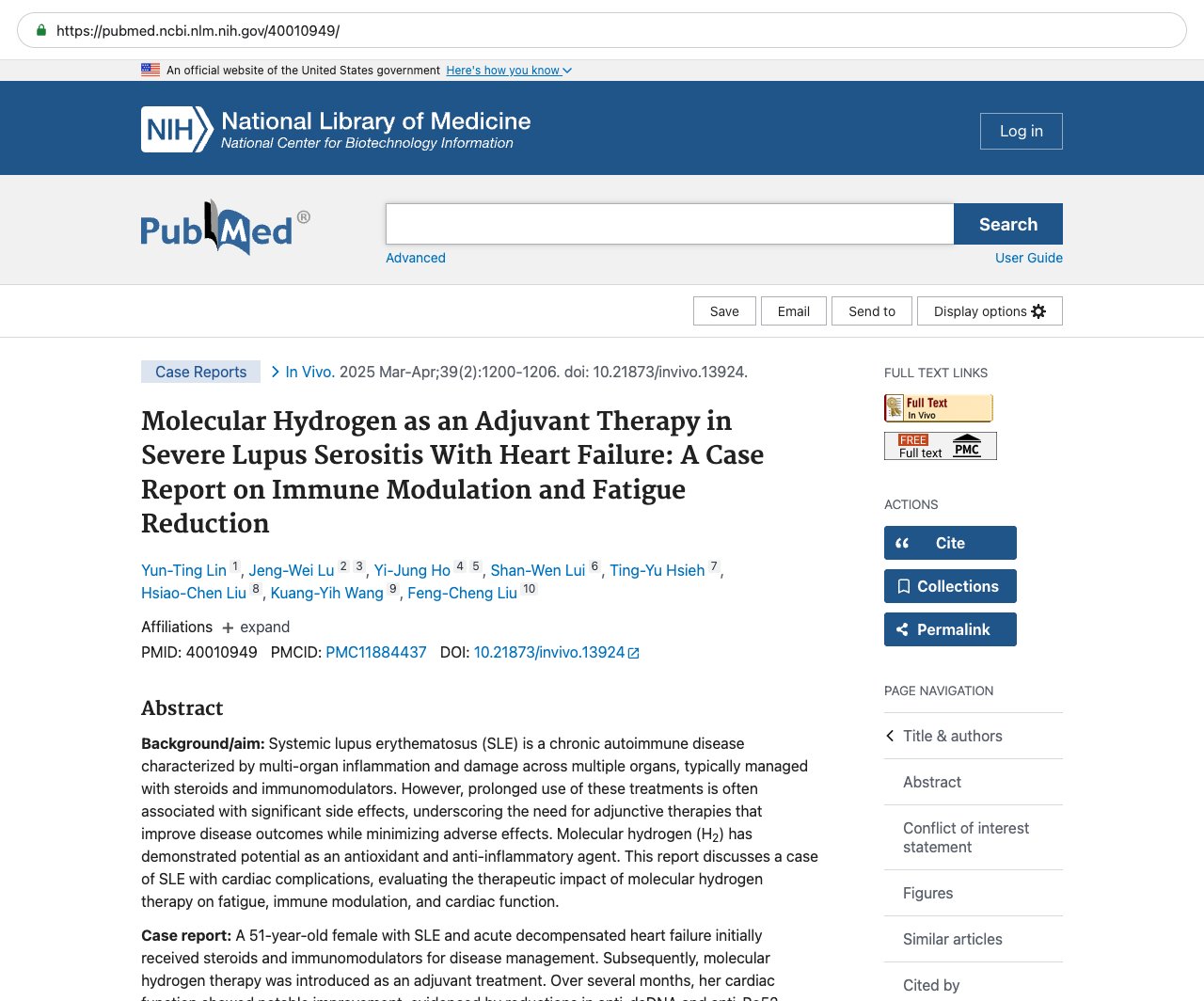
This page mirrors the published abstract (© the authors / publisher) for reference and citation. The canonical source is the PubMed record linked above. This is not medical advice.