2010 · Liu — Hydrogen therapy may be an effective and specific novel treatment for acute radiation syndrome.
Super-Abstract
This hypothesis paper proposes that inhaled molecular hydrogen (H₂) could be an effective treatment for acute radiation syndrome (ARS) — the life-threatening condition caused by high-dose whole-body irradiation. The authors argue that since more than half of radiation damage is caused by hydroxyl radicals, and since H₂ selectively scavenges hydroxyl radicals, H₂ therapy could specifically protect cells from radiation damage. This is a theoretical proposal, not an experimental study.
Commentary
This brief hypothesis paper in Medical Hypotheses (2010) draws a mechanistic parallel between H₂'s demonstrated antioxidant activity in ischaemia-reperfusion models and the radical-mediated damage of ionising radiation. The argument is internally consistent: both processes generate hydroxyl radicals, and H₂'s selectivity for the most damaging ROS (hydroxyl radical and peroxynitrite) makes it a theoretically attractive radioprotector. No experimental data specific to ARS are presented. The paper is closely related to a companion hypothesis (PMID 21275114) proposing H₂-rich saline as a radioprotector published in the same year. Both are calls for further experimental investigation, not evidence-based treatments.
Key quotes
- „More than a half of the ionizing radiation-induced cellular damage is caused by hydroxyl radicals.“ — the radiobiological rationale underpinning the hypothesis
- „Studies have show that reducing hydroxyl radicals can significantly improve the protection of cells from radiation damage.“ — the mechanistic bridge from known radiation biology to the H₂ hypothesis
- „We hypothesize that hydrogen therapy may be an effective, specific and unique treatment for acute radiation syndrome.“ — the central hypothesis — explicitly speculative, not a demonstrated treatment
Our assessment
This is a theoretical hypothesis paper with no original experimental data on H₂ and acute radiation syndrome. The mechanistic reasoning is plausible — H₂ selectively scavenges the hydroxyl radicals that dominate radiation damage — but this is not a human study, and efficacy for ARS has not been demonstrated. It represents a scientifically motivated starting point for investigation. Any suggestion that H₂ „treats” radiation injury must wait for experimental and clinical validation.
Study design
- Type: hypothesis / theory paper · n: n/a (no experimental data) · H₂ delivery: inhalation (proposed)
- Result: theoretical proposal that H₂ inhalation selectively scavenges radiation-induced hydroxyl radicals; no empirical findings
Abstract
Hydrogen is the most abundant chemical element in the universe, however, it is seldom regarded as a therapeutic gas. Recent studies show that inhaled hydrogen gas (H(2)) has antioxidant and antiapoptotic activities that protect the brain against ischemia-reperfusion injury and stroke by selectively reducing hydroxyl and peroxynitrite radicals. It is also well known that more than a half of the ionizing radiation-induced cellular damage is caused by hydroxyl radicals. Studies have show that reducing hydroxyl radicals can significantly improve the protection of cells from radiation damage. In like manner, we hypothesize that hydrogen therapy may be an effective, specific and unique treatment for acute radiation syndrome.
Source & links
Screenshot of the PubMed page
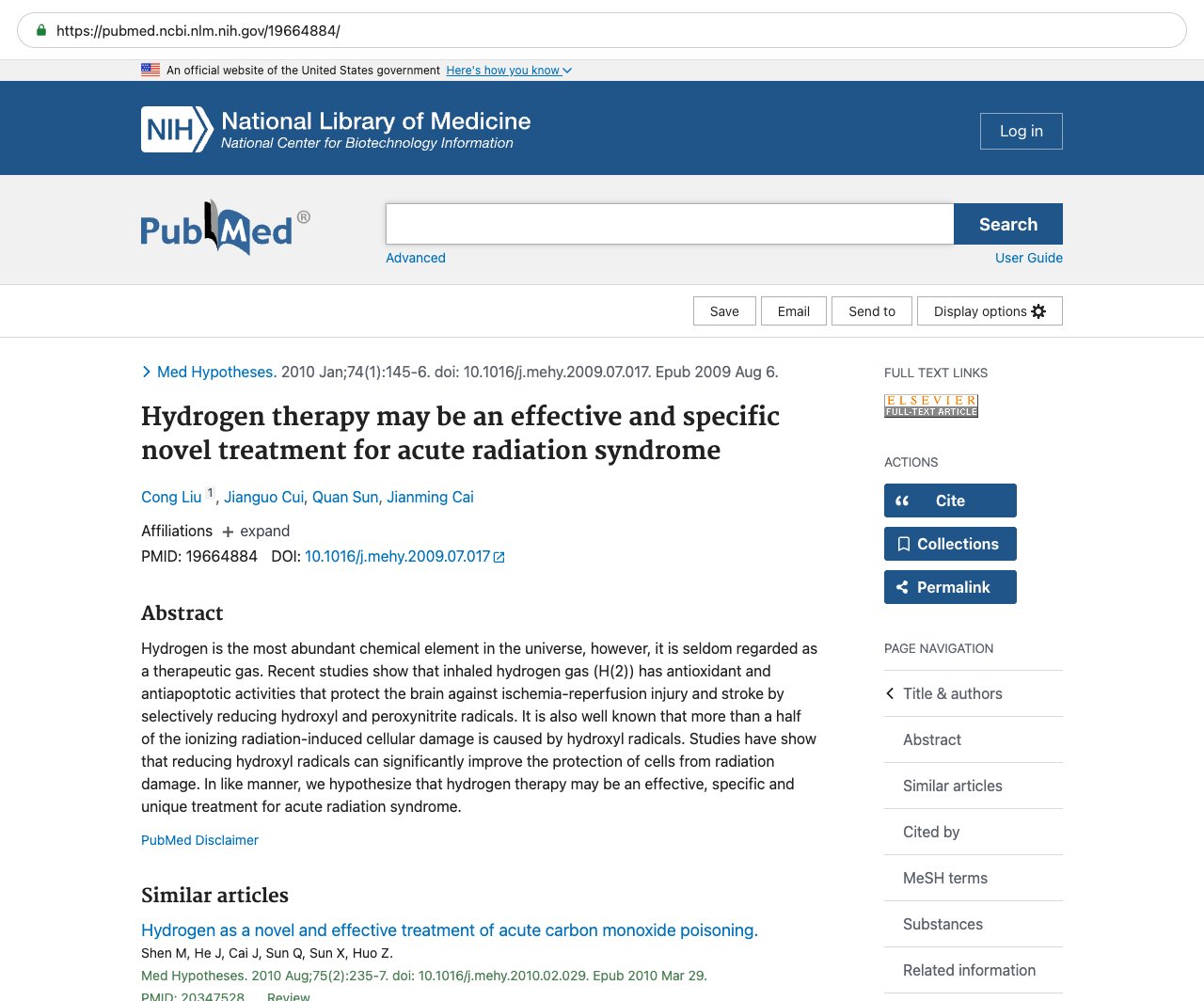
This page mirrors the published abstract (© the authors / publisher) for reference and citation. The canonical source is the PubMed record linked above. This is not medical advice.