2019 · Liu — In vitro and in vivo studies of Mg-30Sc alloys with different phase structure for potential usage within bone.
Super-Abstract
Researchers developed a magnesium-scandium (Mg-30Sc) alloy with a body-centred-cubic (bcc) crystal structure as a biodegradable orthopaedic implant material and tested it in cell cultures and rats over 24 weeks. The β-phase bcc alloy showed superior mechanical strength (>600 MPa compressive strength), low in-vivo corrosion rate, no cytotoxicity, and good bone integration — with only limited hydrogen gas release during degradation. (Acta Biomaterialia, 2019.)
Commentary
This study is primarily a biomaterials engineering paper, not a hydrogen-medicine study in the traditional sense. Its relevance to H₂ biology lies in the fact that magnesium alloy implants inevitably release small amounts of H₂ gas as a degradation by-product — and historically this has been a concern for implant safety and gas pocket formation. The Mg-30Sc alloy is notable because its bcc structure achieves an unusually slow corrosion rate (0.06 mm/year), which limits H₂ gas evolution to levels the authors describe as acceptable. No cytotoxicity or systemic toxicity was observed in either cell or rat models. Bone contact ratio was 75 % after 24 weeks. The study is well-designed for a biomaterials evaluation, but it does not investigate any therapeutic role of H₂ — H₂ is a side product to be minimized, not a therapeutic agent here. Transferability to human orthopaedic use requires much further work including larger animal models and long-term human trials.
Key quotes
- „The β phased Mg-30 wt%Sc alloy displayed acceptable corrosion resistance in vivo (0.06 mm y-1) and maintained mechanical integrity up to 24 weeks.“ — key engineering result: slow degradation preserves mechanical function
- „No cytotoxicity and systematic toxicity were shown for β phased Mg-30 wt%Sc alloy on MC3T3 cell model and rat organisms.“ — safety finding: no detectable toxicity in cells or rats
- „Good osseointegration, limited hydrogen gas release and maintained mechanical integrity were observed after 24 weeks' implantation into the rat femur bone.“ — in-vivo result: H₂ release from implant degradation was limited and acceptable
Our assessment
This is a preclinical biomaterials study, not a study of therapeutic H₂. The H₂ aspect is specifically about minimizing incidental H₂ gas release from a degradable implant — the goal is to keep H₂ low, not to administer it therapeutically. Results are from cell culture and a rat femur model; no human implantation data exist. The alloy concept is scientifically interesting but far from clinical application. This paper is not evidence for therapeutic H₂ in any sense — it belongs to implant materials science.
Study design
- Type: preclinical biomaterials study (in vitro + in vivo) · Model: MC3T3 osteoblast cell line (cytotoxicity); rat femur implantation model, 24-week follow-up · H₂ relevance: incidental H₂ gas evolved during Mg-alloy corrosion (not therapeutic administration)
- Result: β-phase Mg-30Sc: compressive strength 603 MPa, corrosion rate 0.06 mm/year in vivo, bone-implant contact 75 % at 24 weeks; no cytotoxicity on MC3T3; no systemic toxicity in rats; limited H₂ gas release from implant degradation
Abstract
Proper alloying magnesium with element scandium (Sc) could transform its microstructure from α phase with hexagonal closed-packed (hcp) structure into β phase with body-cubic centered (bcc) structure. In the present work, the Mg-30 wt% Sc alloy with single α phase, dual phases (α + β) or β phase microstructure were developed by altering the heat-treatment routines and their suitability for usage within bone was comprehensively investigated. The β phased Mg-30 wt% Sc alloy showed the best mechanical performance with ultimate compressive strength of 603 ± 39 MPa and compressive strain of 31 ± 3%. In vitro degradation test showed that element scandium could effectively incorporate into the surface corrosion product layer, form a double-layered structure, and further protect the alloy matrix. No cytotoxic effect was observed for both single α phased and β phased Mg-30 wt% Sc alloys on MC3T3 cell line. Moreover, the β phased Mg-30 wt%Sc alloy displayed acceptable corrosion resistance in vivo (0.06 mm y-1) and maintained mechanical integrity up to 24 weeks. The degradation process did not significantly influence the hematology indexes of inflammation, hepatic or renal functions. The bone-implant contact ratio of 75 ± 10% after 24 weeks implied satisfactory integration between β phased Mg-30 wt%Sc alloy and the surrounding bone. These findings indicate a potential usage of the bcc-structured Mg-Sc alloy within bone and might provide a new strategy for future biomedical magnesium alloy design. STATEMENT OF SIGNIFICANCE: Scandium is the only rare earth element that can transform the matrix of magnesium alloy into bcc structure, and Mg-30 wt%Sc alloy had been recently reported to exhibit shape memory effect. The aim of the present work is to study the feasibility of Mg-30 wt%Sc alloy with different constitutional phases (single α phase, single β phase or dual phases (α + β)) as biodegradable orthopedic implant by in vitro and in vivo testings. Our findings showed that β phased Mg-30 wt%Sc alloy which is of bcc structure exhibited improved strength and superior in vivo degradation performance (0.06 mm y-1). No cytotoxicity and systematic toxicity were shown for β phased Mg-30 wt%Sc alloy on MC3T3 cell model and rat organisms. Moreover, good osseointegration, limited hydrogen gas release and maintained mechanical integrity were observed after 24 weeks' implantation into the rat femur bone.
Source & links
Screenshot of the PubMed page
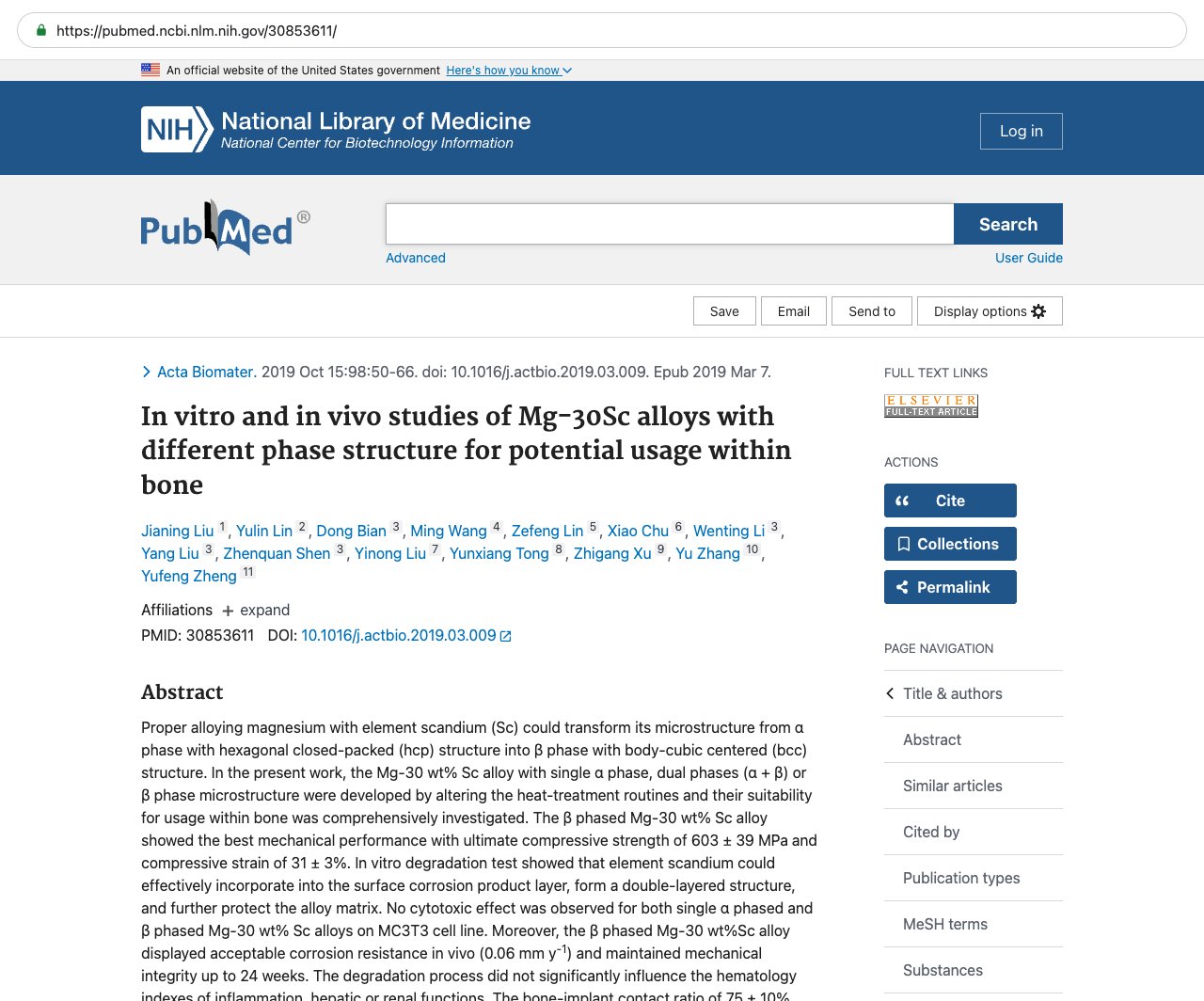
This page mirrors the published abstract (© the authors / publisher) for reference and citation. The canonical source is the PubMed record linked above. This is not medical advice.