2016 · Muramatsu — Hydrogen-Rich Water Ameliorates Bronchopulmonary Dysplasia (BPD) in Newborn Rats
Super-Abstract
Hydrogen-rich water given to pregnant and nursing rats reduced lung damage caused by a bacterial toxin in newborn animals. The H₂ treatment normalized abnormal alveolar enlargement, lowered oxidative and inflammatory markers, and preserved the expression of key lung-development genes. This is a preclinical animal study with no direct implications for human therapy. (Pediatric Pulmonology, 2016.)
Commentary
Bronchopulmonary dysplasia (BPD) is a serious lung disorder predominantly affecting preterm infants, driven by oxidative stress and inflammation that arrest normal alveolar development. Muramatsu et al. modeled BPD by injecting lipopolysaccharide (LPS) into amniotic fluid of pregnant rats; mothers drank hydrogen-rich water from early pregnancy onward. At postnatal days 7 and 14, pups whose mothers received H₂ water showed markedly less alveolar distension and lower levels of nitrotyrosine and 8-OHdG — two oxidative damage markers. Inflammatory cytokines TNFα and IL-6 were also suppressed. Additionally, gene expression of FGFR4, VEGFR2, and HO-1 — important for lung vascular and structural development — was better preserved in the H₂ group. An in-vitro arm tested 10 % H₂ gas on human lung adenocarcinoma cells (A549) and confirmed reduced reactive oxygen species production. The study is well-controlled for a rodent model, but the translation to human premature lung biology remains entirely open.
Key quotes
- „Hydrogen normalized LPS-induced abnormal enlargement of alveoli at P7 and P14.“ — primary structural finding in the rat BPD model
- „Inflammatory marker proteins of TNFα and IL-6 were increased by LPS treatment, and hydrogen suppressed them.“ — H₂ reduced the inflammatory response
- „Lack of any known adverse effects of hydrogen makes hydrogen a promising therapeutic modality for BPD.“ — authors' cautiously optimistic conclusion — in animals
Our assessment
This is a preclinical rat study — not a human trial. The findings are mechanistically interesting: H₂ appears to attenuate oxidative damage and preserve developmental gene programs in a neonatal lung-injury model. However, results in rodents cannot be directly transferred to premature human infants, whose lung physiology and BPD pathogenesis are more complex. The study uses a single model (LPS-induced BPD surrogate), and the H₂ was delivered via maternal drinking water — a translational route difficult to replicate clinically. No safety or dose-optimization data for neonatal humans exist. Bottom line: scientifically promising hypothesis-generating work; clinical relevance is entirely unproven.
Study design
- Type: animal study (in vivo, rat model of BPD) + in-vitro cell experiment · Model: Sprague-Dawley rat pups, LPS injected into amniotic fluid at E16.5; A549 human lung cells for in-vitro arm · H₂ delivery: hydrogen-rich water consumed by mothers from E9.5 through nursing; 10 % H₂ gas for cell experiment
- Result: H₂ normalized alveolar structure at P7 and P14; reduced nitrotyrosine, 8-OHdG, TNFα, IL-6; restored FGFR4, VEGFR2, HO-1 gene expression; reduced ROS in A549 cells — all in animal/cell systems only
Abstract
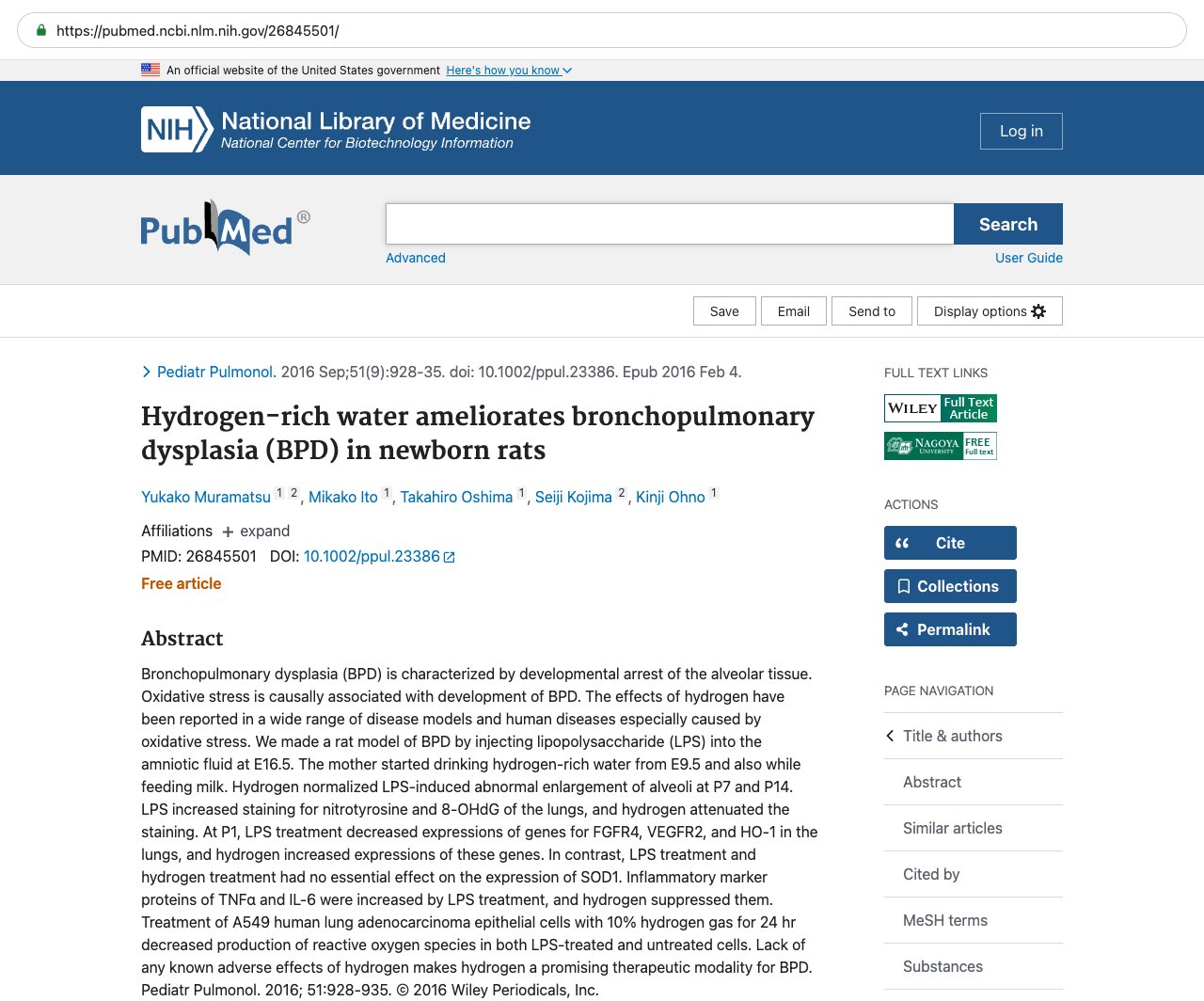
Bronchopulmonary dysplasia (BPD) is characterized by developmental arrest of the alveolar tissue. Oxidative stress is causally associated with development of BPD. The effects of hydrogen have been reported in a wide range of disease models and human diseases especially caused by oxidative stress. We made a rat model of BPD by injecting lipopolysaccharide (LPS) into the amniotic fluid at E16.5. The mother started drinking hydrogen-rich water from E9.5 and also while feeding milk. Hydrogen normalized LPS-induced abnormal enlargement of alveoli at P7 and P14. LPS increased staining for nitrotyrosine and 8-OHdG of the lungs, and hydrogen attenuated the staining. At P1, LPS treatment decreased expressions of genes for FGFR4, VEGFR2, and HO-1 in the lungs, and hydrogen increased expressions of these genes. In contrast, LPS treatment and hydrogen treatment had no essential effect on the expression of SOD1. Inflammatory marker proteins of TNFα and IL-6 were increased by LPS treatment, and hydrogen suppressed them. Treatment of A549 human lung adenocarcinoma epithelial cells with 10% hydrogen gas for 24 hr decreased production of reactive oxygen species in both LPS-treated and untreated cells. Lack of any known adverse effects of hydrogen makes hydrogen a promising therapeutic modality for BPD. Pediatr Pulmonol. 2016; 51:928-935. © 2016 Wiley Periodicals, Inc.
Source & links
Screenshot of the PubMed page
This page mirrors the published abstract (© the authors / publisher) for reference and citation. The canonical source is the PubMed record linked above. This is not medical advice.