2024 International Journal of Medical Sciences Pilot / Observational Human H₂ therapy Drinking (HRW)
2024 · Lu — Using oral molecular hydrogen supplements to combat microinflammation in humans: a pilot observational study
Super-Abstract
Solid oral hydrogen capsules lowered inflammation markers in chronically ill patients. In a pilot study (n = 30) over 4 weeks, the erythrocyte sedimentation rate (ESR) fell dose-dependently (high dose p = 0.016) and the inflammation score DAS28 fell significantly; CRP showed a decreasing trend. (Int. J. Medical Sciences, 2024.)
Commentary
Chronic, smoldering inflammation — so-called microinflammation — damages the body over time and underlies many widespread diseases. This pilot study tested a new delivery form: solid oral hydrogen capsules (OSHCs) that release hydrogen slowly over up to 24 hours, unlike H₂ water, which de-gasses quickly. 30 stable chronically ill patients were distributed across low, medium and high doses and treated for four weeks. The hard findings: the erythrocyte sedimentation rate fell markedly, with a clear dose effect — significantly in the high-dose group (p = 0.016), not in the low-dose group (p = 0.494). CRP showed a decreasing trend over four weeks, but narrowly missed significance (p = 0.077). The rheumatism activity score DAS28 fell significantly, and fatigue (BFI-T) and diabetes control (CSSD70) improved too. Honestly: it is a very small, open observational study with only 10 patients per group and no real placebo control — the authors themselves call for larger clinical studies. What is interesting above all is the concept of prolonged H₂ release.
Key quotes
- „The average ESR120 significantly decreased from the first week to the fourth week, with a noticeable dose effect (low-dose group, p = 0.494; high-dose group, p = 0.016).“ — ESR fell dose-dependently, significant only at high dose
- „Overall, the average CRP concentration showed a distinct decreasing trend after four weeks of OSHCs administration (w0 vs. w4, p = 0.077).“ — CRP trending downward, narrowly not significant
- „OSHCs supplementation may exert anti-inflammatory and antioxidant effects on individuals with chronic inflammation.“ — the authors' cautious conclusion
Our assessment
Relevant because an alternative H₂ delivery (solid capsules with delayed release) is tested here in humans — a concept beyond H₂ water and inhalation that is interesting for application development. The anti-inflammatory direction fits the selective antioxidant profile of H₂ well mechanistically (see Ohsawa 2007). Limitation, stated honestly: a very small sample (n = 30, 10 per dose group), a pilot/observational design without placebo blinding, a mixed patient cohort, and the most important inflammation marker CRP remained only a trend (p = 0.077). This is a promising signal, not proof of efficacy.
Study design
- Type: pilot/observational study (open, dose-staggered) · n: 30 (10 low / 10 medium / 10 high) · Duration: 4 weeks · H₂ delivery: oral solid hydrogen capsules (OSHCs), delayed H₂ release over 24 h
- Result metrics: ESR120 ↓ (high dose p = 0.016; low dose p = 0.494); CRP w0 vs. w4 p = 0.077 (trend); DAS28 significantly ↓; improvements in BFI-T and CSSD70
Abstract
Background: Persistent inflammation over time can cause gradual harm to the body. Molecular hydrogen has the potential to specifically counteract reactive oxygen species (ROS), reduce disease severity, and enhance overall health. Investigations of the anti-inflammatory and antioxidant properties of oral solid hydrogen capsules (OSHCs) are currently limited, prompting our examination of the beneficial effects of OSHCs. Subsequently, we conducted a clinical study to assess the impact of OSHCs supplementation on individuals with chronic inflammation. Materials and methods: Initially, we evaluated the oxidative reduction potential (ORP) properties of the OSHCs solution by comparing it to hydrogen-rich water (HRW) and calcium hydride (CaH2) treated water. In our outpatient department, stable patients with chronic illnesses who were treated with varying doses of OSHCs were randomized into low-, medium-, and high-dose groups for 4 weeks. Primary outcomes included changes in the serum erythrocyte sedimentation rate (ESR) and C-reactive protein (CRP) concentrations after four weeks of OSHCs consumption. Secondary outcomes included changes in the Brief Fatigue Inventory-Taiwan (BFI-T) fatigue scale, Control Status Scale for Diabetes (CSSD70) scores, and Disease Activity Score 28 (DAS28). Results: Compared to HRW and CaH2, OSHCs demonstrated a prolonged reduction in ORP for 60 minutes in vitro and enabled a regulated release of hydrogen over 24 hours. A total of 30 participants, with 10 in each dosage (low/medium/high) group, completed the study. The average ESR120 significantly decreased from the first week to the fourth week, with a noticeable dose effect (low-dose group, p = 0.494; high-dose group, p = 0.016). Overall, the average CRP concentration showed a distinct decreasing trend after four weeks of OSHCs administration (w0 vs. w4, p = 0.077). The average DAS28 score demonstrated a significant decrease following OSHCs treatment. Furthermore, there were improvements in the BFI-T and CSSD70 scores. Conclusion: OSHCs supplementation may exert anti-inflammatory and antioxidant effects on individuals with chronic inflammation. However, further clinical studies could be investigated to explore the potential therapeutic effects of OSHCs.
Source & links
Screenshot of the PubMed page
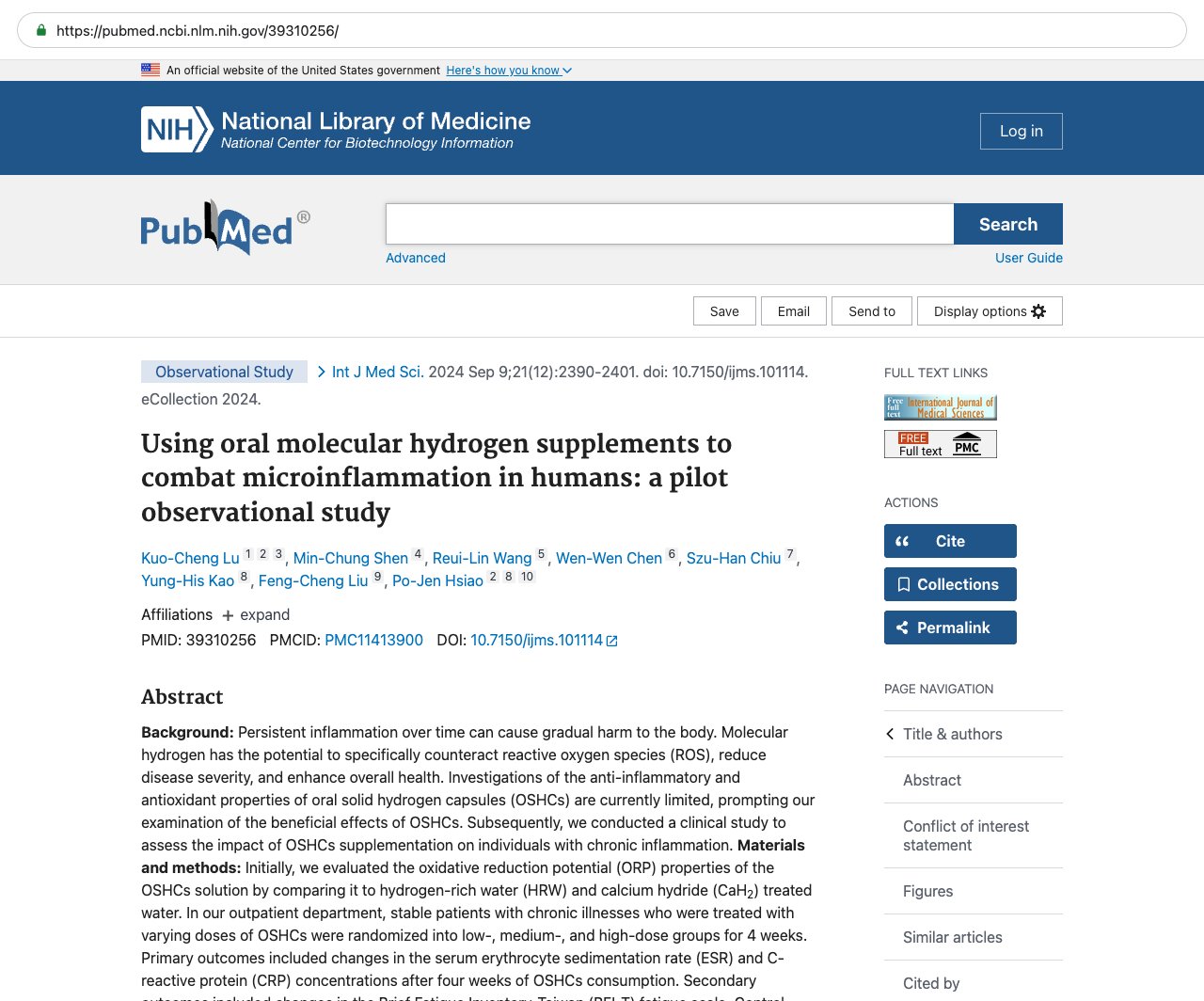
This page mirrors the published abstract (© the authors / publisher) for reference and citation. The canonical source is the PubMed record linked above. This is not medical advice.