2025 · Meng — Oral Administration of Hydrogen-rich Water: Biomedical Activities, Potential Mechanisms, and Clinical Applications
Super-Abstract
Hydrogen-rich water (HRW) reduces oxidative stress, modulates inflammation, regulates metabolism, and protects mitochondrial function — this comprehensive review surveys both laboratory evidence and clinical applications of orally consumed HRW. The authors map five proposed mechanisms of action and report its use in adjuvant treatment, disease prevention, and quality-of-life improvement across a range of conditions. (Current Pharmaceutical Design, 2025.)
Commentary
HRW is one of the most practical routes of H₂ delivery, requiring no special equipment beyond a dissolving tablet or a saturated bottle. Meng et al. provide a structured synthesis that is useful precisely because it spans basic science and clinical reports in one place. The five mechanistic hypotheses they present — direct hydroxyl-radical scavenging, the Fe-porphyrin biosensor model, effects on biological enzymes, lipoprotein regulation, and intestinal-barrier modulation — reflect ongoing scientific debate rather than settled consensus. Several of these remain speculative or supported only by cellular data. On the clinical side, the review covers metabolic, cardiovascular, and immune contexts but does not meta-analyse effect sizes, which limits the strength of conclusions. The authors are transparent that large-scale trials are still needed — an important caveat for readers looking for definitive guidance.
Key quotes
- „The biological effects of HRW include reducing oxidative stress, exerting antiinflammatory effects, regulating glucose and lipid metabolism, protecting mitochondrial function, and regulating apoptosis.“ — summary of the five documented biological activities of HRW
- „Clinically, HRW has been used for adjuvant treatment, disease prevention, and quality of life improvement.“ — three clinical roles of HRW as currently practised
- „In the future, more in-depth studies and large-scale clinical trials are needed.“ — the authors' own assessment of the evidence gap
Our assessment
This is a broad narrative review covering both preclinical mechanisms and clinical uses of HRW. It is a useful entry point into the literature but does not provide quantitative meta-analytical evidence. The mechanistic landscape it describes is genuine and growing, but several hypotheses are still being debated. Clinical findings are summarised without pooled effect sizes, so readers should treat clinical claims as directional rather than definitive. The honest conclusion by the authors — that large trials are still needed — is the appropriate take-away.
Study design
- Type: narrative review · n: n/a (literature analysis) · H₂ delivery: hydrogen-rich water (HRW), oral consumption
- Result: no new experimental data; synthesis of basic-science and clinical evidence for HRW; five mechanistic hypotheses catalogued; clinical applications in metabolic, cardiovascular, and immune domains summarised; authors conclude large-scale trials remain necessary
Abstract
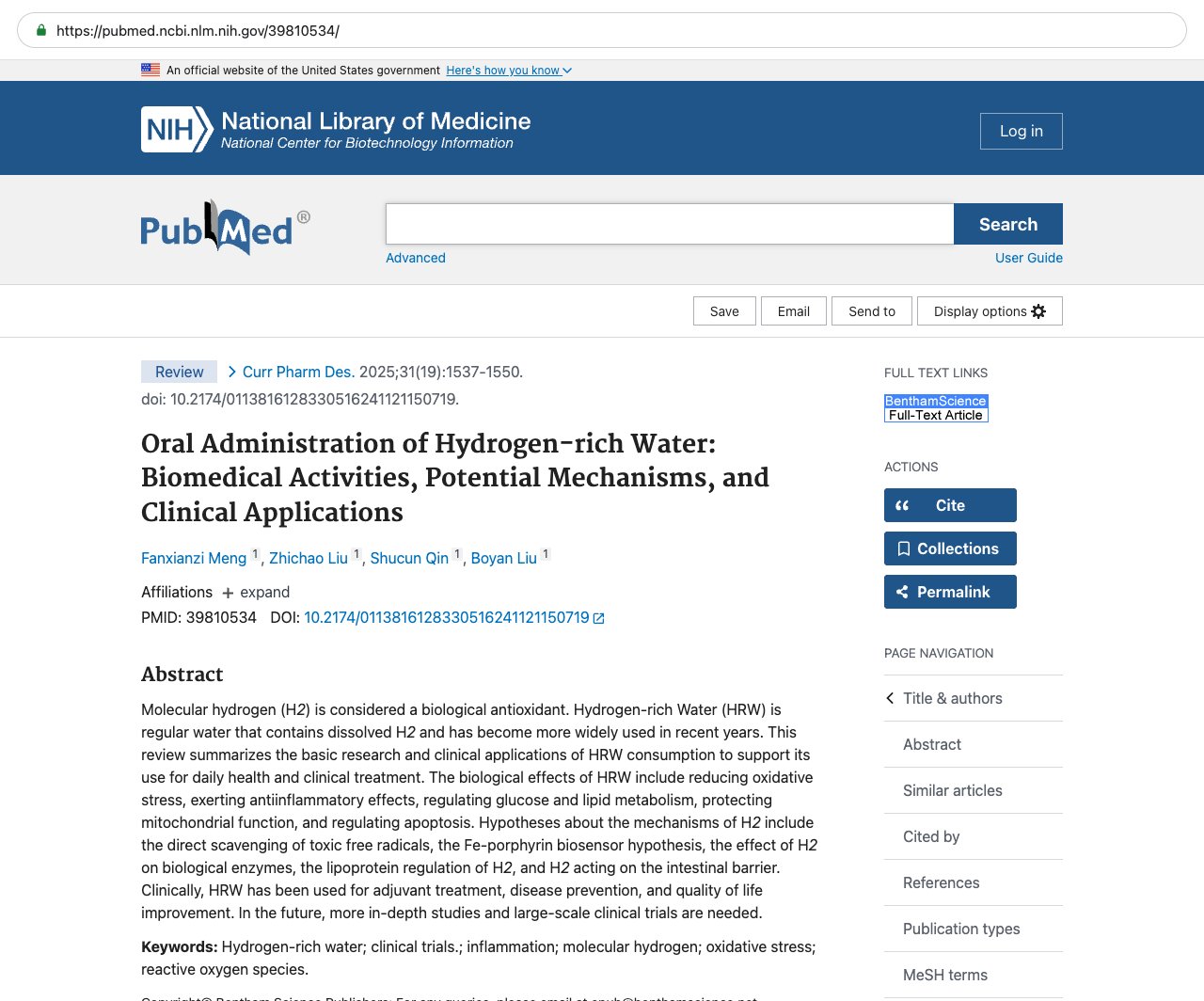
Molecular hydrogen (H2) is considered a biological antioxidant. Hydrogen-rich Water (HRW) is regular water that contains dissolved H2 and has become more widely used in recent years. This review summarizes the basic research and clinical applications of HRW consumption to support its use for daily health and clinical treatment. The biological effects of HRW include reducing oxidative stress, exerting antiinflammatory effects, regulating glucose and lipid metabolism, protecting mitochondrial function, and regulating apoptosis. Hypotheses about the mechanisms of H2 include the direct scavenging of toxic free radicals, the Fe-porphyrin biosensor hypothesis, the effect of H2 on biological enzymes, the lipoprotein regulation of H2, and H2 acting on the intestinal barrier. Clinically, HRW has been used for adjuvant treatment, disease prevention, and quality of life improvement. In the future, more in-depth studies and large-scale clinical trials are needed.
Source & links
Screenshot of the PubMed page
This page mirrors the published abstract (© the authors / publisher) for reference and citation. The canonical source is the PubMed record linked above. This is not medical advice.