2012 · Madsen et al. — Charge-site-dependent dissociation of hydrogen-rich radical peptide cations upon vacuum UV photoexcitation.
Super-Abstract
This study investigates a highly specialized mass spectrometry technique for analyzing peptide structure — specifically how „hydrogen-rich" radical peptide ions fragment when excited by vacuum ultraviolet light. The „hydrogen-rich" in the title refers to a chemical physics concept in peptide fragmentation analysis, not to molecular hydrogen (H₂) as a health-relevant gas. This paper is analytical chemistry research with no biological health application.
Commentary
This paper does not investigate molecular hydrogen (H₂) in a biological or medical context. The term „hydrogen-rich" here describes peptide radical cations that carry extra hydrogen atoms as part of an electron transfer chemistry process used in mass spectrometry. The study's actual focus is on understanding how peptide structure (specifically the location of arginine residues) affects photodissociation fragmentation patterns — a technique relevant to protein sequencing and phosphorylation site identification. While the paper is indexed in a hydrogen research database, it is not relevant to the field of H₂ biology, H₂ therapy, or any health application of molecular hydrogen. It should be considered an indexing artifact.
Key quotes
- „193 nm vacuum ultraviolet photodissociation (VUVPD) was used to investigate the fragmentation of hydrogen-rich radical peptide cations generated by electron transfer reactions.“ — the actual subject: mass spectrometry of peptide ions, not H₂ biology
- „The location of a basic Arg site influences photon-activated C(α)-C(O) bond cleavages of singly charged peptide radical cations.“ — the core finding: peptide structure determines fragmentation — unrelated to H₂ therapy
- „This hybrid ETD/VUVPD method was employed to identify phosphorylation sites of the kinase domain of human TRPM7/ChaK1.“ — the application: protein analysis via mass spectrometry
Our assessment
This paper is not relevant to H₂ biology or molecular hydrogen health research. The term „hydrogen-rich" in the title refers to a specific state of peptide radical cations in mass spectrometry, not to molecular hydrogen gas. No conclusions about H₂ therapy, antioxidant effects, or any health application can be drawn from this study. It appears to have been captured in H₂-related literature databases due to keyword overlap. Readers interested in H₂ research should consult studies that directly investigate molecular hydrogen as a bioactive gas.
Study design
- Type: analytical chemistry / mass spectrometry study · n: synthetic peptide samples · H₂ relevance: none — „hydrogen-rich" refers to peptide radical cation chemistry, not to H₂ gas
- Result: arginine position influences UV photodissociation fragmentation of peptide radical cations; hybrid ETD/VUVPD method used for phosphorylation site mapping
Abstract
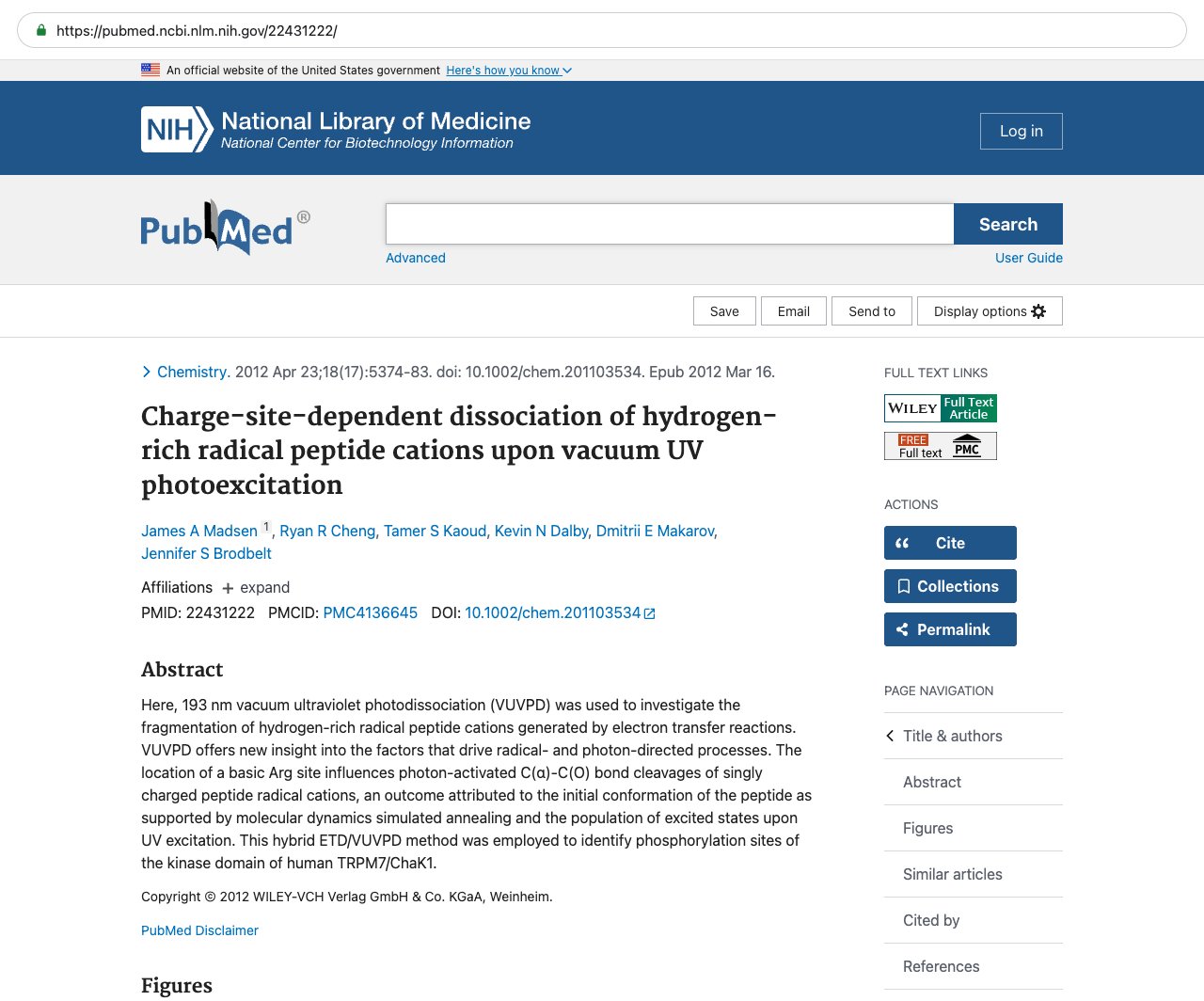
Here, 193 nm vacuum ultraviolet photodissociation (VUVPD) was used to investigate the fragmentation of hydrogen-rich radical peptide cations generated by electron transfer reactions. VUVPD offers new insight into the factors that drive radical- and photon-directed processes. The location of a basic Arg site influences photon-activated C(α)-C(O) bond cleavages of singly charged peptide radical cations, an outcome attributed to the initial conformation of the peptide as supported by molecular dynamics simulated annealing and the population of excited states upon UV excitation. This hybrid ETD/VUVPD method was employed to identify phosphorylation sites of the kinase domain of human TRPM7/ChaK1.
Source & links
Screenshot of the PubMed page
This page mirrors the published abstract (© the authors / publisher) for reference and citation. The canonical source is the PubMed record linked above. This is not medical advice.