2023 · Wang — pH-Responsive Delivery of H₂ through Ammonia Borane-Loaded Hollow Polydopamine for Intervertebral Disc Degeneration Therapy
Super-Abstract
A pH-responsive nanoparticle system (ammonia borane inside hollow polydopamine shells, AB@HPDA) releases H₂ in the acidic environment of a degenerated intervertebral disc, reducing oxidative stress and inflammation in both in-vitro and in-vivo (rat/rabbit) experiments. This is a preclinical proof-of-concept; human applications are a long way off.
Commentary
Intervertebral disc degeneration is a major cause of chronic back pain. The degenerated disc environment is characterised by acidosis, oxidative stress, and inflammation — which further degrade the extracellular matrix. This study exploits the acidity of the diseased disc as a trigger: ammonia borane (AB) reacts with water to release H₂, and this reaction is accelerated at lower pH. The hollow polydopamine shell protects AB until it reaches the acidic disc. In-vitro results confirm pH-controlled H₂ release and good biocompatibility below 500 µg/mL. The in-vivo data (X-ray, MRI, water content, histology) in a rat/rabbit disc degeneration model show significant protection compared with untreated controls. This is a sophisticated drug-delivery engineering study, and H₂ is the active therapeutic payload — but delivery is entirely via an injected nanomaterial, not via drinking water or inhalation.
Key quotes
- „AB@HPDAs can provide efficient hydrogen therapy with controlled H2 release in response to the acidic degenerated IVD microenvironment.“ — core design principle: the disc's own acidity triggers H₂ release
- „The metabolization of AB@HPDA in IVD was slow and lasted up to 11 days.“ — sustained H₂ release over nearly two weeks
- „HPDA and AB@HPDA significantly inhibited IDD, as tested by X-ray, MRI, disc water content, and histology (P < 0.05).“ — multi-method evidence of disc protection in the animal model
Our assessment
A preclinical proof-of-concept study combining materials engineering and H₂ therapy. The pH-triggered release is mechanistically elegant and the multi-modal outcome assessment (X-ray, MRI, histology) is a strength. Limitations: the animal disc degeneration model does not fully replicate human disc disease; the nanomaterial requires intradiscal injection; long-term safety, toxicity, and degradation products of the AB@HPDA system in humans are unknown. Not applicable to any consumer H₂ use — this is a targeted injectable nanomedicine concept.
Study design
- Type: in-vitro + animal preclinical study · Model: intervertebral disc degeneration (rat/rabbit) · H₂ delivery: intradiscal injection of AB@HPDA nanoparticles; H₂ released by pH-responsive ammonia borane hydrolysis
- Result: pH-controlled H₂ release confirmed in vitro; biocompatible below 500 µg/mL; in-vivo: significant preservation of disc structure, water content, and ECM (p < 0.05); inhibited oxidative stress and inflammation in degenerated disc
Abstract
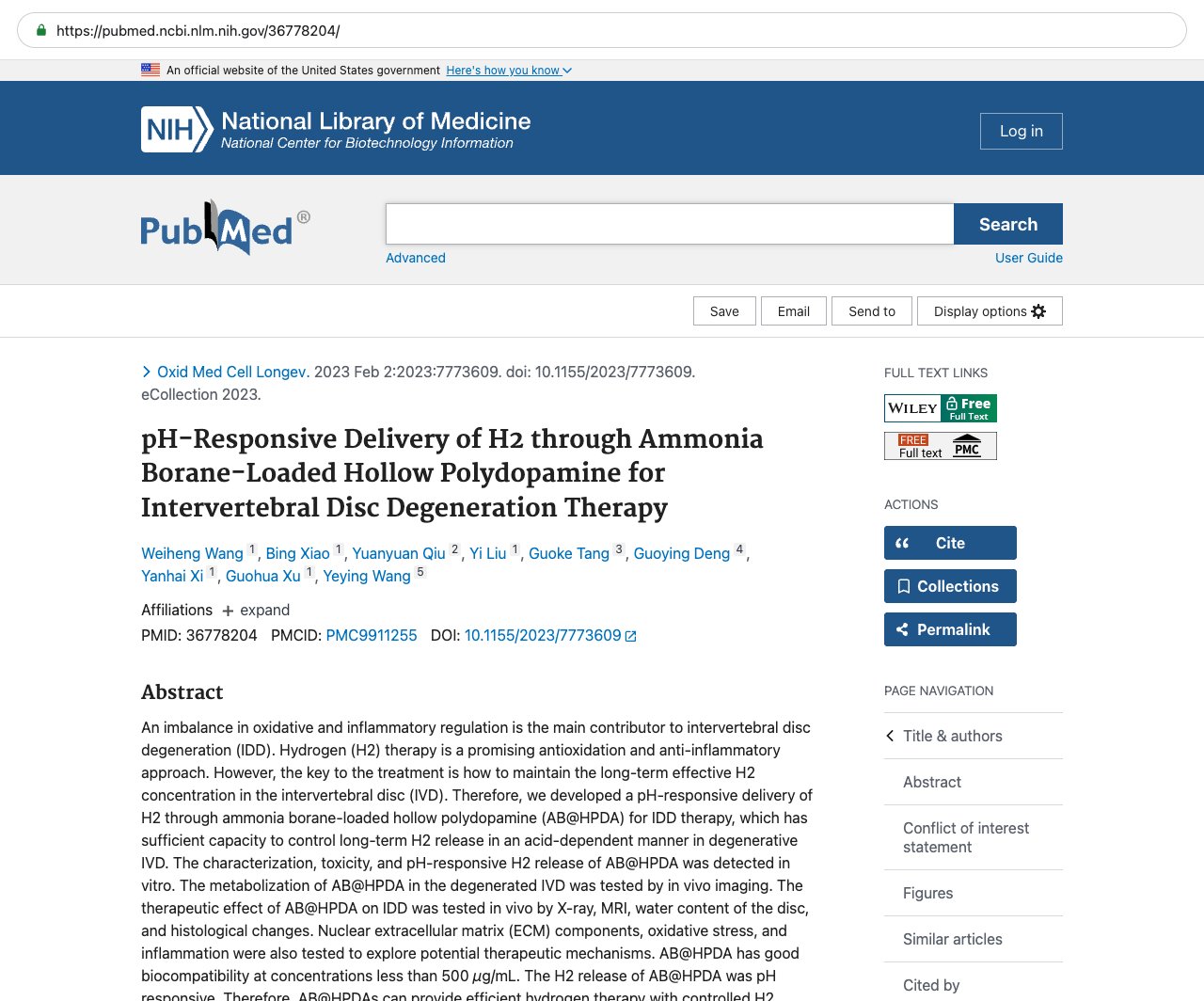
An imbalance in oxidative and inflammatory regulation is the main contributor to intervertebral disc degeneration (IDD). Hydrogen (H2) therapy is a promising antioxidation and anti-inflammatory approach. However, the key to the treatment is how to maintain the long-term effective H2 concentration in the intervertebral disc (IVD). Therefore, we developed a pH-responsive delivery of H2 through ammonia borane-loaded hollow polydopamine (AB@HPDA) for IDD therapy, which has sufficient capacity to control long-term H2 release in an acid-dependent manner in degenerative IVD. The characterization, toxicity, and pH-responsive H2 release of AB@HPDA was detected in vitro. The metabolization of AB@HPDA in the degenerated IVD was tested by in vivo imaging. The therapeutic effect of AB@HPDA on IDD was tested in vivo by X-ray, MRI, water content of the disc, and histological changes. Nuclear extracellular matrix (ECM) components, oxidative stress, and inflammation were also tested to explore potential therapeutic mechanisms. AB@HPDA has good biocompatibility at concentrations less than 500 μg/mL. The H2 release of AB@HPDA was pH responsive. Therefore, AB@HPDAs can provide efficient hydrogen therapy with controlled H2 release in response to the acidic degenerated IVD microenvironment. The metabolization of AB@HPDA in IVD was slow and lasted up to 11 days. HPDA and AB@HPDA significantly inhibited IDD, as tested by X-ray, MRI, disc water content, and histology (P < 0.05). pH-responsive H2 delivery through AB@HPDAs has the potential to efficiently treat IDD by inhibiting ECM degradation and rebalancing oxidative stress and inflammation in degenerative IVDs.
Source & links
Screenshot of the PubMed page
This page mirrors the published abstract (© the authors / publisher) for reference and citation. The canonical source is the PubMed record linked above. This is not medical advice.