2021 · Magliocca et al. — Inhaled gases as novel neuroprotective therapies in the postcardiac arrest period.
Super-Abstract
After cardiac arrest, inhaled gases such as xenon, argon, nitric oxide, and molecular hydrogen (H₂) have shown neuroprotective properties in experimental models. This review summarises the current evidence from preclinical and early clinical studies and points to the need for large randomised trials before any clinical recommendation can be made. (Current Opinion in Critical Care, 2021.)
Commentary
This review from 2021 covers the landscape of inhaled neuroprotective gases evaluated after cardiac arrest. The authors highlight that both xenon and H₂ have reached phase 1 safety trials in humans, and that xenon demonstrated neuroprotective signals in a phase 2 trial (preserved white matter integrity by diffusion tensor MRI). H₂ data at that point remained largely preclinical. The review is honest about the evidence gap: experimental promise does not yet translate into proven clinical benefit. The narrative is balanced — it acknowledges the well-tolerated safety profile in preliminary trials while clearly stating that phase 2 and 3 data are lacking for most of these agents.
Key quotes
- „Inhaled gases, as Xe, Ar, NO, and H2 have consistently shown neuroprotective effects in experimental studies.“ — the shared preclinical finding across four different inhaled gases
- „Safety of both Xe and H2 after cardiac arrest has been reported in phase 1 clinical trials.“ — the limited but encouraging human safety data for H₂
- „Results from phase 2 and 3 clinical trials are needed to assess their efficacy in the treatment of postcardiac arrest brain injury.“ — the authors' honest conclusion: promising but unproven in humans
Our assessment
This is a narrative review — no new experimental data, no meta-analytic pooling. Its value lies in synthesising the state of the field in 2021. For H₂ specifically, the evidence base at the time of writing was almost entirely preclinical; the review correctly flags this. Honest limitation: review articles from authors embedded in a research area can lean optimistic; critical appraisal of individual studies is not the primary purpose here. Clinical translation for H₂ in post-arrest neuroprotection remains an open research question.
Study design
- Type: narrative review · n: n/a (literature synthesis) · H₂ delivery: inhalation (experimental settings reviewed)
- Result: preclinical neuroprotective evidence for H₂ confirmed across models; phase 1 safety data for H₂ exist; phase 2/3 efficacy data in humans still absent at time of publication
Abstract
PURPOSE OF REVIEW: The purpose of this review is to summarize recent advances about inhaled gases as novel neuroprotective agents in the postcardiac arrest period. RECENT FINDINGS: Inhaled gases, as nitric oxide (NO) and molecular hydrogen (H2), and noble gases as xenon (Xe) and argon (Ar) have shown neuroprotective properties after resuscitation. In experimental settings, the protective effect of these gases has been demonstrated in both in-vitro studies and animal models of cardiac arrest. They attenuate neuronal degeneration and improve neurological function after resuscitation acting on different pathophysiological pathways. Safety of both Xe and H2 after cardiac arrest has been reported in phase 1 clinical trials. A randomized phase 2 clinical trial showed the neuroprotective effects of Xe, combined with targeted temperature management. Xe inhalation for 24 h after resuscitation preserves white matter integrity as measured by fractional anisotropy of diffusion tensor MRI. SUMMARY: Inhaled gases, as Xe, Ar, NO, and H2 have consistently shown neuroprotective effects in experimental studies. Ventilation with these gases appears to be well tolerated in pigs and in preliminary human trials. Results from phase 2 and 3 clinical trials are needed to assess their efficacy in the treatment of postcardiac arrest brain injury.
Source & links
Screenshot of the PubMed page
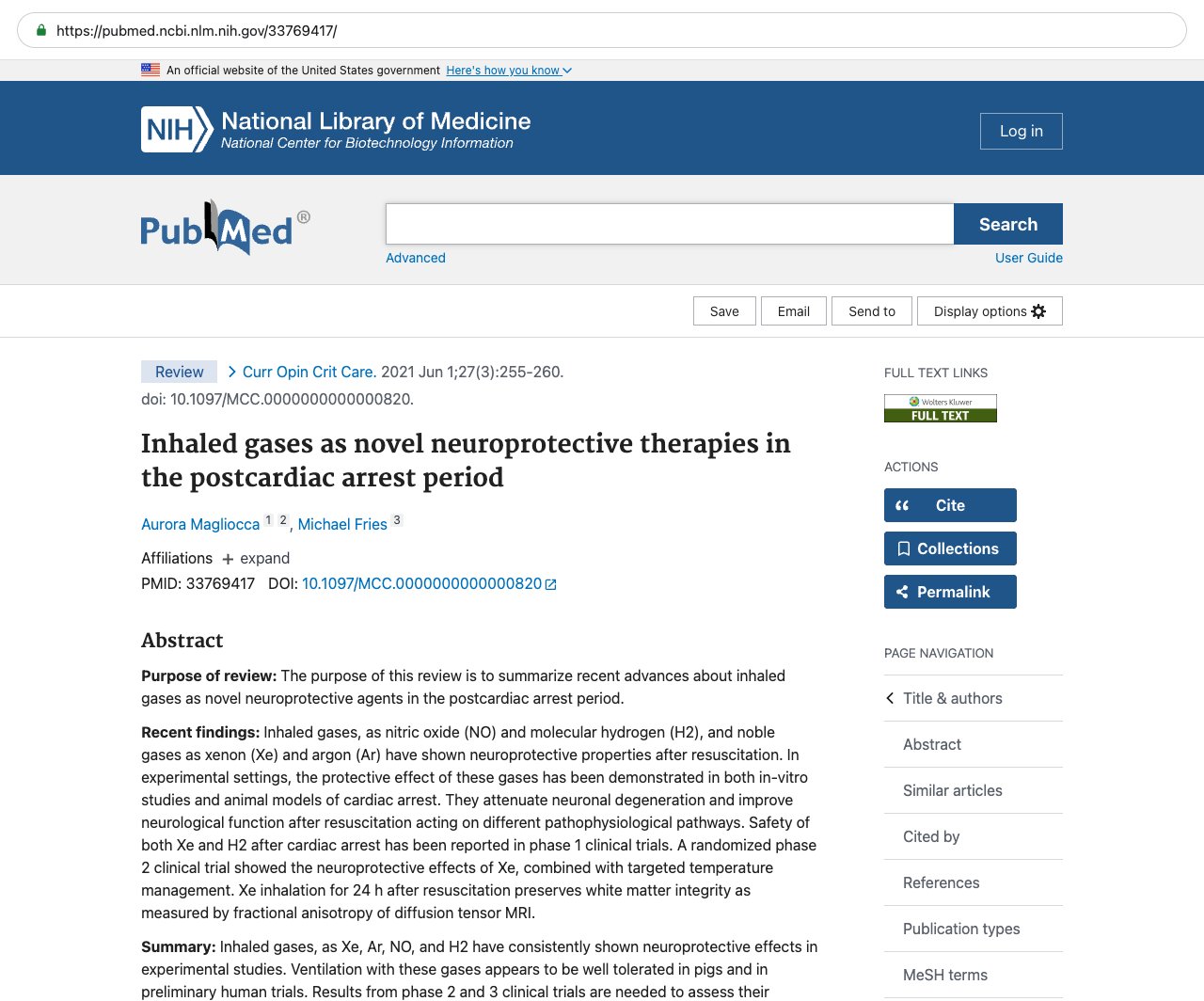
This page mirrors the published abstract (© the authors / publisher) for reference and citation. The canonical source is the PubMed record linked above. This is not medical advice.