2016 Circulation journal : official journal of the Japanese Circulation Society Pilot / Observational Human H₂ therapy Inhalation
2016 · Tamura et al. — Feasibility and Safety of Hydrogen Gas Inhalation for Post-Cardiac Arrest Syndrome — First-in-Human Pilot Study.
Super-Abstract
In this first-in-human pilot study, 5 out-of-hospital cardiac arrest patients who achieved spontaneous circulation received H₂ gas inhalation combined with standard temperature management — no adverse effects were observed, and 4 of 5 patients survived 90 days with favorable neurological outcomes. This is an exploratory safety study, not a controlled efficacy trial. (Circulation Journal, 2016.)
Commentary
Post-cardiac arrest syndrome (PCAS) causes devastating brain and heart damage through ischemia-reperfusion injury — the same oxidative mechanism that H₂ is most studied for. Animal data had shown H₂ inhalation reduces cerebral and cardiac dysfunction after cardiac arrest. This tiny pilot (n=5) is the first attempt in humans, conducted under strict real-world ICU conditions. Out of 107 cardiac arrest patients in the study period, only 21 achieved return of spontaneous circulation (ROSC), and only 5 met all criteria after exclusions — showing how demanding this patient population is. The 4/5 survival rate with good neurological function is notable, but with n=5 and no control group, no causal conclusions can be drawn. The study's contribution is establishing feasibility and safety for a subsequent RCT.
Key quotes
- „No undesirable effects attributable to HI were observed and 4 patients survived 90 days with a favorable neurological outcome.“ — safety and preliminary outcome: no harm, high survival in this tiny cohort
- „Hydrogen gas inhalation (HI) ameliorates cerebral and cardiac dysfunction in animal models of post-cardiac arrest syndrome (PCAS).“ — mechanistic rationale: translating animal evidence into first human test
- „HI in combination with TTM is a feasible therapy for patients with PCAS.“ — conclusion: feasibility established — efficacy still to be tested
Our assessment
A critical safety and feasibility study in one of the most challenging emergency medicine indications. With n=5 and no control arm, no efficacy conclusions are possible — but the absence of safety signals is meaningful given the severity of the patient population and the novelty of the intervention. Limitations: extremely small n; no randomization; heavy selection bias from 107 → 21 → 5; survival outcomes in PCAS are inherently variable. The study correctly frames itself as a first step toward a powered RCT.
Study design
- Type: First-in-human uncontrolled pilot study · n: 5 (from 107 out-of-hospital cardiac arrest patients; 21 achieved ROSC; 5 met inclusion criteria) · H₂ delivery: H₂ gas inhalation combined with target temperature management (TTM)
- Setting: ICU post-cardiac arrest, January 2014 – January 2015
- Result: No adverse effects attributable to H₂ inhalation; 4/5 patients survived 90 days with favorable neurological outcome; feasibility confirmed
Abstract
BACKGROUND: Hydrogen gas inhalation (HI) ameliorates cerebral and cardiac dysfunction in animal models of post-cardiac arrest syndrome (PCAS). HI for human patients with PCAS has never been studied. METHODS AND RESULTS: Between January 2014 and January 2015, 21 of 107 patients with out-of-hospital cardiac arrest achieved spontaneous return of circulation. After excluding 16 patients with specific criteria, 5 patients underwent HI together with target temperature management (TTM). No undesirable effects attributable to HI were observed and 4 patients survived 90 days with a favorable neurological outcome. CONCLUSIONS: HI in combination with TTM is a feasible therapy for patients with PCAS. (Circ J 2016; 80: 1870-1873).
Source & links
Screenshot of the PubMed page
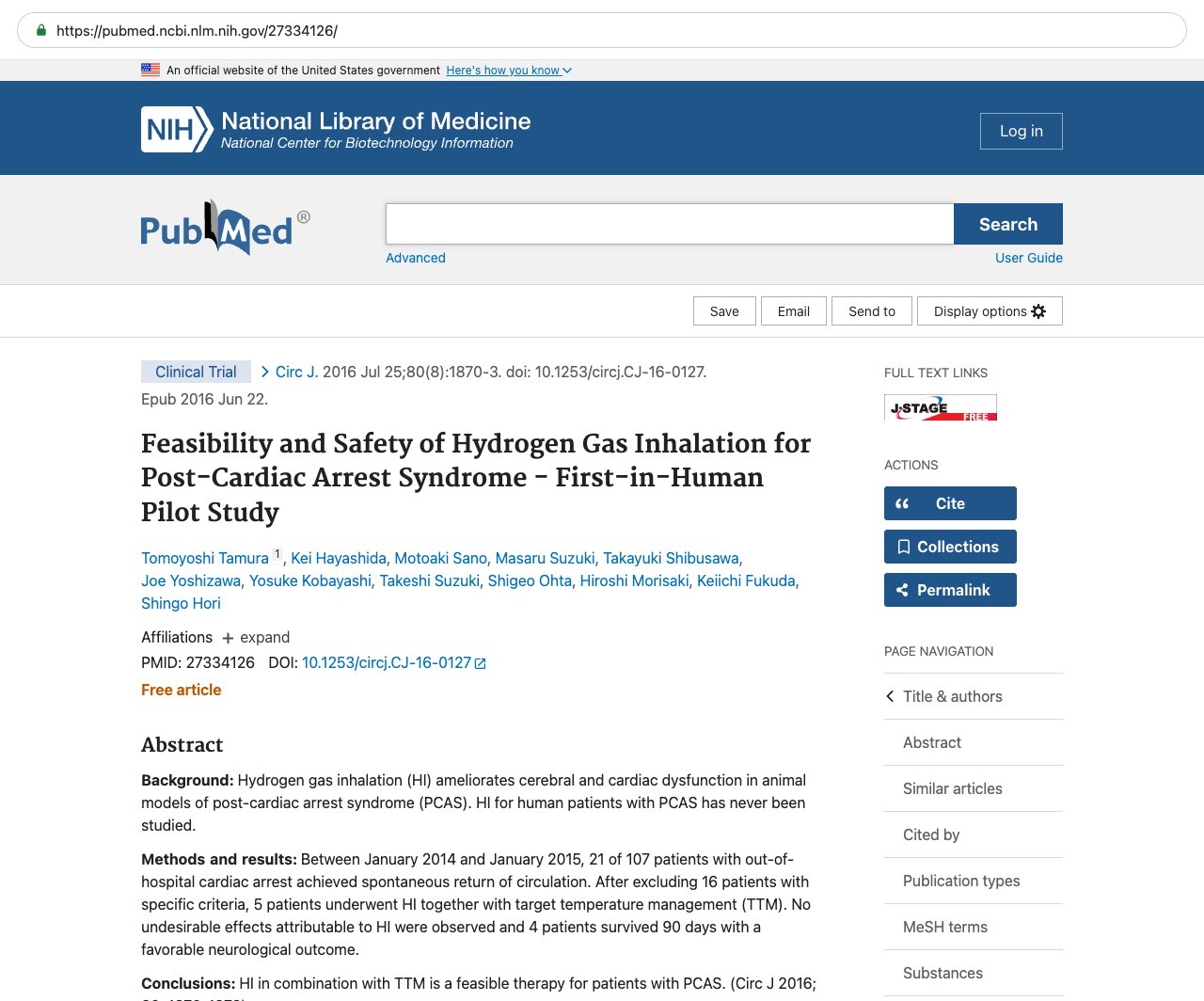
This page mirrors the published abstract (© the authors / publisher) for reference and citation. The canonical source is the PubMed record linked above. This is not medical advice.