2003 · Maier — Availability and use of molecular hydrogen as an energy substrate for Helicobacter species
Super-Abstract
This review summarises evidence that the gastric pathogen Helicobacter pylori and the liver pathogen H. hepaticus can use molecular hydrogen (H₂) — produced by gut fermentation — as a respiratory energy source, and that this H₂ utilisation substantially enhances their ability to colonise the stomach. This is a microbiology literature review about bacterial energy metabolism, not a study of H₂ as a health supplement.
Commentary
Maier's 2003 review synthesises primary research on how two Helicobacter species exploit gut-produced H₂ for energy. In the large intestine, sugar fermentation by the microbiome generates H₂ gas. H. pylori (stomach pathogen) and H. hepaticus (liver pathogen) each possess a respiratory hydrogenase enzyme that oxidises H₂ as an electron donor, coupled to an energy-yielding respiratory chain. The review discusses: the biochemistry of these hydrogenase enzymes, measurements of H₂ levels in colonised tissues, and the demonstration (from mutant studies) that H₂ utilisation markedly increases H. pylori's colonisation efficiency. The central message is that endogenous gut H₂ is a virulence-enabling fuel for these pathogens — the bacteria benefit from H₂, not the host. This is the opposite context from therapeutic H₂ supplementation, and no inference about beneficial effects of exogenous H₂ for humans can be drawn from this review.
Key quotes
- „The amount of the gas within tissues colonized by these pathogens is ample, and use of H2 significantly increases the stomach colonization ability of H. pylori.“ — H₂ in colonised tissues is sufficient to fuel bacterial growth; H₂ use boosts H. pylori colonisation — not a benefit for the host
- „The gastric pathogen Helicobacter pylori and the liver pathogen Helicobacter hepaticus have the capacity to use molecular hydrogen as a respiratory substrate.“ — the two pathogens covered in this review both possess H₂-utilising hydrogenases
- „Molecular hydrogen is produced in the large intestine of animals due to the fermentation reactions of sugar catabolism.“ — endogenous source of H₂ that pathogens exploit
Our assessment
A microbiology review documenting that gut-produced H₂ fuels Helicobacter virulence — a context where H₂ benefits pathogens, not the human host. This review provides no evidence for or against beneficial effects of exogenous H₂ supplementation in humans. It is a literature synthesis, not a new experiment. The described mechanism — H₂ as bacterial energy substrate — is well-documented but biologically distinct from the antioxidant/signalling mechanisms proposed in H₂ health research.
Study design
- Type: narrative review · Domain: microbiology / infectious disease · H₂ context: endogenous gut fermentation H₂ as bacterial energy substrate (not exogenous supplementation)
- Scope: H. pylori and H. hepaticus hydrogenase biochemistry; H₂ levels in colonised tissues; colonisation efficiency studies with H₂-utilisation mutants
Abstract
Molecular hydrogen is produced in the large intestine of animals due to the fermentation reactions of sugar catabolism. The gastric pathogen Helicobacter pylori and the liver pathogen Helicobacter hepaticus have the capacity to use molecular hydrogen as a respiratory substrate. The amount of the gas within tissues colonized by these pathogens is ample, and use of H2 significantly increases the stomach colonization ability of H. pylori.
Source & links
Screenshot of the PubMed page
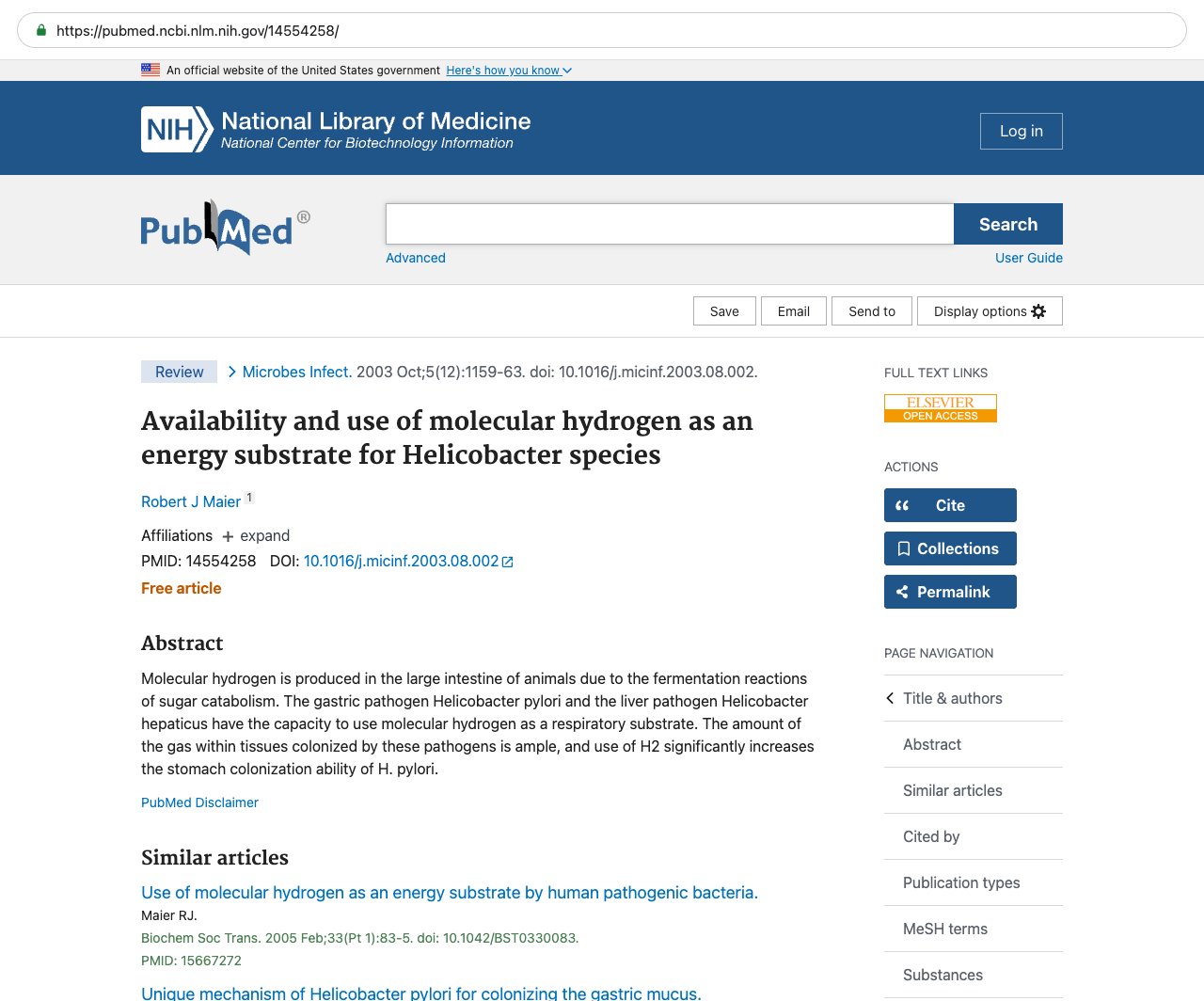
This page mirrors the published abstract (© the authors / publisher) for reference and citation. The canonical source is the PubMed record linked above. This is not medical advice.