2025 · Shogenova — Efficiency and Safety of the Combined Use of Thermal Heliox, Nitric Oxide and Molecular Hydrogen in COPD Exacerbation with Respiratory Failure and Pulmonary Hypertension in the Post-COVID Period
Super-Abstract
In patients hospitalized with severe COPD exacerbation after COVID-19, combining three medical gases — thermal heliox, nitric oxide, and molecular hydrogen (H₂) — alongside standard therapy produced better improvements in breathing, gas exchange, and exercise tolerance than any single gas used alone. The triple combination was safe and reduced markers of vascular dysfunction and metabolic disturbance. This is one of few clinical studies testing H₂ inhalation as part of intensive respiratory care. (Terapevticheskii arkhiv, 2025.)
Commentary
This randomized, controlled, parallel-group study from Russia enrolled 100 post-COVID COPD patients with serious respiratory failure and secondary pulmonary arterial hypertension — a clinically severe and difficult-to-treat population. Five groups received various combinations of thermal heliox (t-He/O₂), nitric oxide (NO), and H₂ on top of standard care including non-invasive ventilation. The triple combination group showed the best outcomes across multiple endpoints: gas exchange, acid-base balance, hemodynamics, and physical tolerance. However, the study does not report specific statistical figures in the abstract, making precise effect size assessment difficult. The journal (Terapevticheskii arkhiv) is a peer-reviewed Russian internal medicine journal. The evidence level (ev 3) reflects the multi-arm randomized design without evident blinding for the inhalation conditions.
Key quotes
- „The combination of t-He/O2, NO and H2 with simultaneous pathogenetic therapy and NIV in patients with exacerbation of COPD complicated by hypoxemic, hypercapnic RF and secondary PAH in the post-COVID period is safe and more effective compared to groups receiving each medical gas separately.“ — the primary conclusion: triple-gas combination is safer and more effective than individual components
- „Complex therapy improves the clinical condition of patients, reduces signs of hypoxemia and hypercapnia, vascular endothelial dysfunction, metabolic disorders and increases tolerance to physical activity.“ — the range of endpoints that improved in the combined group
- „A positive effect of the complex use of medical gases on the clinical condition of patients, gas exchange parameters in the lungs, metabolism, hemodynamic parameters and exercise tolerance was found in comparison with these parameters in patients who received medical gases separately.“ — summary of the direction of benefit across all measured domains
Our assessment
A meaningful clinical study testing H₂ as one component of multi-gas inhalation therapy in a challenging post-COVID respiratory population. The triple combination benefit over mono-gas comparators is noteworthy, though the study cannot isolate H₂'s individual contribution since no group received only H₂ vs. placebo gas. Key limitations: no blinding described (gases differ in physical properties), no explicit statistical values in abstract, single-center Russian study, small group sizes (n=18–22 per arm). The safety finding — no adverse events — is clinically relevant given that H₂ inhalation in ventilated patients is a safety-relevant question. The study supports feasibility and directional benefit rather than providing high-confidence effect estimates.
Study design
- Type: randomized, comparative, controlled, parallel study · n: 100 (52 men, 48 women; 5 groups, n=18–22 each) · H₂ delivery: inhalation (H₂ gas, sequential with other gases)
- Comparators: t-He/O₂ + NO + H₂ (main); t-He/O₂ + NO; t-He/O₂ + H₂; NO + H₂; standard NIV + O₂ (control)
- Result: triple combination (t-He/O₂ + NO + H₂) produced the greatest improvement in gas exchange, hemodynamics, and exercise tolerance; all gas groups outperformed control; no adverse effects reported
Abstract
AIM: To study the efficacy and safety of the combined use of thermal heliox (t-He/O2), nitric oxide (NO) and molecular hydrogen (H2) in patients with exacerbation of chronic obstructive pulmonary disease (COPD) complicated by hypoxemic, hypercapnic respiratory failure (RF) and secondary pulmonary arterial hypertension (PAH) in the post-COVID period. MATERIALS AND METHODS: The randomized, comparative, controlled, parallel study included patients (n=100, 52 men and 48 women) with exacerbation of COPD levels of evidence C and D (GOLD 2021-2023) with hypoxemic, hypercapnic respiratory failure and secondary PAH, who had pneumonia caused by SARS-CoV-2 before hospitalization. Patients with similar demographic, clinical, and functional parameters, who received non-invasive ventilation (NIV) and oxygen (O2) along with standard drug therapy, were divided into 5 groups: Group 1 (main): (n=22: 12 men, 10 women, who received t-He/O2, NO, and H2 sequentially); Group 2 (n=20: 10 men, 10 women, who received t-He/O2 and NO); Group 3 (n=20: 11 men, 9 women, who received t-He/O2 and H2); Group 4 (n=18: 10 men, 8 women, who received NO and H2); Group 5 (control) (n=20: 9 men, 11 women). The dynamics of the clinical condition of patients, gas exchange in the lungs, acid-base balance, left-to-right discharge fraction, hemodynamic parameters, and exercise tolerance were assessed. RESULTS: A positive effect of the complex use of medical gases on the clinical condition of patients, gas exchange parameters in the lungs, metabolism, hemodynamic parameters and exercise tolerance was found in comparison with these parameters in patients who received medical gases separately and with the control group. CONCLUSION: The combination of t-He/O2, NO and H2 with simultaneous pathogenetic therapy and NIV in patients with exacerbation of COPD complicated by hypoxemic, hypercapnic RF and secondary PAH in the post-COVID period is safe and more effective compared to groups receiving each medical gas separately. Complex therapy improves the clinical condition of patients, reduces signs of hypoxemia and hypercapnia, vascular endothelial dysfunction, metabolic disorders and increases tolerance to physical activity by normalizing gas exchange in the lungs, increasing oxygen delivery to tissues, reducing the shunt fraction, and restoring metabolism.
Source & links
Screenshot of the PubMed page
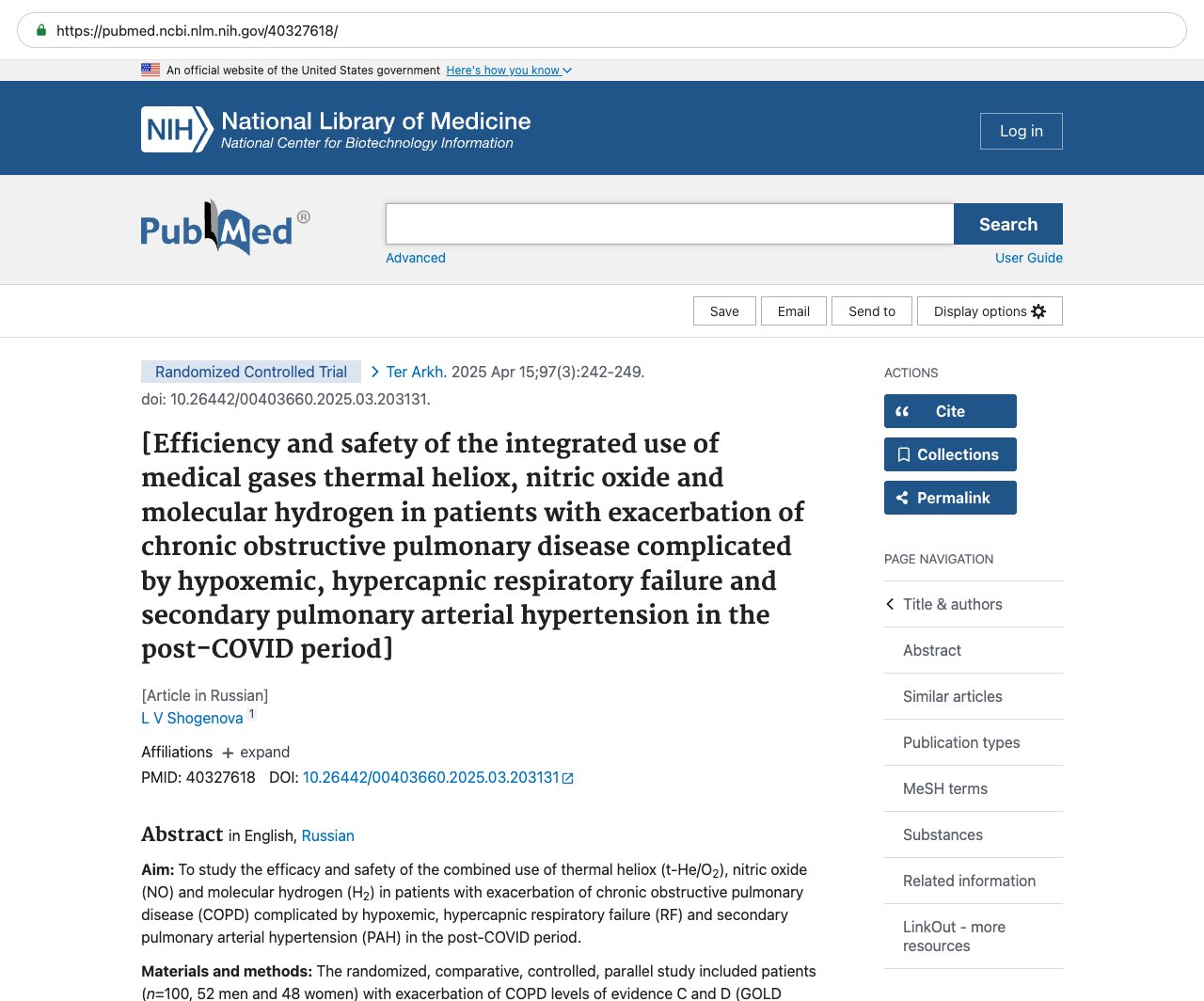
This page mirrors the published abstract (© the authors / publisher) for reference and citation. The canonical source is the PubMed record linked above. This is not medical advice.