2021 · V — Investigations of Dianhydro-D-glucitol adsorbed on AuNPs surface: In silico and in vitro approach based on anticancer activity studies against A549 lung cancer cell lines
Super-Abstract
This in-vitro and computational chemistry study examined how attaching a lung-cancer drug (Dianhydro-D-glucitol) to gold nanoparticles affects its anticancer behaviour against A549 lung cancer cells. Molecular hydrogen enters the picture only as a structural feature (intramolecular hydrogen bonds) studied via density-functional theory — this is not a study of molecular H₂ as a biological or therapeutic agent.
Commentary
The study belongs to the field of nano-drug delivery and computational chemistry. Its main topics are: surface-enhanced Raman scattering (SERS) characterisation, density functional theory (DFT) modelling of hydrogen-bond geometry, molecular docking of a chemotherapy agent with cancer proteins, and cytotoxicity (MTT assay) of drug-nanoparticle conjugates against A549 lung cancer cells. The term „hydrogen“ in this context refers exclusively to intramolecular hydrogen bonds within the drug molecule — a routine chemical concept — not to dissolved molecular hydrogen (H₂) as used in hydrogen medicine. This paper was likely included in a database query on H₂ due to keyword overlap; it does not contribute evidence for or against therapeutic H₂ use.
Key quotes
- „The stabilized geometry, inter- and intra-molecular hydrogen bond, and harmonic vibrational wavenumbers of DIS and DIS adsorbed on AuNPs (DISA) surface have been investigated with the help of the density functional theory (DFT) method.“ — hydrogen here means chemical hydrogen bonds in the drug structure — not biological molecular H₂
- „This study enlightens the potential of SERS agents for targeted drug delivery and photothermal.“ — the actual conclusion: gold nanoparticles as drug-delivery and imaging agents
- „The in vitro cytotoxic effects of DPH and DPHA molecules on lung cancer cell lines were analyzed using the MTT assay and the SERS method.“ — cytotoxicity endpoint — chemotherapy compound, not H₂
Our assessment
This study is not about molecular hydrogen (H₂) as a therapeutic agent. It is a computational + in-vitro chemistry paper on gold-nanoparticle drug delivery for a specific chemotherapy compound. The word „hydrogen“ appears only in the context of intramolecular hydrogen bonds — a standard chemical feature of any organic molecule. No evidence is provided for or against H₂ therapy. The study's relevance to hydrogen medicine is zero; its inclusion appears to be a database indexing artefact.
Study design
- Type: computational (DFT/NBO/molecular docking) + in-vitro (preclinical) · Model: A549 lung cancer cells · H₂ relevance: none — hydrogen refers to intramolecular hydrogen bonds, not molecular H₂
- Agent studied: Dianhydro-D-glucitol (DIS) adsorbed on gold nanoparticles (AuNPs) — a chemotherapy/drug-delivery application
- Key finding: DIS+AuNP conjugate showed cytotoxic activity against A549 cells (MTT assay); SERS characterisation confirmed adsorption; DFT modelling described electronic properties — no H₂ biology involved
Abstract
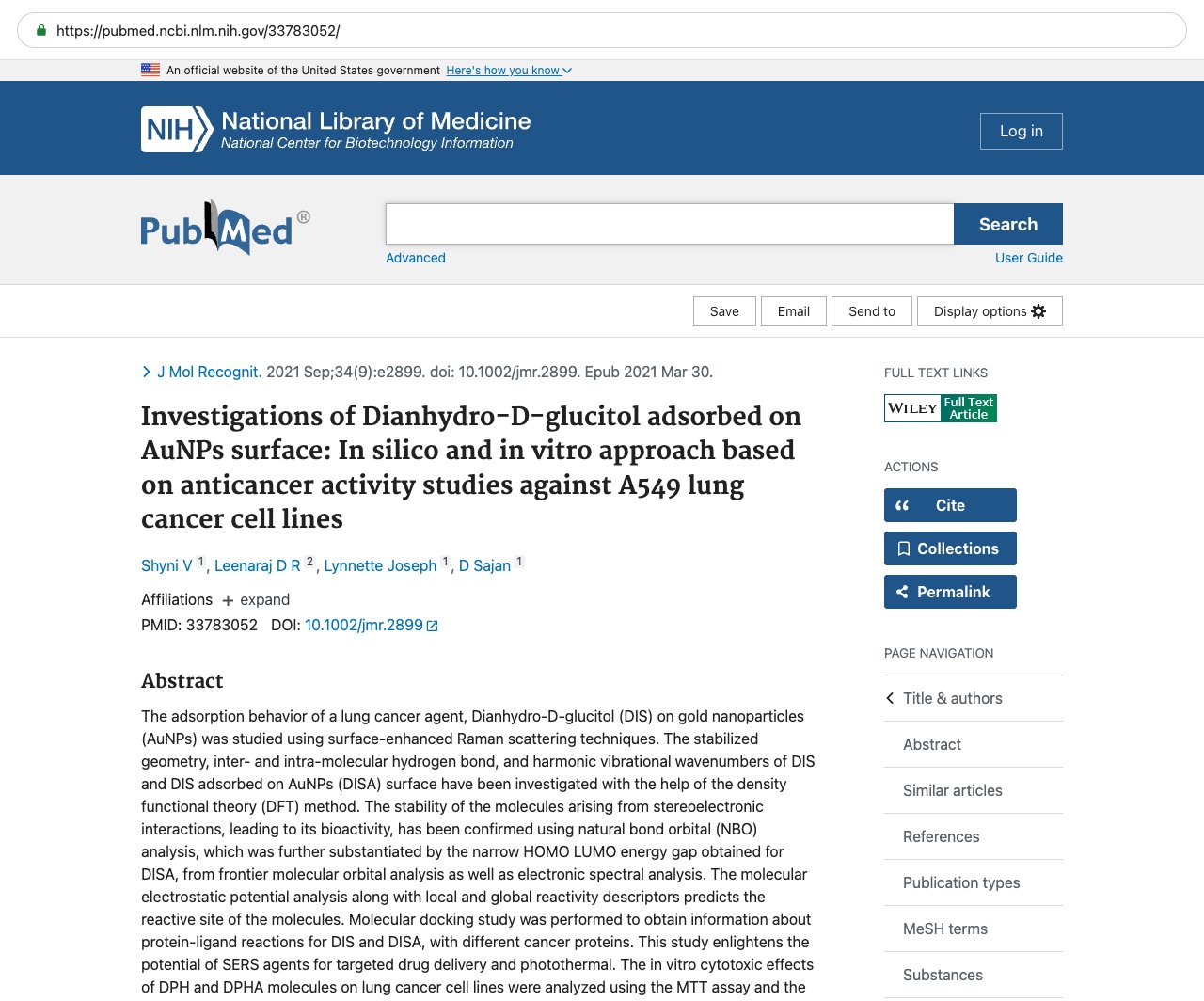
The adsorption behavior of a lung cancer agent, Dianhydro-D-glucitol (DIS) on gold nanoparticles (AuNPs) was studied using surface-enhanced Raman scattering techniques. The stabilized geometry, inter- and intra-molecular hydrogen bond, and harmonic vibrational wavenumbers of DIS and DIS adsorbed on AuNPs (DISA) surface have been investigated with the help of the density functional theory (DFT) method. The stability of the molecules arising from stereoelectronic interactions, leading to its bioactivity, has been confirmed using natural bond orbital (NBO) analysis, which was further substantiated by the narrow HOMO LUMO energy gap obtained for DISA, from frontier molecular orbital analysis as well as electronic spectral analysis. The molecular electrostatic potential analysis along with local and global reactivity descriptors predicts the reactive site of the molecules. Molecular docking study was performed to obtain information about protein-ligand reactions for DIS and DISA, with different cancer proteins. This study enlightens the potential of SERS agents for targeted drug delivery and photothermal. The in vitro cytotoxic effects of DPH and DPHA molecules on lung cancer cell lines were analyzed using the MTT assay and the SERS method.
Source & links
Screenshot of the PubMed page
This page mirrors the published abstract (© the authors / publisher) for reference and citation. The canonical source is the PubMed record linked above. This is not medical advice.