2023 · Makav — The effect of hydrogen-rich water on letrozole-induced polycystic ovary syndrome in rats
Super-Abstract
In a rat model of polycystic ovary syndrome (PCOS), drinking hydrogen-rich water significantly reduced cyst numbers, lowered oxidative stress markers (MDA, cortisol, testosterone), and increased the antioxidant glutathione. This is an animal study; the results are promising but cannot yet be transferred to women with PCOS.
Commentary
PCOS is a common endocrine disorder in women of reproductive age, associated with elevated androgens, insulin resistance, and oxidative stress. The letrozole model used here is a well-established rat model that reproduces many hormonal features of human PCOS. Hydrogen-rich water was delivered as the sole drinking fluid throughout the experimental period. The observed improvements in histopathology (fewer cysts), hormonal profile (lower testosterone and cortisol), and redox balance (higher glutathione, lower MDA) are consistent with H₂'s known antioxidant mechanism. However, PCOS in women is a complex, multifactorial condition that is not fully captured by a rodent letrozole model. Dose translation from rodents to humans is non-trivial, and hormonal effects measured in rats may differ substantially in women. Controlled clinical trials in PCOS patients are needed.
Key quotes
- „The histopathological analysis showed a reduction in the number of cysts in the PCOS + H2 group compared with the PCOS group (P < 0.0001).“ — key structural finding in ovarian tissue
- „The malondialdehyde, cortisol and testosterone data revealed a significant decrease in the PCOS + H2 group compared with the PCOS group.“ — hormonal and oxidative stress markers improved
- „The study findings demonstrate that hydrogen-rich water reduces the number of cysts and oxidative damage in rats with PCOS.“ — authors' conclusion — animal study only
Our assessment
This is an animal study (rat model) — it provides a biological rationale for investigating H₂ in PCOS but does not constitute clinical evidence. The results cannot be directly applied to women. Strengths include a well-established PCOS model and measurement of multiple relevant biomarkers. Limitations include small group sizes (n = 8 per group), a single H₂ dose and administration route, and the known gap between rodent endocrinology and human PCOS complexity.
Study design
- Type: controlled animal experiment · Model: female rat, letrozole-induced PCOS (n = 8 per group, 4 groups) · H₂ delivery: hydrogen-rich water as drinking water
- Result: significant reduction in ovarian cysts (p < 0.0001); decreased MDA, cortisol, testosterone; increased glutathione (p = 0.0012) in the PCOS + H₂ group vs. PCOS-only group
Abstract
RESEARCH QUESTION: What is the effect of hydrogen-rich water on rats with polycystic ovary syndrome (PCOS)? DESIGN: Female rats were divided into four groups, each consisting of eight animals. The control group received a carboxymethyl cellulose (CMC) solution, the molecular hydrogen (H2) group was given hydrogen-rich water and a CMC solution, the PCOS group was administered letrozole dissolved in a CMC solution and the PCOS + H2 group was given hydrogen-rich water and letrozole dissolved in a CMC solution. Blood and tissue samples were then collected, and biochemical and histopathological analyses were conducted on the samples. RESULTS: The histopathological analysis showed a reduction in the number of cysts in the PCOS + H2 group compared with the PCOS group (P < 0.0001). Additionally, the malondialdehyde, cortisol and testosterone data revealed a significant decrease in the PCOS + H2 group compared with the PCOS group (P = 0.0458, P = 0.0003, P = 0.0041, respectively). The glutathione also showed a statistically significant increase in the PCOS + H2 group compared with the PCOS group (P = 0.0012). CONCLUSION: The study findings demonstrate that hydrogen-rich water reduces the number of cysts and oxidative damage in rats with PCOS.
Source & links
Screenshot of the PubMed page
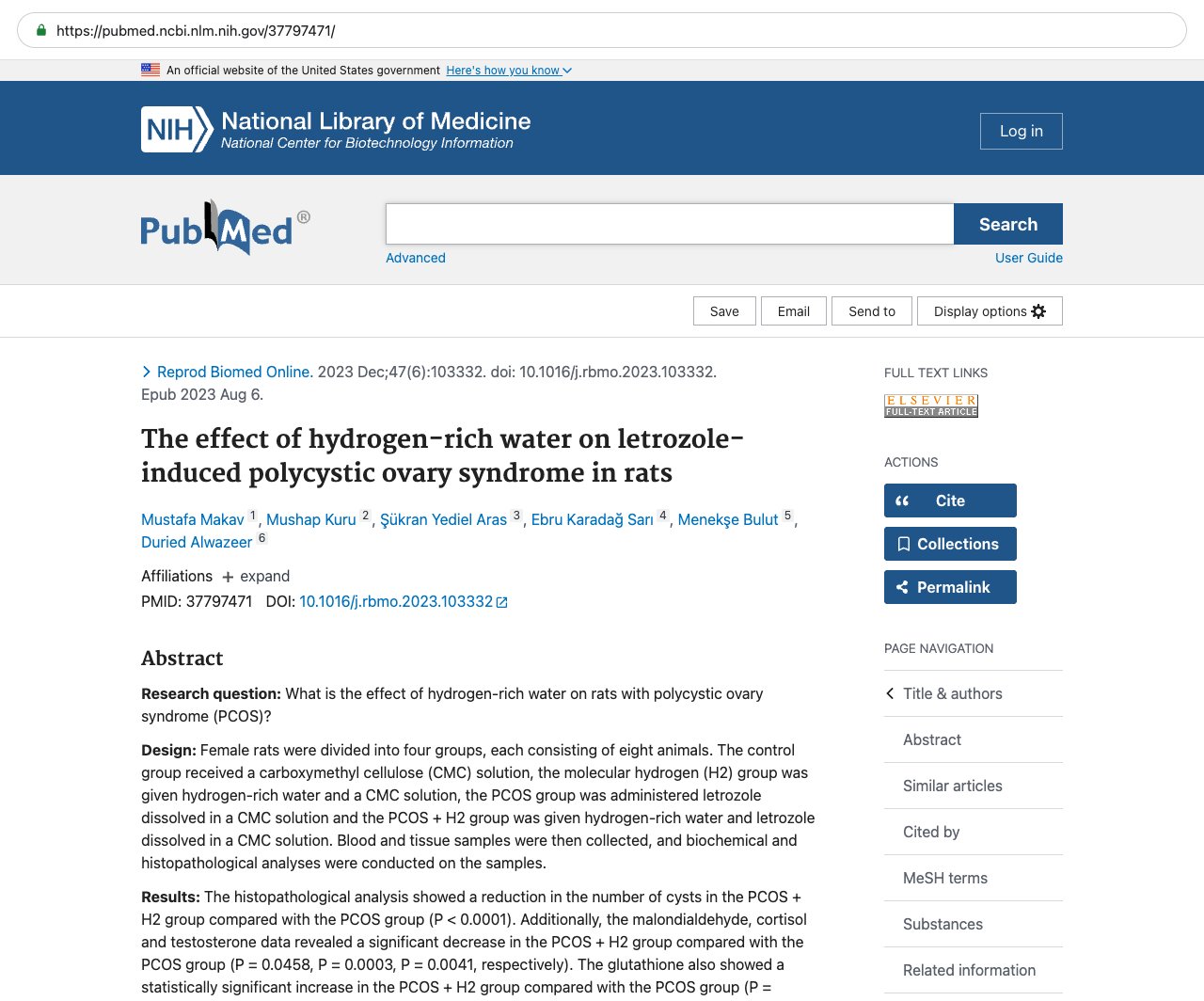
This page mirrors the published abstract (© the authors / publisher) for reference and citation. The canonical source is the PubMed record linked above. This is not medical advice.