2025 · An — Hydrogen activates ACOD1-itaconate pathway to ameliorate steroid-associated osteonecrosis
Super-Abstract
Hydrogen-rich water (HRW) protects bone from cortisone damage: In the mouse model of steroid-induced bone necrosis, H₂ reduced the death of bone cells, improved bone structure and blood perfusion — via activation of the anti-inflammatory ACOD1-itaconate metabolic pathway. (Biomaterials, 2025.)
Commentary
Steroid-associated osteonecrosis (SAON) arises when patients receive high-dose cortisone — effective prevention has barely existed so far. The team gave mice in which bone necrosis was induced with glucocorticoids hydrogen-rich water (HRW) to drink. The result is broad: less apoptosis of bone cells (osteocytes), an improved trabecular bone architecture, more bone-forming osteoblasts and fewer bone-resorbing osteoclasts. In addition, blood lipid values improved (LDL, triglycerides, total cholesterol fell) and blood perfusion rose, including more „type H“ vessels. Mechanistically, H₂ shifted the macrophages from the inflammatory M1 to the repairing M2 form, lowered TNF-α and — the real twist — upregulated the enzyme ACOD1, which forms the anti-inflammatory metabolite itaconate. The fact that giving the itaconate derivative dimethyl itaconate mimics the same protection dose-dependently cleanly underpins this pathway. Staying honest: this is a <strong>preclinical mouse study</strong>, not human evidence — but it delivers a concrete, testable mechanism.
Key quotes
- „HRW treatment significantly reduces osteocyte apoptosis, improves deteriorated trabecular architecture, increases osteoblast numbers and the bone formation, while decreases osteoclast numbers and the bone resorption.“ — the breadth of the bone protection
- „HRW shifts the polarization of macrophages from M1 to M2 phenotype and suppresses inflammatory marker TNF-α.“ — the anti-inflammatory mechanism
- „The protective effects of HRW are mimicked by supplementation with the itaconate derivative dimethyl itaconate in a dose-dependent manner, highlighting the importance of the ACOD1-itaconate pathway.“ — the proof of the ACOD1-itaconate pathway
Our assessment
A mechanistically strong piece of work from the high-ranking journal Biomaterials: it links drinkable H₂ water with a precise molecular protective pathway (ACOD1/itaconate) and at the same time shows hard endpoints (bone structure, blood perfusion, blood lipids). Notable because it examines orally administered HRW — here in an indication field beyond the usual antioxidant mechanistic picture. Limitation, stated honestly: purely preclinical (mouse), model with artificially induced necrosis; no transferability to patients without clinical studies. Statements like „prevents bone necrosis“ apply explicitly only to the mouse model.
Study design
- Type: preclinical (mouse model of SAON) · n: animal model (number in the full text) · Duration: not stated in the abstract · H₂ delivery: saturated hydrogen-rich water (HRW), oral
- Result figures: ↓ osteocyte apoptosis, ↑ osteoblasts/bone formation, ↓ osteoclasts/bone resorption; ↓ LDL, triglycerides, total cholesterol; ↑ blood perfusion & type H vessels; M1→M2 shift, ↓ TNF-α, ↑ ACOD1; dimethyl itaconate mimics the effect dose-dependently
Abstract
Steroid-associated osteonecrosis (SAON) remains a challenging clinical condition as there are few effective preventive measures. This study investigates the effects of hydrogen (H2) administrated via saturated hydrogen-rich water (HRW) in mice received high dose of glucocorticoids (for inducing SAON model). Here we find that HRW treatment significantly reduces osteocyte apoptosis, improves deteriorated trabecular architecture, increases osteoblast numbers and the bone formation, while decreases osteoclast numbers and the bone resorption. Additionally, HRW-treated mice exhibit improved serum lipid profiles, including decreased levels of low-density lipoprotein (LDL), triglycerides (TG), and total cholesterol (T-CHO), as well as reduced lipid accumulation. HRW treatment also enhances blood perfusion and increases formation of type H vessels in SAON mice. We further demonstrate that HRW shifts the polarization of macrophages from M1 to M2 phenotype and suppresses inflammatory marker TNF-α. RNA sequencing data and subsequent validation reveal that HRW upregulates ACOD1 mRNA and protein levels in bone tissues. The protective effects of HRW are mimicked by supplementation with the itaconate derivative dimethyl itaconate in a dose-dependent manner, highlighting the importance of the ACOD1-itaconate pathway in the prevention of SAON by HRW. These findings indicate that HRW ameliorates SAON by modulating the ACOD1-itaconate pathway, presenting a novel avenue for the cost-effective prevention of osteonecrosis.
Source & links
Screenshot of the PubMed page
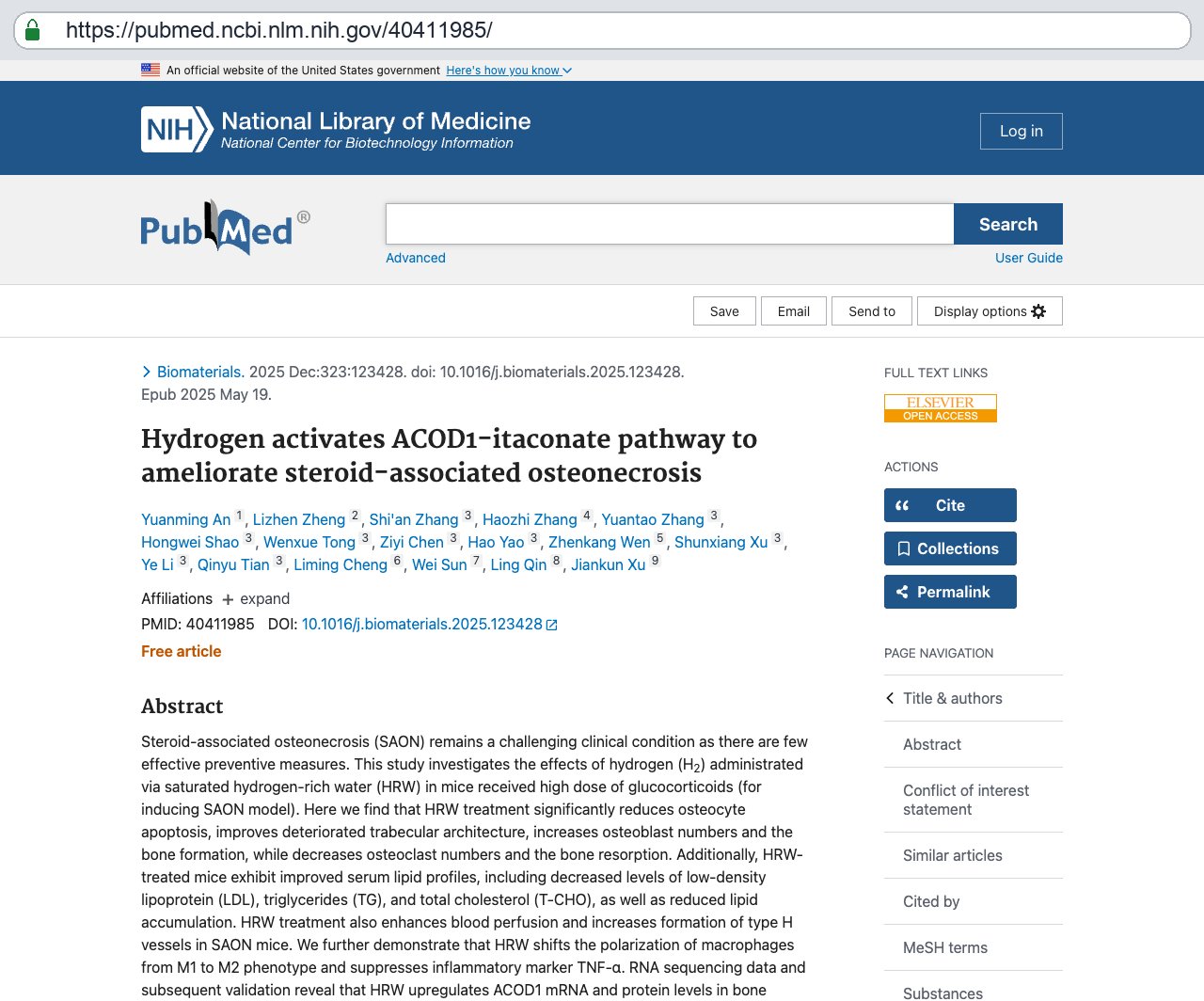
This page mirrors the published abstract (© the authors / publisher) for reference and citation. The canonical source is the PubMed record linked above. This is not medical advice.