2025 · Maruyama et al. — Hydrogen Gas Inhalation Improved Intestinal Microbiota in Ulcerative Colitis: A Randomised Double-Blind Placebo-Controlled Trial
Super-Abstract
In 10 patients with active ulcerative colitis, inhaling hydrogen gas for 4 hours a day over 8 weeks shifted the gut microbiota differently from air inhalation (β-diversity, p = 0.02), but the authors saw no clear therapeutic effect on the colitis. α-diversity was higher in the hydrogen group, but this difference was not statistically significant (p = 0.19). The abstract reports a significant change in the summed Mayo endoscopic subscores before and after inhalation without saying in which group, and no inhalation-related adverse events. With 10 participants and no named primary endpoint, the results are exploratory. (Biomedicines, 2025.)
Commentary
Earlier mouse studies cited in the abstract reported that hydrogen increases gut microbiota diversity and slows the progression of ulcerative colitis, a disease in which dysbiosis is thought to play a part. This randomised, double-blind, placebo-controlled trial enrolled 10 patients aged 20 or older with active ulcerative colitis, defined by a Lichtiger clinical activity index of 3 to 10 and Mayo endoscopic subscores of at least 1. Patients were assigned to inhale either hydrogen gas or air (placebo) for 4 hours every day for 8 weeks. The abstract does not give the hydrogen concentration, the number of patients per group or a primary endpoint. Before and after the inhalation period, the investigators assessed clinical indices and analysed stool samples by metagenomic sequencing, looking at α-diversity, β-diversity and functional genes. Adverse events were also recorded.
Key quotes
- „The hydrogen group showed higher α-diversity (p = 0.19), and the variation in β-diversity was markedly different, compared to the placebo group, in intestinal microbiota analysis (p = 0.02).“ — the microbiota result: only the β-diversity difference reached statistical significance
- „No inhalation-related adverse events were observed.“ — the safety finding, based on a very small group of patients
- „Hydrogen inhalation appeared to improve intestinal microbiota diversity; however, no clear therapeutic effect on ulcerative colitis was observed.“ — the authors' conclusion, which separates microbiota changes from clinical benefit
Our assessment
This is a randomised, double-blind trial, but with 10 patients it can only describe tendencies. The authors themselves report no clear therapeutic effect on ulcerative colitis. The title speaks of improved microbiota, yet the α-diversity difference was not statistically significant (p = 0.19). Only the change in β-diversity differed between groups (p = 0.02). A β-diversity difference describes a different shift in community composition and does not by itself show a health benefit. The 115 gene changes come from a functional analysis within the hydrogen group. Limitations: very small sample, group sizes and hydrogen concentration not reported, no primary endpoint named, 8-week duration, microbiota measures as surrogate markers, many outcomes tested, and the Mayo subscore result is reported without saying which group changed or whether the groups differed.
Study design
- Type: randomised, double-blind, placebo-controlled trial · n: 10 patients with active ulcerative colitis (split per group not reported) · H₂ delivery: hydrogen gas inhalation, 4 hours daily for 8 weeks (concentration not reported)
- Comparator: air inhalation (placebo) on the same schedule
- Result: no primary endpoint named. β-diversity change differed from placebo (p = 0.02). α-diversity higher with hydrogen, not significant (p = 0.19). 115 significant functional gene changes in the hydrogen group. Summed Mayo endoscopic subscores changed significantly before and after inhalation (group not specified). No clear therapeutic effect on the colitis, no inhalation-related adverse events
Abstract
Background/Objective: Dysbiosis is implicated in the pathogenesis of ulcerative colitis. Hydrogen has been reported to promote intestinal microbiota diversity and suppress ulcerative colitis progression in mice models. In this study, we investigated changes in the intestinal microbiota, therapeutic effects, and safety of hydrogen inhalation in patients with ulcerative colitis. Methods: In this randomised, double-blind, placebo-controlled trial, 10 active patients with ulcerative colitis (aged ≥20 years; Lichtiger's clinical activity index, 3-10; and Mayo endoscopic subscores ≥1) participated, and they were assigned to either a hydrogen or air inhalation group (hydrogen and placebo groups, respectively). All patients inhaled gas for 4 h every day for 8 weeks. Subsequently, we performed clinical indices and microbiota analyses using the metagenomic sequencing of stool samples before and after inhalation. Results: There was significant difference in the sum of the Mayo endoscopic subscores before and after inhalation in the clinical assessment indices. The hydrogen group showed higher α-diversity (p = 0.19), and the variation in β-diversity was markedly different, compared to the placebo group, in intestinal microbiota analysis (p = 0.02). Functional gene analysis revealed 115 significant genetic changes in the hydrogen group following treatment. No inhalation-related adverse events were observed. Conclusions: Hydrogen inhalation appeared to improve intestinal microbiota diversity; however, no clear therapeutic effect on ulcerative colitis was observed. Further studies are needed, and hydrogen inhalation may possibly lead to a logical solution combined with microbiome therapy, such as faecal microbiota transplantation, with fewer adverse events.
Source & links
Screenshot of the PubMed page
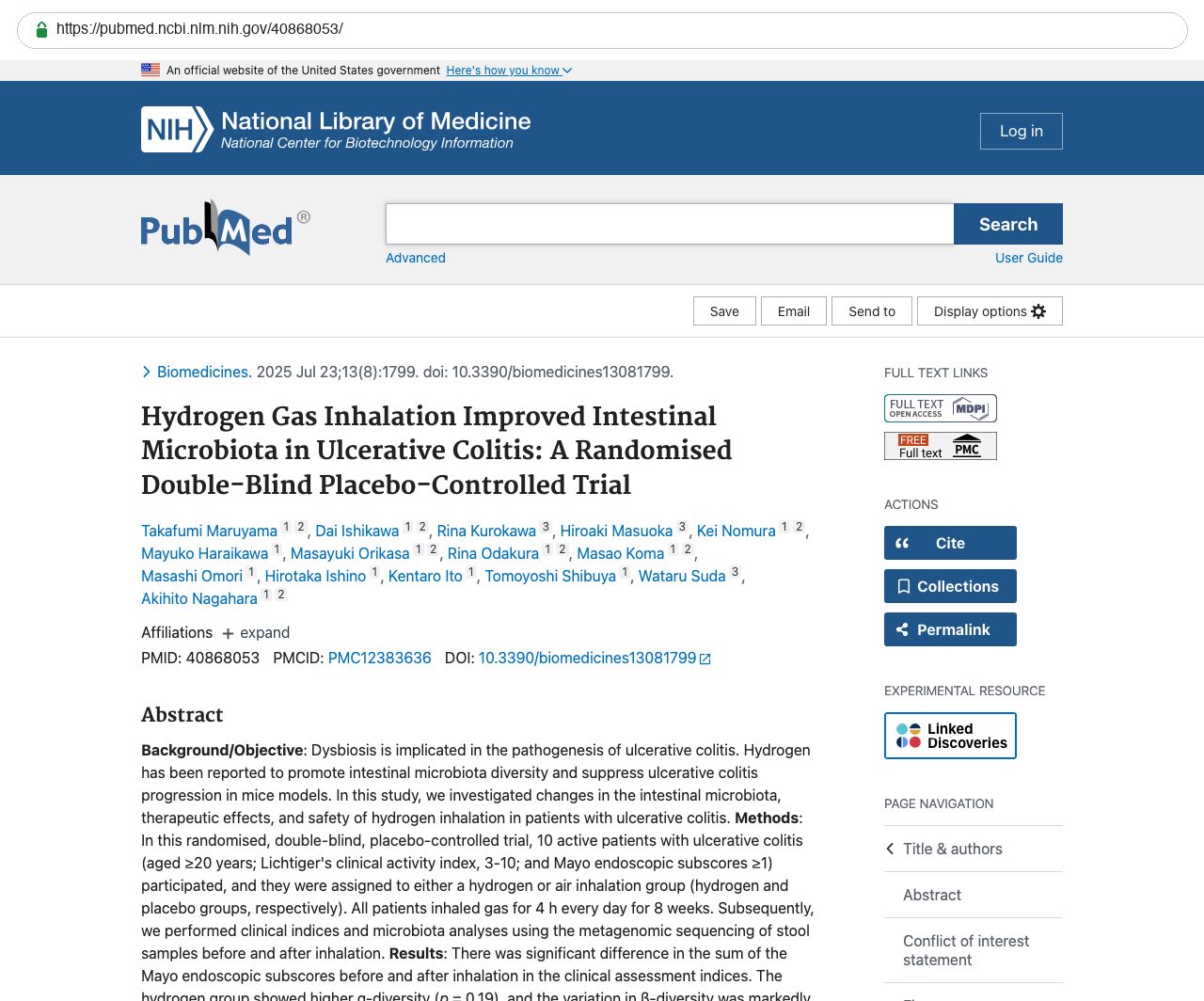
This page mirrors the published abstract (© the authors / publisher) for reference and citation. The canonical source is the PubMed record linked above. This is not medical advice.