2025 Advances in radiation oncology RCT Human H₂ therapy Inhalation Cancer (adjunct)Immune / Inflammation
2025 · Liu et al. — Clinical Efficacy of Hydrogen Therapy on Acute Radiation Enteritis and Inflammatory Response in Patients with Cervical Cancer Undergoing Concurrent Chemoradiation Therapy
Super-Abstract
In a randomized trial of patients with cervical cancer receiving chemoradiation (28 with hydrogen, 30 controls), those who also inhaled hydrogen-oxygen gas on each radiation day had lower inflammation markers and milder acute radiation enteritis than the control group (P < .05). Tumor response to the cancer treatment did not differ significantly between the groups, and no hydrogen-related adverse events were reported. The abstract does not name a primary endpoint, does not describe what the control group received or whether anyone was blinded, and reports results only as P < .05. (Advances in Radiation Oncology, 2025.)
Commentary
Acute radiation enteritis is a common inflammatory side effect of concurrent chemoradiation for cervical cancer, and this study asked whether inhaled hydrogen can prevent it. Patients with cervical cancer undergoing concurrent chemoradiation were enrolled prospectively and randomized to an experimental group (n = 28) or a control group (n = 30). The experimental group inhaled a gas mixture of 66.6% hydrogen and 33.3% oxygen at 3 L/min for 2 hours on each radiation therapy day. The abstract does not say what the control group received, whether a sham gas was used, or how many treatment days the course included. During treatment the investigators monitored inflammation markers (C-reactive protein, the neutrophil-to-lymphocyte and platelet-to-lymphocyte ratios, interleukin 6), blood counts and fecal occult blood. Clinical scores were LENT-SOMA, the Patient-Generated Subjective Global Assessment (PG-SGA) and Radiation Therapy Oncology Group (RTOG) enteritis grades. Tumor response was assessed with the Response Evaluation Criteria in Solid Tumors (RECIST).
Key quotes
- „Compared with the control group, the experimental group showed significantly lower levels of C-reactive protein, neutrophil-to-lymphocyte ratio, interleukin 6, and fecal occult blood positivity rates (P < .05).“ — the main laboratory result, reported only as P < .05
- „no significant difference in tumor response was observed between groups based on the Response Evaluation Criteria in Solid Tumors“ — tumor response did not differ, a check that matters for any add-on during cancer treatment
- „Hydrogen inhalation is a safe and effective adjunctive therapy that significantly alleviates inflammation and mitigates clinical symptoms of ARE in patients with cervical cancer who are undergoing CCRT, without compromising antitumor treatment outcomes.“ — the authors' conclusion, which one trial of this size cannot confirm on its own
Our assessment
This randomized trial reports differences in favour of hydrogen inhalation across inflammation markers, toxicity scores and enteritis grades. Hydrogen was tested as an add-on to reduce a side effect of chemoradiation, not as a cancer treatment, and tumor response did not differ significantly between the groups. Limitations: 28 and 30 patients; blinding and the control condition are not described, so clinician-rated toxicity scores and the patient-rated nutrition assessment could be influenced by knowledge of group allocation. No primary endpoint is named, many outcomes were tested, and results are given only as P < .05, without effect sizes or confidence intervals. The platelet-to-lymphocyte ratio was measured, but its result is not reported. Treatment duration is not stated. The absence of a difference in tumor response in a small sample cannot exclude smaller effects in either direction. The authors' description of hydrogen as safe and effective goes beyond what a single trial can establish.
Study design
- Type: prospective randomized controlled trial (blinding not described) · n: 28 hydrogen, 30 control · H₂ delivery: inhaled gas mixture of 66.6% H₂ and 33.3% O₂, 3 L/min, 2 hours on each radiation therapy day
- Comparator: control group; the abstract does not describe its treatment or a sham inhalation
- Result: no primary endpoint named. Lower C-reactive protein, neutrophil-to-lymphocyte ratio, interleukin 6 and fecal occult blood positivity, lower LENT-SOMA and PG-SGA scores and milder RTOG enteritis grades with hydrogen (all P < .05). Tumor response (RECIST) not significantly different. No hydrogen-related adverse events reported
Abstract
PURPOSE: Acute radiation enteritis (ARE) is a common toxic inflammatory reaction in patients with cervical cancer undergoing concurrent chemoradiation therapy (CCRT). Molecular hydrogen, as a novel antioxidant and anti-inflammatory agent, may alleviate treatment-related toxicity. This study aimed to evaluate the efficacy of inhaled hydrogen in preventing ARE and modulating systemic inflammation. METHODS: Eligible patients with cervical cancer undergoing CCRT were prospectively enrolled and randomized into an experimental group (n = 28) or a control group (n = 30). The experimental group received inhalation therapy with a hydrogen-oxygen gas mixture (66.6% hydrogen, 33.3% oxygen; 3 L/min, 2 h/d) on each radiation therapy day. Inflammatory biomarkers-including C-reactive protein, neutrophil-to-lymphocyte ratio, platelet-to-lymphocyte ratio, and interleukin 6-as well as hemogram parameters, fecal occult blood, Late Effects Normal Tissue Task Force-Subjective, Objective, Management, and Analytic scores; Patient-Generated Subjective Global Assessment scores; and Radiation Therapy Oncology Group enteritis grades were monitored during treatment and Response Evaluation Criteria in Solid Tumors scores. RESULTS: Baseline characteristics (age, tumor stage, pathology, and surgical history) were balanced between groups (P > .05). Compared with the control group, the experimental group showed significantly lower levels of C-reactive protein, neutrophil-to-lymphocyte ratio, interleukin 6, and fecal occult blood positivity rates (P < .05). Clinical assessments also indicated lower Late Effects Normal Tissue Task Force-Subjective, Objective, Management, and Analytic and Patient-Generated Subjective Global Assessment scores and milder Radiation Therapy Oncology Group enteritis grading in the hydrogen group (P < .05). Importantly, no significant difference in tumor response was observed between groups based on the Response Evaluation Criteria in Solid Tumors, suggesting that hydrogen therapy did not interfere with the antitumor efficacy of CCRT. No adverse events related to hydrogen inhalation were reported. CONCLUSION: Hydrogen inhalation is a safe and effective adjunctive therapy that significantly alleviates inflammation and mitigates clinical symptoms of ARE in patients with cervical cancer who are undergoing CCRT, without compromising antitumor treatment outcomes.
Source & links
Screenshot of the PubMed page
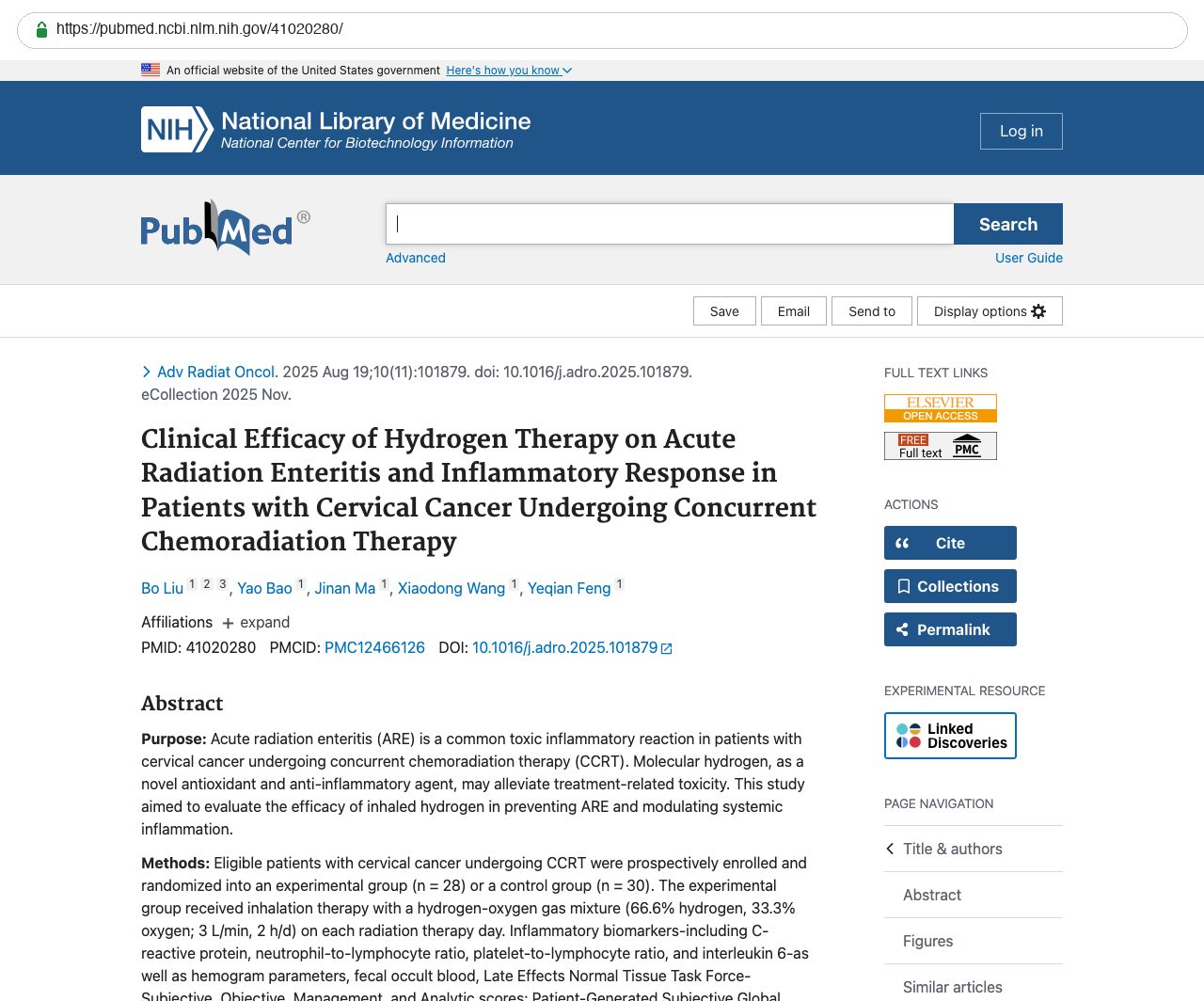
This page mirrors the published abstract (© the authors / publisher) for reference and citation. The canonical source is the PubMed record linked above. This is not medical advice.