2016 Zhonghua jie he he hu xi za zhi = Zhonghua jiehe he huxi zazhi = Chinese journal of tuberculosis and respiratory diseases RCT Human H₂ therapy Inhalation
2016 · Gong et al. — Protective effect of hydrogen on the lung of sanitation workers exposed to haze.
Super-Abstract
In this randomized double-blind placebo-controlled trial with 96 sanitation workers chronically exposed to air pollution, daily inhalation of an H₂/O₂ mixture for 30 days improved lung function (FEV1, PEF), reduced airway inflammation markers (FeNO, IL-2, MMP-12), and improved respiratory symptoms such as cough — compared to a nitrogen/oxygen control. (Chinese Journal of Tuberculosis and Respiratory Diseases, 2016.)
Commentary
This is a methodologically solid RCT targeting a real occupational health problem: sanitation workers in Chinese cities experience chronic high-level exposure to particulate matter (PM2.5, PM10) and are at elevated risk for airway inflammation, reduced lung function, and systemic inflammatory sequelae. The study design is unusually rigorous for this field — randomized, double-blind, placebo-controlled, with repeated measurements at days 0, 8, 15, and 30. The H₂/O₂ mixture (67%/33%) differs from typical H₂-alone protocols and delivers a high H₂ fraction. The lung function improvements (FEV1, PEF) are objective and clinically relevant. Importantly, not all markers improved: CRP, TGF-β1, and serum MDA showed no significant differences between groups — a sign of honest reporting and methodological care.
Key quotes
- „The FeNO levels of the treatment group were lower than those of the control group on 8th day of treatment, with significant difference.“ — exhaled NO as airway inflammation marker: reduced early in H₂ group
- „The levels of FEV1 were significantly higher in participants from the treatment group as compared to the control group on both 8th and 30th day of treatment.“ — objective lung function: improved across the treatment period
- „Inhalation of hydrogen gas could alleviate airway inflammation and oxidative stress of sanitation workers exposed to air pollution. There was even a significant inhibitory effect on the level of systemic inflammatory response.“ — conclusion: local and systemic anti-inflammatory effects documented
Our assessment
One of the stronger RCTs in the H₂ inhalation literature, with a well-defined population, repeated measurement time points, objective lung function outcomes, and honest null reporting for non-significant markers. Limitations: the population is specific (haze-exposed workers in Shijiazhuang, January–February), limiting generalizability; the H₂/O₂ mixture concentration (67% H₂) is much higher than typical commercial devices; 30 days is a short observation window; long-term lung function effects are unknown. Still, this study provides one of the cleaner signals for H₂ inhalation in respiratory health.
Study design
- Type: Randomized double-blind placebo-controlled trial · n: 96 (treatment: H₂/O₂ 66.67%/33.33%; control: N₂/O₂ 66.67%/33.33%) · H₂ delivery: 1 h/day inhalation for 30 days
- Population: Sanitation workers in Shijiazhuang, chronically exposed to urban haze (PM pollution)
- Result: FEV1 and PEF improved significantly; FeNO reduced (day 8); IL-2 and MMP-12 reduced in sputum and serum; IL-10 increased; CRP, TGF-β1, serum MDA: no significant differences (null findings honestly reported); cough improved
Abstract
Objective: To study the protective effect of hydrogen inhalation on the lungs of sanitation workers exposed to haze. Methods: In this randomized, double-blind, placebo controlled clinical trial, 96 sanitation workers living in Shijiazhuang urban area were recruited during January to February, 2016. All enrolled participants were randomized to 2 groups; the treatment group inhaled H2∶O2 mixture (66.67%∶33.33%) 1 hour per day for 30 days, while the control group inhaled N2∶O2 mixture (66.67%∶33.33%) 1 hour per day for 30 days. Respiratory symptoms were evaluated and fractional exhaled nitric oxide(FeNO), biochemical indexes, lung function were measured at baseline(the 0th day) and during treatment (the 8th day, 15th day, and 30th day). Results: (1)The FeNO levels of the treatment group (16±5)×109 were lower than those of the control group(21±14)×109 on 8th day of treatment, with significant difference(F=6.94, P<0.05). (2)The levels of FEV1 were significantly higher in participants from the treatment group as compared to the control group on both 8th [(96±13)% vs(94±14)%(F=3.96, P<0.05)] and 30th day [(97±14)% vs (95±12)%(F=8.5, P<0.05)] of treatment, while PEF was also increased on 15th day [(73±15)% vs(67±18)%(F=8.68, P<0.05)]. (3)The sputum levels of MMP-12 and SOD3 were consistently lower in the treatment group as compared to the control group at each time point, and the levels of IL-10 were higher in the treatment group as compared to the control group on the 15th and 30th day. MDA and IL-2 levels were lower in the treatment group than in the control group on the 30th day(P<0.05). The sputum levels of CRP and TGF-β1 at each time point were not different between the 2 groups (P>0.05). (4)The serum levels of IL-2 and SOD3 were lower in the treatment group as compared to the control group while IL-10 was higher than in the control group at each time point, and MMP-12 was lower in the treatment group than that in the control group on the 30th day(P<0.05). The relative ratios of CRP, TGF-β1 and MDA in serum at each time point between the 2 groups were not significantly different (P>0.05). (5)Hydrogen inhalation improved respiratory symptoms such as cough. Conclusions: Inhalation of hydrogen gas could alleviate airway inflammation and oxidative stress of sanitation workers exposed to air pollution. There was even a significant inhibitory effect on the level of systemic inflammatory response. Importantly, inhalation of hydrogen could improve respiratory symptoms such as cough.
Source & links
Screenshot of the PubMed page
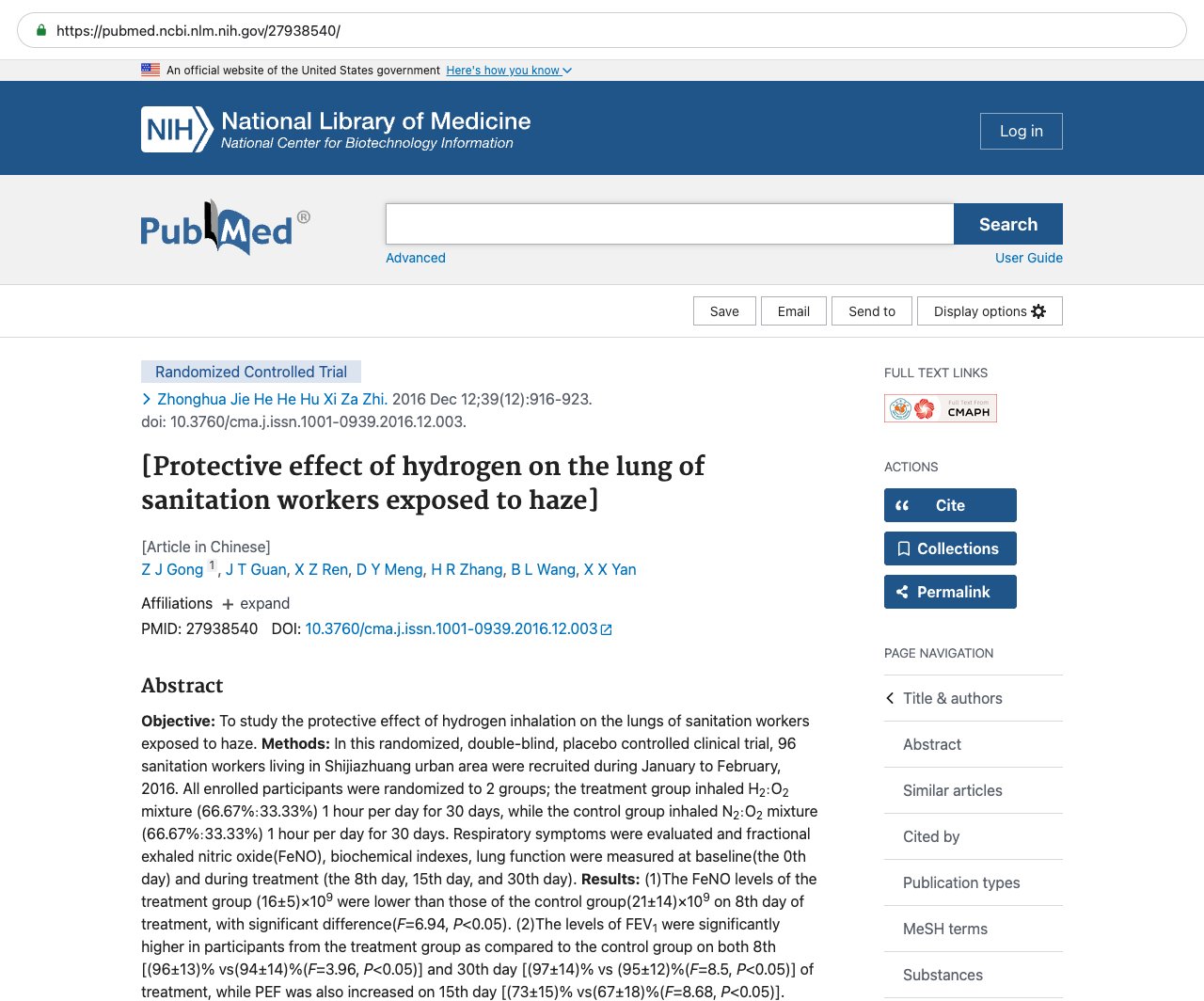
This page mirrors the published abstract (© the authors / publisher) for reference and citation. The canonical source is the PubMed record linked above. This is not medical advice.