2026 Drug design, development and therapy RCT Human H₂ therapy Inhalation Respiratory / COVIDImmune / Inflammation
2026 · Wei et al. — Preliminary Effects of Hydrogen-Oxygen Inhalation on Nodule Size, IL-6, and Neutrophils in Patients with Small Pulmonary Nodules
Super-Abstract
In 59 patients with small pulmonary nodules, 14 days of hydrogen-oxygen inhalation were followed by a 0.64 mm reduction in nodule diameter in the hydrogen group (p < 0.01), but the abstract does not report a direct comparison with the air-inhalation control group. Serum IL-6 and blood neutrophil counts also fell, while CRP and the Mayo malignancy risk score did not change significantly in either group. The trial was small and single-centre, and the abstract gives no information on blinding, hydrogen concentration or adverse events. (Drug Design, Development and Therapy, 2026.)
Commentary
The trial asked whether inhaling a hydrogen-oxygen gas mixture changes the size of small pulmonary nodules and blood markers of inflammation, with a separate analysis in smokers. At a single centre, 59 patients with nodules confirmed by chest CT were randomly assigned to hydrogen-oxygen inhalation (n = 30) or air inhalation (n = 29) for 14 consecutive days. The abstract does not give the hydrogen concentration, the daily inhalation time or whether participants or assessors were blinded. The primary endpoint was the change in nodule diameter before and after the intervention. Secondary endpoints were serum IL-6, C-reactive protein (CRP), peripheral blood neutrophil count and the Mayo malignant transformation risk score. All measures were repeated at a 3-month follow-up, and the abstract does not make clear at which time point the reported changes were measured. The trial was registered in the Chinese Clinical Trial Registry (ChiCTR2300076152).
Key quotes
- „After intervention, the observation group had a significant reduction in nodule diameter by 0.64 mm (95% CI: 0.20-1.08, P<0.01).“ — the primary endpoint, reported for the hydrogen group without a between-group comparison
- „No significant pre- and post-intervention differences were observed in CRP level and Mayo malignant transformation risk score in either group (all P>0.05).“ — two secondary endpoints that did not change in either group
- „Within the limitations of this single-center, small-sample study with a 3-month follow-up, hydrogen-oxygen inhalation can reduce SPN diameter and downregulate peripheral blood IL-6 and neutrophil levels, exerting a targeted anti-inflammatory effect especially in smoking patients.“ — the authors' conclusion, with their own caveat on size and follow-up
Our assessment
The trial was randomised and registered, and it names a primary endpoint. The abstract reports the 0.64 mm reduction in nodule diameter for the hydrogen group but does not say how the air-inhalation group changed or whether the two groups differed significantly. It also does not discuss whether a change of this size matters clinically. CRP and the Mayo malignancy risk score did not change in either group. Limitations: single centre, 59 patients, 14 days of treatment and 3 months of follow-up. The abstract gives no information on blinding, hydrogen concentration, daily dose or adverse events, although the authors describe the intervention as safe. Nodule diameter, IL-6 and neutrophils are intermediate measures, not clinical outcomes. The size of the smoking subgroup is not reported. In this sample the results suggest changes in these markers, but they do not show that hydrogen alters the course of lung nodules.
Study design
- Type: single-centre randomised controlled trial, blinding not stated · n: 59 (30 hydrogen-oxygen, 29 air) · H₂ delivery: hydrogen-oxygen inhalation on 14 consecutive days, concentration and daily duration not given in the abstract
- Comparator: air inhalation
- Result: primary endpoint: nodule diameter in the hydrogen group reduced by 0.64 mm (95% CI 0.20–1.08, p < 0.01), no between-group comparison reported. Secondary: IL-6 −1.36 pg/mL (95% CI 0.70–2.02, p < 0.01), neutrophils −1.14 × 10⁹/L (95% CI 0.51–1.77, p < 0.01). CRP and Mayo risk score unchanged in both groups (all p > 0.05). Smokers: IL-6 and neutrophils fell (both p < 0.01), CRP stable
Abstract
OBJECTIVE: To evaluate the effects of hydrogen-oxygen inhalation on nodule diameter and peripheral blood inflammatory factors in patients with small pulmonary nodules (SPNs), and to further analyze its efficacy in the smoking subgroup. The primary endpoint was the change in pulmonary nodule diameter before and after intervention; secondary endpoints included alterations in serum IL-6, CRP, peripheral blood neutrophil count, and Mayo malignant transformation risk score. METHODS: A total of 59 patients with SPNs confirmed by chest CT were enrolled and randomly divided into the observation group (hydrogen-oxygen inhalation, n=30) and control group (air inhalation, n=29). The intervention lasted 14 consecutive days, and all indicators were re-examined at 3-month follow-up. This study was registered in the Chinese Clinical Trial Registry (ChiCTR) with the registration number ChiCTR2300076152 (registration date: September 26, 2023). RESULTS: Baseline demographic and clinical characteristics were well balanced between the two groups (all P>0.05). After intervention, the observation group had a significant reduction in nodule diameter by 0.64 mm (95% CI: 0.20-1.08, P<0.01). Serum IL-6 decreased by 1.36 pg/mL (95% CI: 0.70-2.02, P<0.01), and peripheral blood neutrophil count decreased by 1.14×10⁹/L (95% CI: 0.51-1.77, P<0.01). No significant pre- and post-intervention differences were observed in CRP level and Mayo malignant transformation risk score in either group (all P>0.05). In the smoking subgroup, IL-6 level and neutrophil count also decreased significantly after hydrogen-oxygen inhalation (both P<0.01), while CRP remained relatively stable. CONCLUSION: Within the limitations of this single-center, small-sample study with a 3-month follow-up, hydrogen-oxygen inhalation can reduce SPN diameter and downregulate peripheral blood IL-6 and neutrophil levels, exerting a targeted anti-inflammatory effect especially in smoking patients. It may serve as a safe non-invasive adjuvant intervention for SPNs, while further multicenter large-sample studies are needed to validate its general applicability.
Source & links
Screenshot of the PubMed page
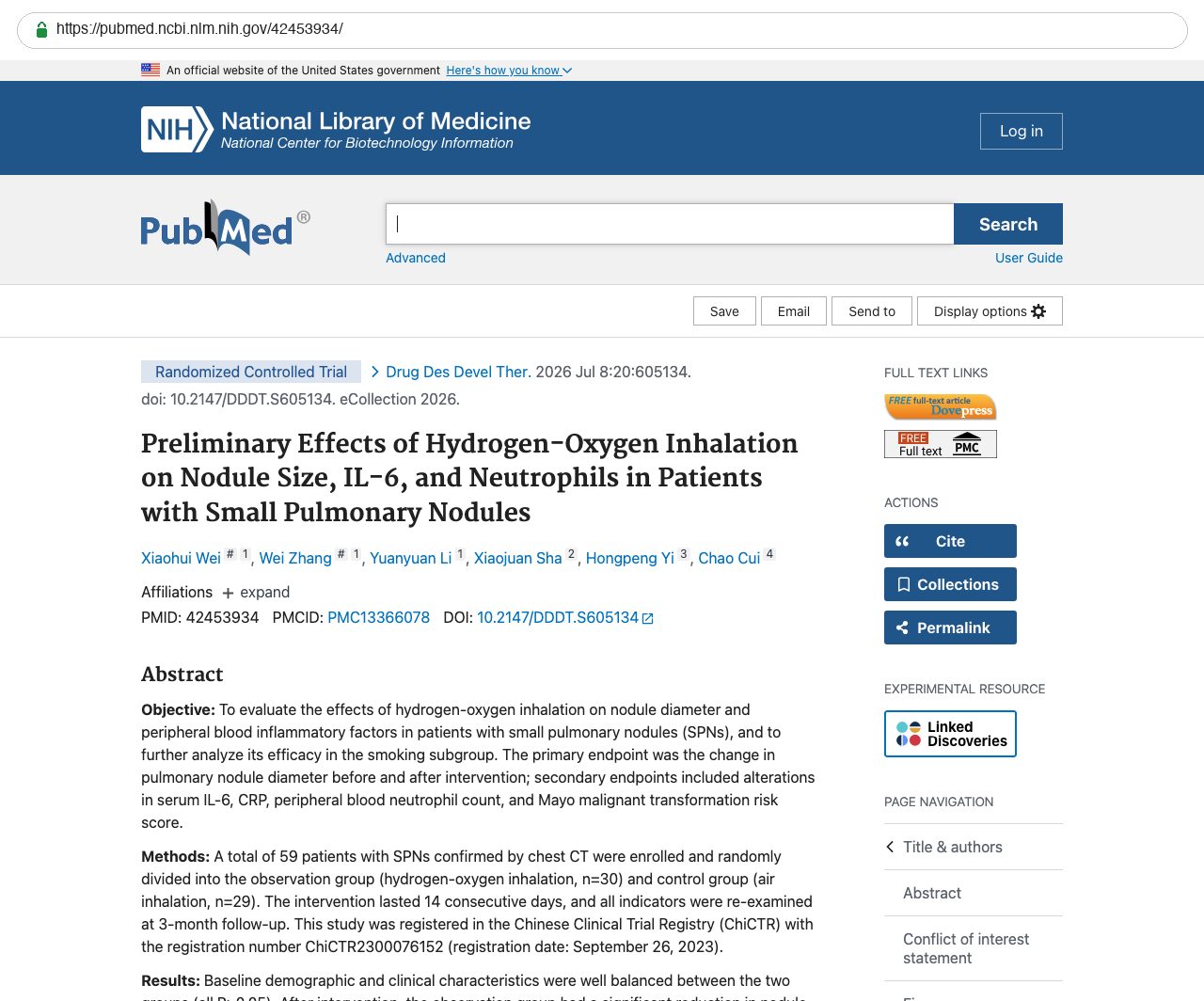
This page mirrors the published abstract (© the authors / publisher) for reference and citation. The canonical source is the PubMed record linked above. This is not medical advice.