2022 · Fu — Role of Molecular Hydrogen in Ageing and Ageing-Related Diseases
Super-Abstract
This comprehensive review summarizes how molecular hydrogen may counteract multiple hallmarks of biological aging — from oxidative stress and genomic instability to mitochondrial dysfunction and chronic inflammation — and surveys its potential role in age-related diseases such as neurodegeneration, cardiovascular disease, diabetes, and cancer. As a review article, it synthesizes existing preclinical and clinical research rather than providing new experimental data; conclusions are theoretical and evidence quality varies substantially by topic.
Commentary
This is a broad, ambitious review that attempts to connect H₂'s known mechanistic effects — selective antioxidant, Nrf2 activator, anti-inflammatory agent — to the major molecular hallmarks of aging as defined in the aging biology literature (genomic stability, telomere maintenance, proteostasis, nutrient sensing, mTOR, autophagy, mitochondrial function, cellular senescence, inflammation). The scope is impressive, covering both fundamental aging mechanisms and specific disease applications. The review's strength is its systematic mechanistic framing: it does not just list diseases but explains the theoretical molecular chain linking H₂ to each aging pathway. A key honest caveat the authors themselves make — and which the reader should weight — is that most of the disease-specific evidence comes from animal or in-vitro studies; human clinical trial evidence for H₂ in most of these aging-related diseases remains sparse. The review is a useful map of the research landscape, but should not be read as definitive clinical proof for any of the listed conditions.
Key quotes
- „Through its antioxidative effect, hydrogen maintains genomic stability, mitigates cellular senescence, and takes part in histone modification, telomere maintenance, and proteostasis.“ — the proposed mechanistic breadth: H₂ is linked to multiple hallmarks of aging
- „hydrogen may prevent inflammation and regulate the nutrient-sensing mTOR system, autophagy, apoptosis, and mitochondria, which are all factors related to ageing.“ — further proposed aging-pathway connections — these are mechanistic hypotheses, not proven clinical effects
- „Hydrogen can also be used for prevention and treatment of various ageing-related diseases, such as neurodegenerative disorders, cardiovascular disease, pulmonary disease, diabetes, and cancer.“ — the review's broad therapeutic claim — based on heterogeneous evidence quality
Our assessment
This is a narrative review covering a wide field with heterogeneous underlying evidence. The breadth is both its strength and its weakness: covering aging hallmarks, specific organ systems, and multiple diseases necessarily means that evidence quality varies enormously — from well-controlled human trials (for some conditions) to purely theoretical mechanistic arguments or single animal studies (for others). This review cannot be cited as blanket clinical proof for H₂ in aging or any specific disease. It is most appropriately used as a map of the H₂-aging research landscape and a source of mechanistic hypotheses for future investigation. Readers should consult primary studies for each specific disease area mentioned.
Study design
- Type: narrative review · n: n/a (literature synthesis) · H₂ delivery: various (inhalation, drinking water, saline injection across cited studies)
- Topics covered: genomic stability, cellular senescence, telomere maintenance, proteostasis, mTOR/autophagy, mitochondria, inflammation, neurodegenerative disease, cardiovascular disease, pulmonary disease, diabetes, cancer
- Evidence base: heterogeneous mix of in-vitro, animal, and human studies; review does not disaggregate evidence quality by disease area
Abstract
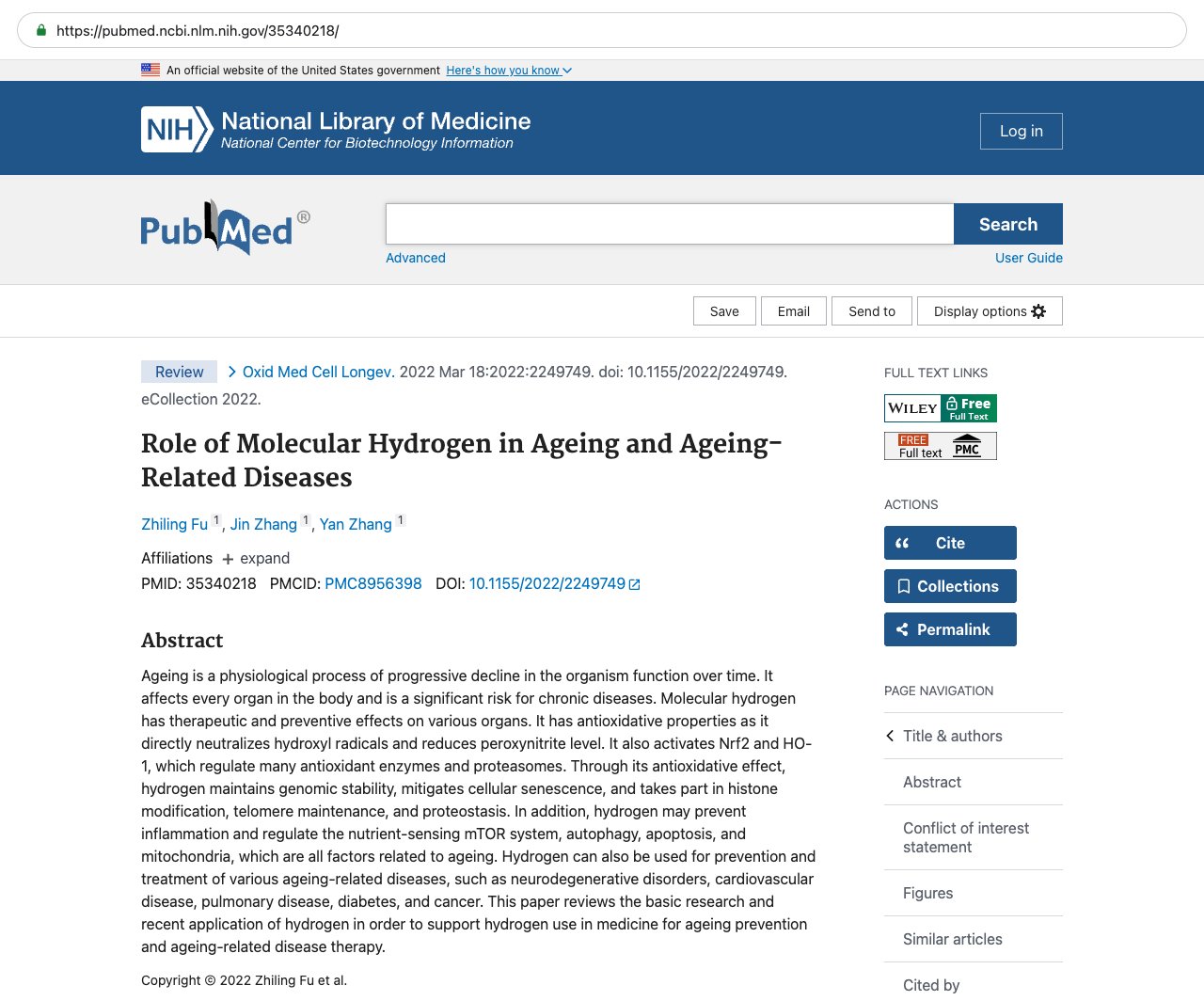
Ageing is a physiological process of progressive decline in the organism function over time. It affects every organ in the body and is a significant risk for chronic diseases. Molecular hydrogen has therapeutic and preventive effects on various organs. It has antioxidative properties as it directly neutralizes hydroxyl radicals and reduces peroxynitrite level. It also activates Nrf2 and HO-1, which regulate many antioxidant enzymes and proteasomes. Through its antioxidative effect, hydrogen maintains genomic stability, mitigates cellular senescence, and takes part in histone modification, telomere maintenance, and proteostasis. In addition, hydrogen may prevent inflammation and regulate the nutrient-sensing mTOR system, autophagy, apoptosis, and mitochondria, which are all factors related to ageing. Hydrogen can also be used for prevention and treatment of various ageing-related diseases, such as neurodegenerative disorders, cardiovascular disease, pulmonary disease, diabetes, and cancer. This paper reviews the basic research and recent application of hydrogen in order to support hydrogen use in medicine for ageing prevention and ageing-related disease therapy.
Source & links
Screenshot of the PubMed page
This page mirrors the published abstract (© the authors / publisher) for reference and citation. The canonical source is the PubMed record linked above. This is not medical advice.