2020 · Meng — Hydrogen Gas Represses the Progression of Lung Cancer via Down-regulating CD47
Super-Abstract
In lung cancer cell lines and a mouse tumour model, hydrogen gas treatment reduced the expression of CD47 — a „don't eat me“ signal that cancer cells use to evade immune destruction — and thereby inhibited cancer cell growth, invasion, migration, and promoted macrophage-mediated tumour cell clearance. This is an in-vitro and animal study; no human data are presented. (Bioscience Reports, 2020.)
Commentary
This study makes a mechanistically interesting contribution to the understanding of how H₂ may interact with cancer immunology. CD47 is a well-validated immune checkpoint molecule that inhibits macrophage phagocytosis — its downregulation is a recognised anti-tumour strategy. The study shows that H₂ gas reduces CD47 expression in a dose-dependent manner in A549 and H1975 lung cancer cells, and links this to enhanced macrophage phagocytosis. The CDC42 downregulation finding adds a cytoskeletal invasion-inhibition layer to the mechanism. The key limitation is that all cancer biology results are from cell lines and mouse xenograft studies — clinical relevance is entirely unknown. Importantly, knockdown of CD47 enhanced H₂'s anti-tumour effect, while CD47 overexpression abolished it, providing robust mechanistic confirmation.
Key quotes
- „H2 treatment caused decreases in the expression levels of CD47 and cell division control protein 42 (CDC42) in a dose-dependent manner.“ — the key mechanistic finding: H₂ downregulates both CD47 and CDC42 dose-dependently
- „Up-regulation of CD47 abolished H2 roles in promoting lung cancer cell apoptosis and repressing cell growth, invasion and migration.“ — mechanistic confirmation: CD47 is essential for H₂'s anti-tumour effect
- „H2 treatment induced obvious inhibitions in the expression levels of CDC42 and CD47 in mice tumor tissues, as well as reinforced macrophage-mediated phagocytosis in A549 and H1975 cells.“ — in-vivo and in-vitro confirmation of immune activation
Our assessment
This is an in-vitro cell culture and mouse xenograft study — a preclinical investigation only. The CD47-mediated mechanism is scientifically coherent and the confirmation through CD47 gain/loss-of-function experiments is methodologically solid. However, cell line and mouse xenograft results cannot be extrapolated to human lung cancer therapy. CD47 is an active area of cancer immunotherapy research, but the specific role of H₂ in modulating CD47 in human patients is entirely unknown. This study contributes a novel hypothesis — not clinical evidence.
Study design
- Type: in-vitro cell culture + in-vivo mouse xenograft study · Cell lines: A549 and H1975 (human non-small cell lung cancer) · H₂ delivery: hydrogen gas (inhalation/dissolved in medium); dose-dependent treatment
- Result: dose-dependent CD47 and CDC42 downregulation; H₂ inhibited proliferation, invasion, migration; promoted apoptosis and macrophage phagocytosis in vitro and in vivo; CD47 overexpression abolished anti-tumour effects; CD47 knockdown enhanced them
Abstract
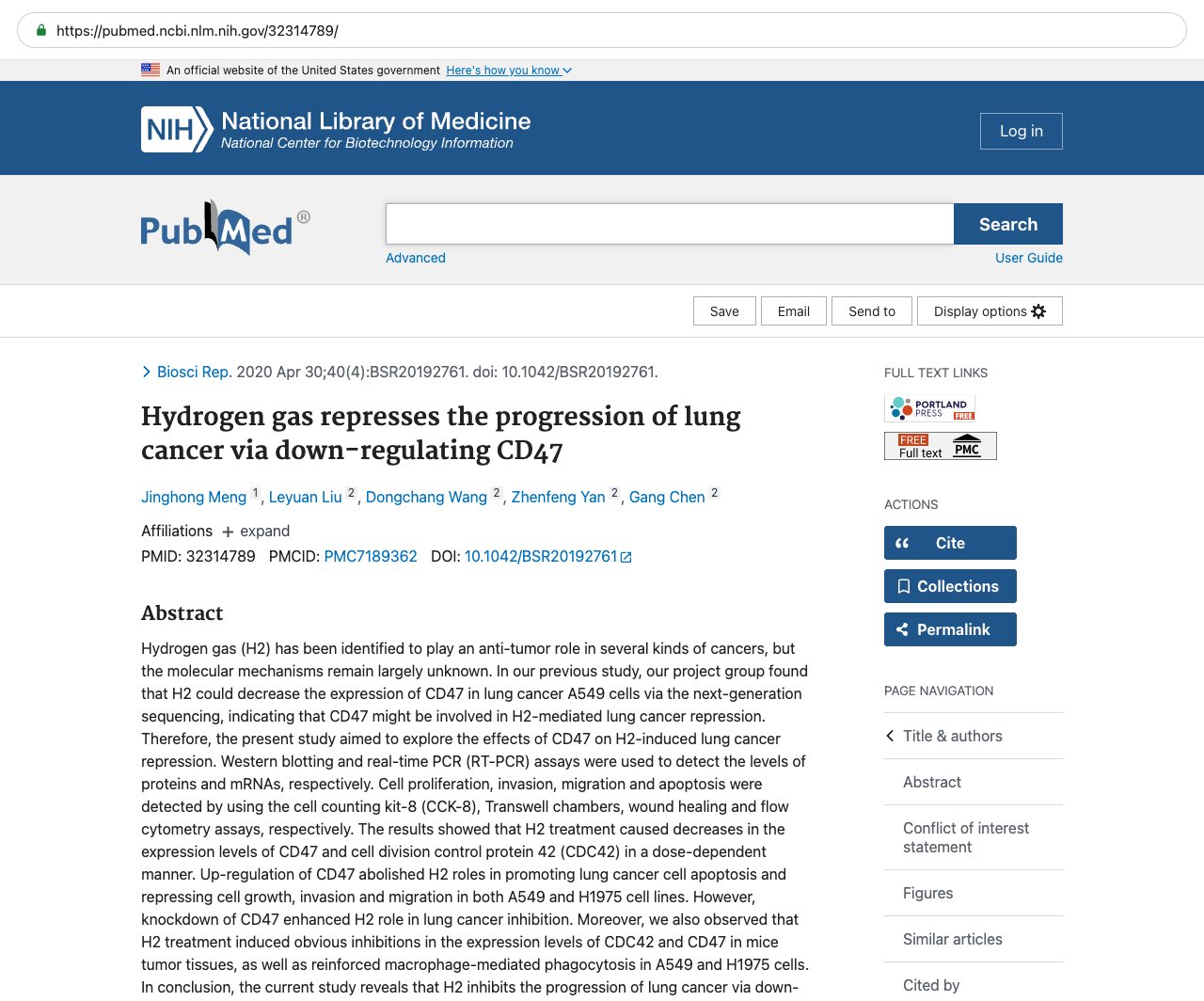
Hydrogen gas (H2) has been identified to play an anti-tumor role in several kinds of cancers, but the molecular mechanisms remain largely unknown. In our previous study, our project group found that H2 could decrease the expression of CD47 in lung cancer A549 cells via the next-generation sequencing, indicating that CD47 might be involved in H2-mediated lung cancer repression. Therefore, the present study aimed to explore the effects of CD47 on H2-induced lung cancer repression. Western blotting and real-time PCR (RT-PCR) assays were used to detect the levels of proteins and mRNAs, respectively. Cell proliferation, invasion, migration and apoptosis were detected by using the cell counting kit-8 (CCK-8), Transwell chambers, wound healing and flow cytometry assays, respectively. The results showed that H2 treatment caused decreases in the expression levels of CD47 and cell division control protein 42 (CDC42) in a dose-dependent manner. Up-regulation of CD47 abolished H2 roles in promoting lung cancer cell apoptosis and repressing cell growth, invasion and migration in both A549 and H1975 cell lines. However, knockdown of CD47 enhanced H2 role in lung cancer inhibition. Moreover, we also observed that H2 treatment induced obvious inhibitions in the expression levels of CDC42 and CD47 in mice tumor tissues, as well as reinforced macrophage-mediated phagocytosis in A549 and H1975 cells. In conclusion, the current study reveals that H2 inhibits the progression of lung cancer via down-regulating CD47, which might be a potent method for lung cancer treatment.
Source & links
Screenshot of the PubMed page
This page mirrors the published abstract (© the authors / publisher) for reference and citation. The canonical source is the PubMed record linked above. This is not medical advice.