2018 Biomedicine & pharmacotherapy = Biomedecine & pharmacotherapie Mechanism / Preclinical Inhalation
2018 · Wang — Hydrogen gas inhibits lung cancer progression through targeting SMC3
Super-Abstract
In lung cancer cell lines and a mouse xenograft model, hydrogen gas (H₂) inhibited cell viability, migration, and invasion while promoting apoptosis — apparently by downregulating SMC3, a chromosome condensation regulator. The tumour suppression effect in mice was weaker than cisplatin. This is a preclinical in-vitro and animal study; no human data exists. (Biomedicine & Pharmacotherapy, 2018.)
Commentary
This study takes an unusual mechanistic angle: instead of focusing on oxidative stress or established redox pathways, the authors performed RNA sequencing to find genes differentially expressed after H₂ treatment in A549 and H1975 lung cancer cells. They identified SMC3 — a structural maintenance of chromosomes protein involved in chromosome condensation — as a key target. H₂ reduced SMC3 expression, altered its subcellular localisation, and increased its ubiquitination (marking it for degradation). When SMC3 was artificially overexpressed, H₂'s anti-tumour effects were abolished, confirming the causal link. The mouse tumour data show H₂ reduced tumour weight compared to untreated controls, though cisplatin performed better. This dual in-vitro/in-vivo design strengthens the mechanistic narrative, but the clinical gap remains vast: how much H₂ reaches a tumour in a living human, at what concentration, and for how long — none of this is addressed.
Key quotes
- „H2 inhibited cell viability, migration and invasion, and catalyzed cell apoptosis and H2 induced A549 and H1975 cells G2/M arrest.“ — broad anti-tumour effects at the cellular level
- „inhibition of the proliferation, migration and invasion and promotion of the apoptosis of A549 and H1975 cells induced by H2 were all abolished when overexpressed SMC3 in the presence of H2.“ — causal evidence that SMC3 is the key mediator of H₂'s effect
- „the tumor weight in H2 group was significantly smaller than that in control group, but was bigger than cis-platinum group.“ — honest comparison: H₂ reduces tumour size in mice, but less than cisplatin
Our assessment
This is a preclinical study (cell lines + mouse xenograft). The SMC3 pathway is a novel and interesting mechanistic finding, well supported by the rescue experiment. However, the in-vivo data come from immunocompromised mice with transplanted human cell lines — a model far removed from spontaneous lung cancer in a patient. H₂ performed clearly worse than the chemotherapy agent used as comparison. No clinical conclusions can be drawn. The finding is hypothesis-generating for future mechanistic research, not a basis for therapeutic claims.
Study design
- Type: in-vitro + animal study · Cell models: A549 and H1975 (human NSCLC lines) · Animal model: mouse xenograft
- H₂ delivery: gas (inhalation, in vitro) · Key assays: CCK-8, flow cytometry, wound-healing, transwell invasion, RNA-seq, qPCR, western blot, immunohistochemistry
- Result: H₂ reduced cell viability, migration, invasion; induced G2/M arrest; decreased SMC3, NIBPL, SMC5/6 and Cyclin D1/CDK4/CDK6; mouse tumour weight reduced vs. control but higher than cisplatin group
Abstract
Lung cancer is one of the most common lethal malignancies in the globe. The patients' prognoses are dim due to its high metastatic potential and drug resistance. Therefore, in the present study, we aim to find a more potent therapeutic approach for lung cancer. We mainly explored the function of hydrogen gas (H2) on cell viability, apoptosis, migration and invasion in lung cancer cell lines A549 and H1975 by CCK-8, flow cytometry, wound healing and transwell assays, respectively. We used RNA-seq, qPCR and western blotting to detect the different expression genes (DEGs) between H2 group and control group to find the gene related to chromosome condensation. Besides, we confirmed the structural maintenance of chromosomes 3 (SMC3) and H2 on the progression of lung cancer in vitro and vivo. Results showed that H2 inhibited cell viability, migration and invasion, and catalyzed cell apoptosis and H2 induced A549 and H1975 cells G2/M arrest. Besides, H2 down-regulated the expression of NIBPL, SMC3, SMC5 and SMC6, and also reduced the expression of Cyclin D1, CDK4 and CDK6. H2 translocated the subcellular location of SMC3 during cell division and decreased its stability and increased its ubiquitination in both A549 and H1975 cells. In addition, inhibition of the proliferation, migration and invasion and promotion of the apoptosis of A549 and H1975 cells induced by H2 were all abolished when overexpressed SMC3 in the presence of H2. Animal experimental assay demonstrated that the tumor weight in H2 group was significantly smaller than that in control group, but was bigger than cis-platinum group. The expression of Ki-67, VEGF and SMC3 were decreased when mice were treated with H2 or cis-platinum, especially for cis-platinum. All data suggested that H2 inhibited lung cancer progression through down-regulating SMC3, a regulator for chromosome condensation, which provided a new method for the treatment of lung cancer.
Source & links
Screenshot of the PubMed page
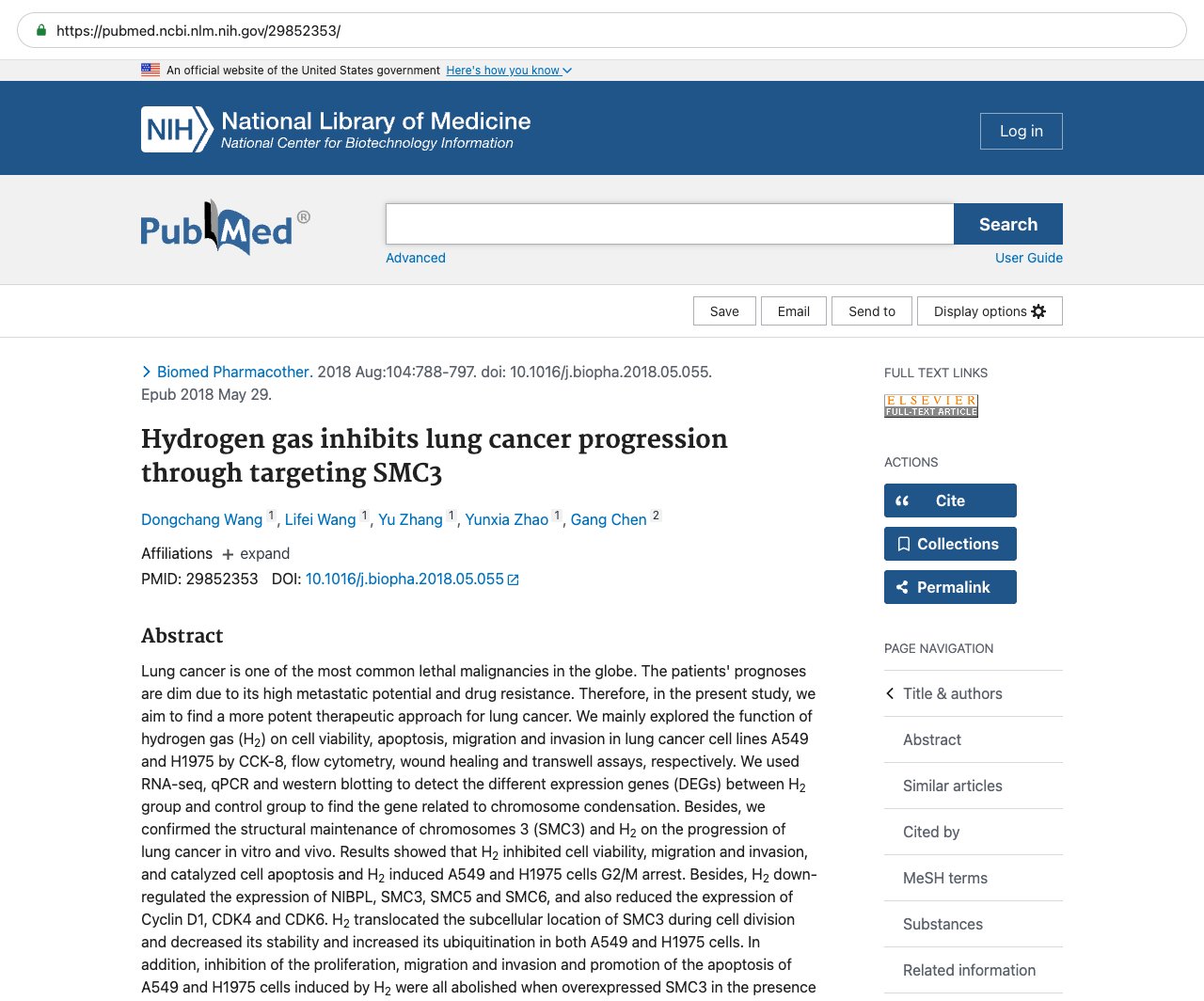
This page mirrors the published abstract (© the authors / publisher) for reference and citation. The canonical source is the PubMed record linked above. This is not medical advice.