2023 · Meng — Hydrogen-rich water treatment targets RT1-Db1 and RT1-Bb to alleviate premature ovarian failure in rats
Super-Abstract
In a cyclophosphamide-induced rat model of premature ovarian failure (POF), hydrogen-rich water restored hormonal markers (higher AMH and estradiol, lower FSH), reduced ovarian cell death, and — through proteomic analysis — identified two novel molecular targets, RT1-Db1 and RT1-Bb, potentially mediating H₂'s protective effect. These are animal findings and require validation in human studies.
Commentary
Premature ovarian failure affects roughly 1 % of women under 40 and leads to infertility, early menopause, and long-term health consequences. Effective causal treatments are scarce. Cyclophosphamide, a chemotherapy drug, is commonly used to create a reproducible POF model in rodents by inducing oxidative damage in ovarian tissue. This study not only confirms the protective effect of H₂ on hormonal parameters and histopathology, but goes further with quantitative proteomics (tandem mass tag method) to identify candidate protein targets — RT1-Db1 and RT1-Bb, both related to immune regulation (MHC class II molecules in rats). This mechanistic depth is valuable, but the rat MHC equivalents may behave differently from human immune pathways. Clinical translation would require identification of human orthologues and targeted trials.
Key quotes
- „In HRW treatment of POF rats, the serum AMH and E2 levels significantly increased, and FSH level significantly reduced, indicating the protective role of HRW.“ — key hormonal evidence of ovarian protection
- „A total of 16 candidate differentially expressed proteins (DEPs) were identified after the cross analysis of DEPs from POF vs. control and POF+HRW vs. POF groups.“ — proteomic approach revealed multiple mechanistic candidates
- „The crucial targets, RT1-Db1 and RT1-Bb, were finally identified based on both protein-protein interaction network and GeneMANIA network.“ — proposed molecular targets of HRW in POF — not yet validated in humans
Our assessment
An animal study with proteomic depth. The combination of functional outcome measurement (hormones, histology) and unbiased proteomics makes this study methodologically interesting. However, the clinical relevance is limited by the species gap, the chemotherapy-induced model (which may not represent idiopathic POF), and the fact that RT1-Db1/RT1-Bb are rat-specific MHC-II molecules whose human equivalents behave differently. Results cannot be transferred to women with POF without further research.
Study design
- Type: controlled animal experiment with proteomic analysis · Model: female rat, cyclophosphamide-induced POF · H₂ delivery: hydrogen-rich water as drinking water
- Result: significant increase in AMH and E2; significant decrease in FSH; reduced ovarian apoptosis (TUNEL); 16 differentially expressed proteins identified; RT1-Db1 and RT1-Bb named as key HRW targets
Abstract
BACKGROUND: Premature ovarian failure (POF) is defined as the cessation of ovarian function before the age of 40 years, imposing a significant health burden on patients. However, effective etiological therapy for POF is scarce. Thus, we aimed to explore the protective role and targets of hydrogen-rich water (HRW) in POF. METHODS: Based on cyclophosphamide (CTX)-induced POF rat models, the protective role of HRW treatment was mainly determined through serum 17-β-estradiol (E2), follicle-stimulating hormone (FSH), anti-mullerian hormone (AMH) levels, ovarian histomorphological analysis, and TUNEL assay. Tandem mass tag (TMT)-based quantitative proteomic analysis was then conducted on ovarian tissues, and the targets of HRW in POF were identified integrating differential expression analysis, functional enrichment analysis, and interaction analysis. RESULTS: In HRW treatment of POF rats, the serum AMH and E2 levels significantly increased, and FSH level significantly reduced, indicating the protective role of HRW. After TMT quantitative proteomic analysis, a total of 16 candidate differentially expressed proteins (DEPs) were identified after the cross analysis of DEPs from POF vs. control and POF+HRW vs. POF groups, which were found to be significantly enriched in 296 GO terms and 36 KEGG pathways. The crucial targets, RT1-Db1 and RT1-Bb, were finally identified based on both protein-protein interaction network and GeneMANIA network. CONCLUSIONS: The HRW treatment could significantly alleviate the ovarian injury of POF rats; RT1-Db1 and RT1-Bb are identified as two crucial targets of HRW treatment in POF rats.
Source & links
Screenshot of the PubMed page
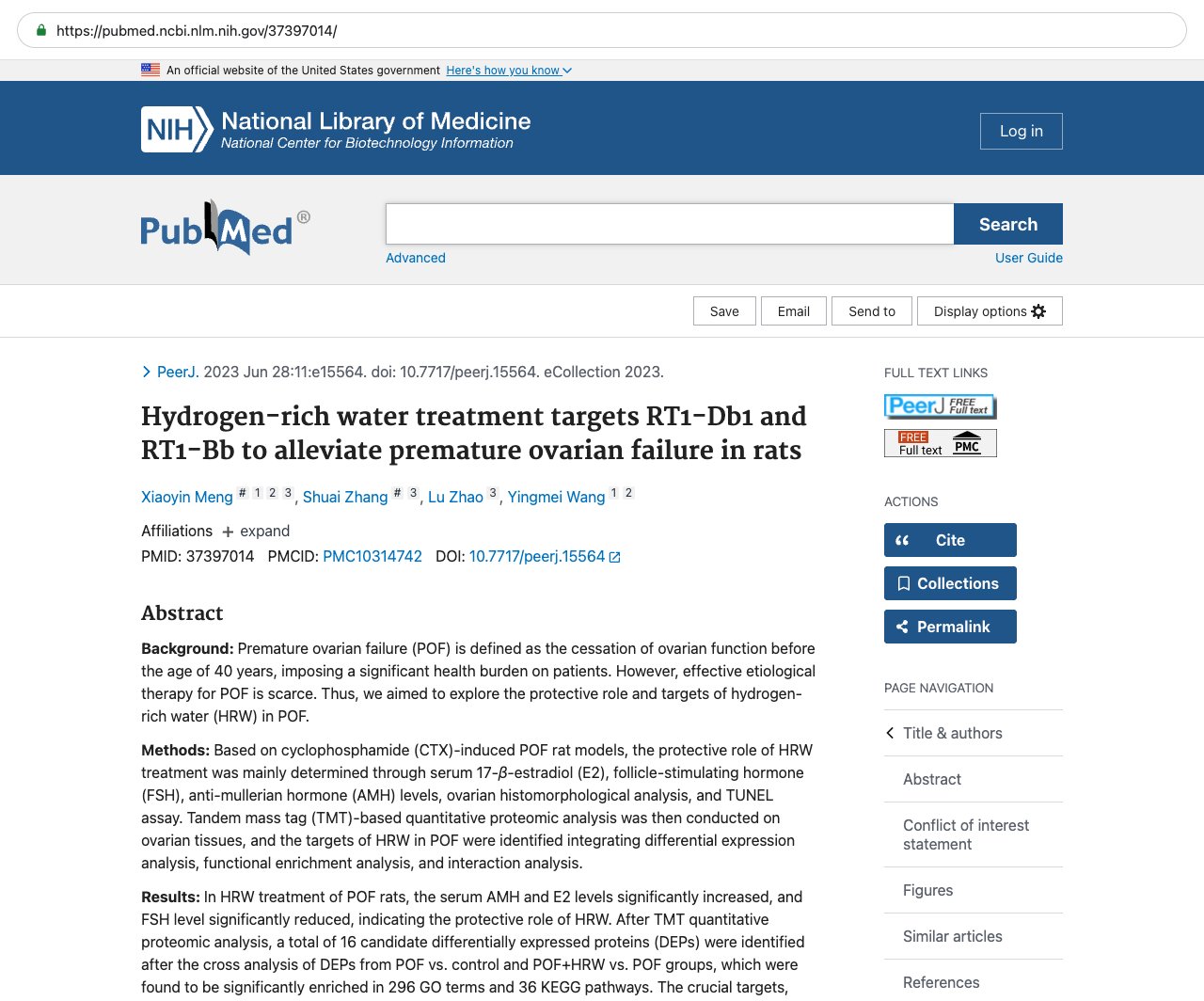
This page mirrors the published abstract (© the authors / publisher) for reference and citation. The canonical source is the PubMed record linked above. This is not medical advice.