2026 · Merigo — Gas Therapies for Neuro-Protection
Super-Abstract
Cardiac arrest causes severe neurological damage, and conventional treatment options remain inadequate — but inhaled gas therapies including molecular hydrogen (H₂), nitric oxide, xenon and argon show neuroprotective promise through antioxidant, anti-inflammatory and anti-apoptotic mechanisms. This review in Critical Care Clinics synthesises preclinical and early clinical evidence, while clearly stating that large-scale trials are still needed before these approaches can enter standard post-resuscitation care. (Critical Care Clinics, 2026.)
Commentary
This is a high-level narrative review aimed at critical care clinicians, addressing one of the most urgent unsolved problems in resuscitation medicine: secondary neurological injury after cardiac arrest. H₂ is presented as one of several gaseous neuroprotectants, alongside nitric oxide, xenon and argon, sharing mechanisms of action rooted in redox biology and cell death suppression. The review is optimistic in tone but intellectually honest: the authors explicitly state that large randomised controlled trials are lacking and that current evidence does not support routine clinical use. The paper is useful for framing where H₂ stands within the broader gas therapy landscape, but should not be read as an endorsement of clinical H₂ treatment after cardiac arrest.
Key quotes
- „Gas therapies, including inhaled nitric oxide (NO), molecular hydrogen (H2), xenon (Xe), and argon (Ar), have emerged as promising neuroprotective agents.“ — H₂ placed in context of a broader class of gaseous neuroprotectants
- „These gases exert protective effects, preserving neurologic function and improving outcomes after CA through antioxidant, anti-inflammatory, and anti-apoptotic mechanisms.“ — the shared mechanistic rationale across gas therapies
- „Despite promising preclinical and early clinical data, large-scale trials are essential to validate their efficacy, optimize protocols, refine dosing, and ensure clinical translation.“ — the authors' honest caveat on the current evidence base
Our assessment
This is a narrative review — no original data, no pooled effect sizes. H₂ is discussed as one of four medical gases with neuroprotective potential in the post-cardiac-arrest setting; it is not singled out as superior. The mechanistic rationale is well-supported by preclinical work, but the authors are explicit that large clinical trials are still outstanding. This review is appropriate as background reading on the research landscape, not as clinical guidance.
Study design
- Type: narrative review (Critical Care Clinics) · n: n/a (literature synthesis) · H₂ delivery: inhalation (focus of review)
- Clinical context: neuroprotection after cardiac arrest · Gases reviewed: H₂, NO, xenon, argon
- Conclusion: promising preclinical and early clinical signals; large-scale RCTs required before clinical translation; gas therapy could represent a paradigm shift in resuscitation medicine
Abstract
Cardiac arrest (CA) remains a major cause of mortality and neurologic impairment, underscoring the urgent need for innovative neuroprotective strategies. Gas therapies, including inhaled nitric oxide (NO), molecular hydrogen (H2), xenon (Xe), and argon (Ar), have emerged as promising neuroprotective agents. These gases exert protective effects, preserving neurologic function and improving outcomes after CA through antioxidant, anti-inflammatory, and anti-apoptotic mechanisms. Despite promising preclinical and early clinical data, large-scale trials are essential to validate their efficacy, optimize protocols, refine dosing, and ensure clinical translation. Advancing gas therapies into standard post-CA care could revolutionize neuroprotection, offering a paradigm shift in resuscitation medicine.
Source & links
Screenshot of the PubMed page
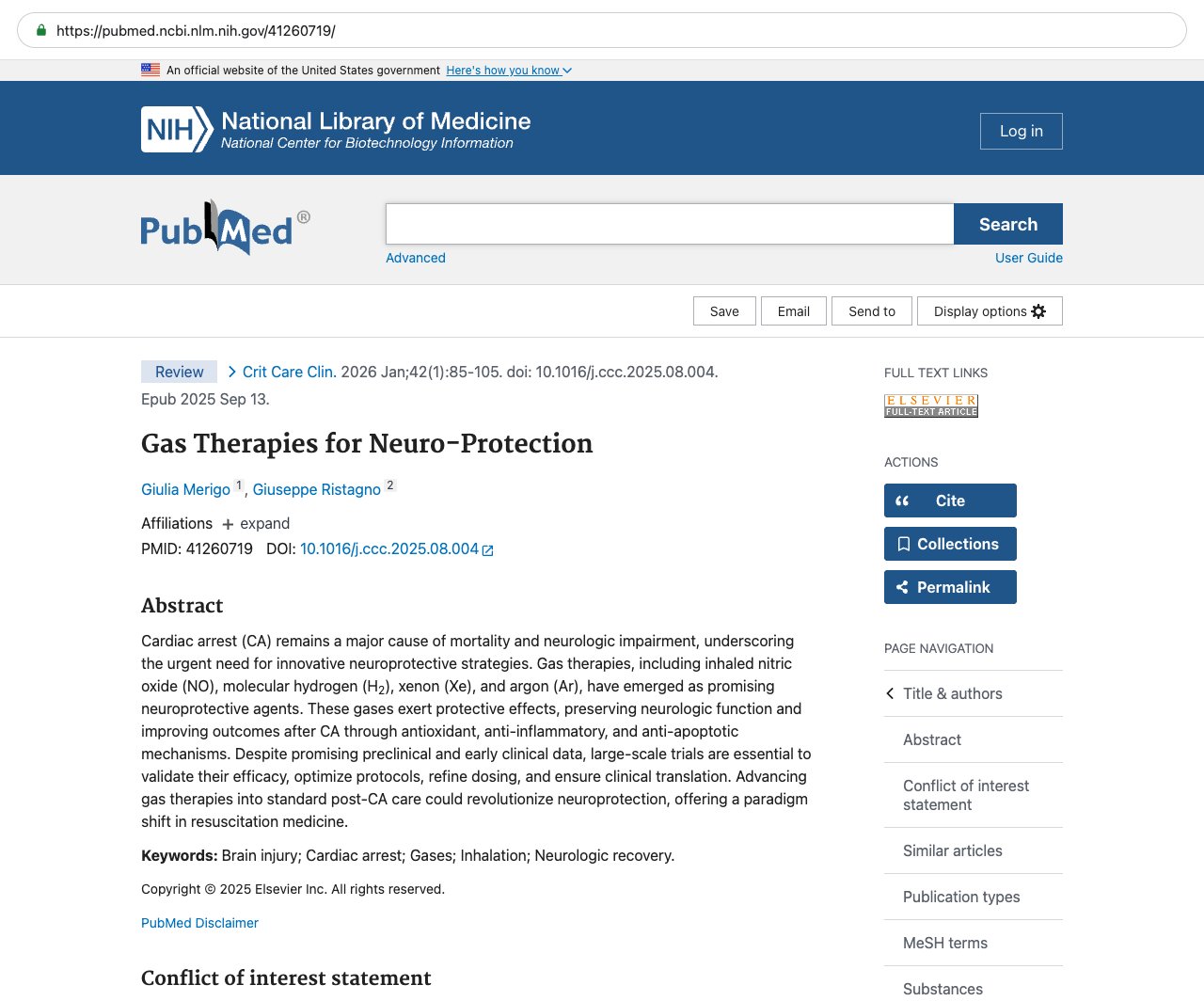
This page mirrors the published abstract (© the authors / publisher) for reference and citation. The canonical source is the PubMed record linked above. This is not medical advice.