2017 · Mizuno et al. — Hydrogen-Rich Water for Improvements of Mood, Anxiety, and Autonomic Nerve Function in Daily Life
Super-Abstract
In 26 adult volunteers, drinking 600 mL of hydrogen-rich water a day for 4 weeks lowered the K6 questionnaire score and resting sympathetic nerve activity, measured as change from baseline, significantly more than placebo water did. The authors interpret both changes as effects on central nervous system function. The abstract reports no p-values or effect sizes, no hydrogen concentration and no results for the cognitive tests that were also run. (Medical Gas Research, 2017.)
Commentary
The authors describe chronic oxidative stress and inflammation as causes of declining brain function and low quality of life (QOL), and they asked whether drinking hydrogen-rich water (HRW) affects QOL. The study was randomised, double-blind and placebo-controlled, with two crossover phases. Its 26 adult volunteers (13 women, 13 men, mean age 34.4 ± 9.9 years) drank 600 mL of HRW a day or 600 mL of placebo water a day, each for 4 weeks. Outcomes came from psychophysiological tests: questionnaires, tests of autonomic nerve function and tests of cognitive function. The reported results are change ratios (post-treatment divided by pre-treatment) for the K6 questionnaire score and for sympathetic nerve activity at rest. The abstract does not state the hydrogen concentration of the water, the washout period between the two phases, a primary endpoint or adverse events.
Key quotes
- „Change ratios (post-treatment/pre-treatment) for K6 score and sympathetic nerve activity during the resting state were significantly lower after HRW administration than after PLW administration.“ — the main result, the only outcomes the abstract reports, given without numbers
- „In this double-blinded, placebo-controlled study with a two-way crossover design, 26 volunteers (13 females, 13 males; mean age, 34.4 ± 9.9 years) were randomized to either a group administered oral HRW (600 mL/d) or placebo water (PLW, 600 mL/d) for 4 weeks.“ — design and dose: a small crossover study in volunteers, not patients
- „These results suggest that HRW may reinforce QOL through effects that increase central nervous system functions involving mood, anxiety, and autonomic nerve function.“ — the authors' conclusion, carefully worded as a suggestion
Our assessment
This is a randomised, double-blind, placebo-controlled crossover study, so each volunteer served as their own control. Two measures, the K6 score and resting sympathetic nerve activity, fell more with hydrogen-rich water than with placebo water. In this small sample, that suggests an effect on these measures but does not show a change in quality of life itself. Limitations: 26 volunteers and 4 weeks per phase. The abstract names no primary endpoint. Questionnaires, autonomic tests and cognitive tests were run, but only two results are reported, so it is unclear how many outcomes were compared and what the others showed. No p-values, hydrogen concentration, washout period or adverse events are given. The participants were volunteers, not patients with a diagnosed condition. The link to quality of life is the authors' interpretation of surrogate measures.
Study design
- Type: randomised, double-blind, placebo-controlled crossover study with two phases · n: 26 adult volunteers (13 women, 13 men, mean age 34.4 ± 9.9 years) · H₂ delivery: drinking hydrogen-rich water, 600 mL a day for 4 weeks (H₂ concentration not stated)
- Comparator: placebo water, 600 mL a day for 4 weeks, in crossover
- Result: no primary endpoint named. Change ratios (post/pre) for the K6 score and for resting sympathetic nerve activity significantly lower after hydrogen-rich water than after placebo water (no p-values given). Results of the cognitive tests and other questionnaires not reported in the abstract
Abstract
Health and a vibrant life are sought by everyone. To improve quality of life (QOL), maintain a healthy state, and prevent various diseases, evaluations of the effects of potentially QOL-increasing factors are important. Chronic oxidative stress and inflammation cause deteriorations in central nervous system function, leading to low QOL. In healthy individuals, aging, job stress, and cognitive load over several hours also induce increases in oxidative stress, suggesting that preventing the accumulation of oxidative stress caused by daily stress and daily work contributes to maintaining QOL and ameliorating the effects of aging. Hydrogen has anti-oxidant activity and can prevent inflammation, and may thus contribute to improve QOL. The present study aimed to investigate the effects of drinking hydrogen-rich water (HRW) on the QOL of adult volunteers using psychophysiological tests, including questionnaires and tests of autonomic nerve function and cognitive function. In this double-blinded, placebo-controlled study with a two-way crossover design, 26 volunteers (13 females, 13 males; mean age, 34.4 ± 9.9 years) were randomized to either a group administered oral HRW (600 mL/d) or placebo water (PLW, 600 mL/d) for 4 weeks. Change ratios (post-treatment/pre-treatment) for K6 score and sympathetic nerve activity during the resting state were significantly lower after HRW administration than after PLW administration. These results suggest that HRW may reinforce QOL through effects that increase central nervous system functions involving mood, anxiety, and autonomic nerve function.
Source & links
Screenshot of the PubMed page
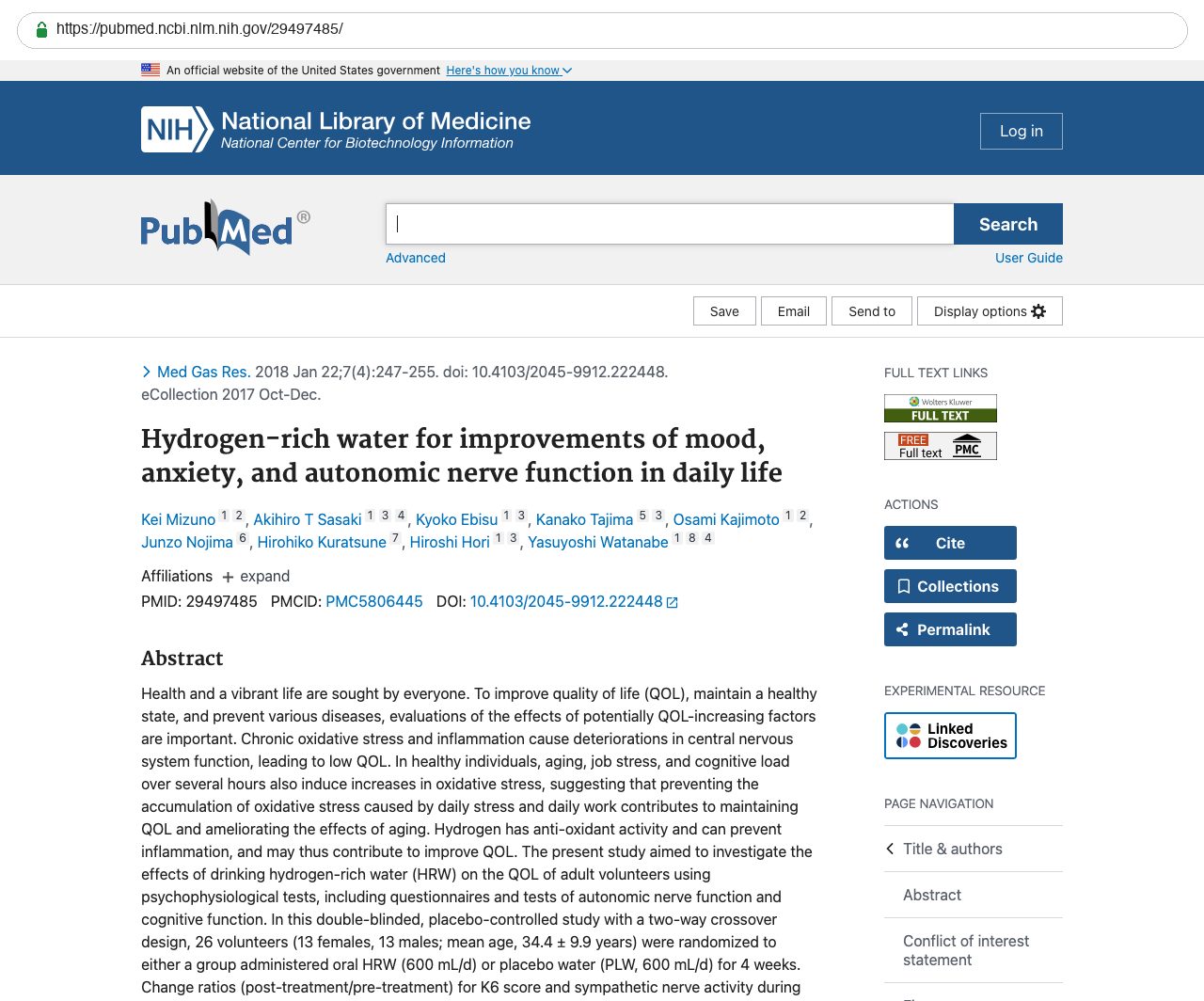
This page mirrors the published abstract (© the authors / publisher) for reference and citation. The canonical source is the PubMed record linked above. This is not medical advice.