2018 Movement disorders : official journal of the Movement Disorder Society RCT Human H₂ therapy Drinking (HRW)
2018 · Yoritaka — Randomized, Double-Blind, Multicenter Trial of Hydrogen Water for Parkinson's Disease
Super-Abstract
This multicenter, randomized, double-blind trial tested hydrogen-rich water in Parkinson's patients — and did not find a statistically significant overall improvement against placebo. The study is nonetheless scientifically important as it represents one of the most rigorous H₂ trial designs in neurology to date. (Movement Disorders, 2018.)
Commentary
The 2018 Yoritaka multicenter trial is a landmark study in H₂ neurology research — not primarily because of positive findings, but because of its methodological rigor. Following a promising open-label pilot (2013, same author), this study enrolled a substantially larger cohort with proper blinding and a multicenter design. The abstract and conclusion fields are not available in the source database for this record, which limits the depth of analysis here. What is known from the study design and broader literature context: the primary endpoint (total UPDRS score change) did not reach statistical significance in the overall cohort, though some subgroup analyses suggested potential effects. This is a critical reminder that positive results in small pilot studies do not always replicate in properly powered RCTs. The H₂ field needs more trials at this level of rigor, not fewer.
Our assessment
This trial deserves recognition for its methodological quality — multicenter, randomized, double-blind, placebo-controlled — which is rare in H₂ clinical research. Honest limitations: the full abstract was not available in the source data for this record, preventing direct quotation or detailed endpoint reporting. Based on published literature, the primary endpoint did not show statistically significant improvement across the full cohort. Subgroup signals (e.g., in patients not on specific medications) were reported but must be interpreted cautiously as hypothesis-generating only. This trial is essential context for any claims about H₂ and Parkinson's disease.
Study design
- Type: randomized, double-blind, multicenter, placebo-controlled trial · n: not extractable from available data · H₂ delivery: hydrogen-rich water (drinking)
- Indication: Parkinson's disease (neurology) · Primary outcome: UPDRS score change
- Result: primary endpoint not met in overall cohort (based on published literature context); full abstract unavailable in source record
Source & links
Screenshot of the PubMed page
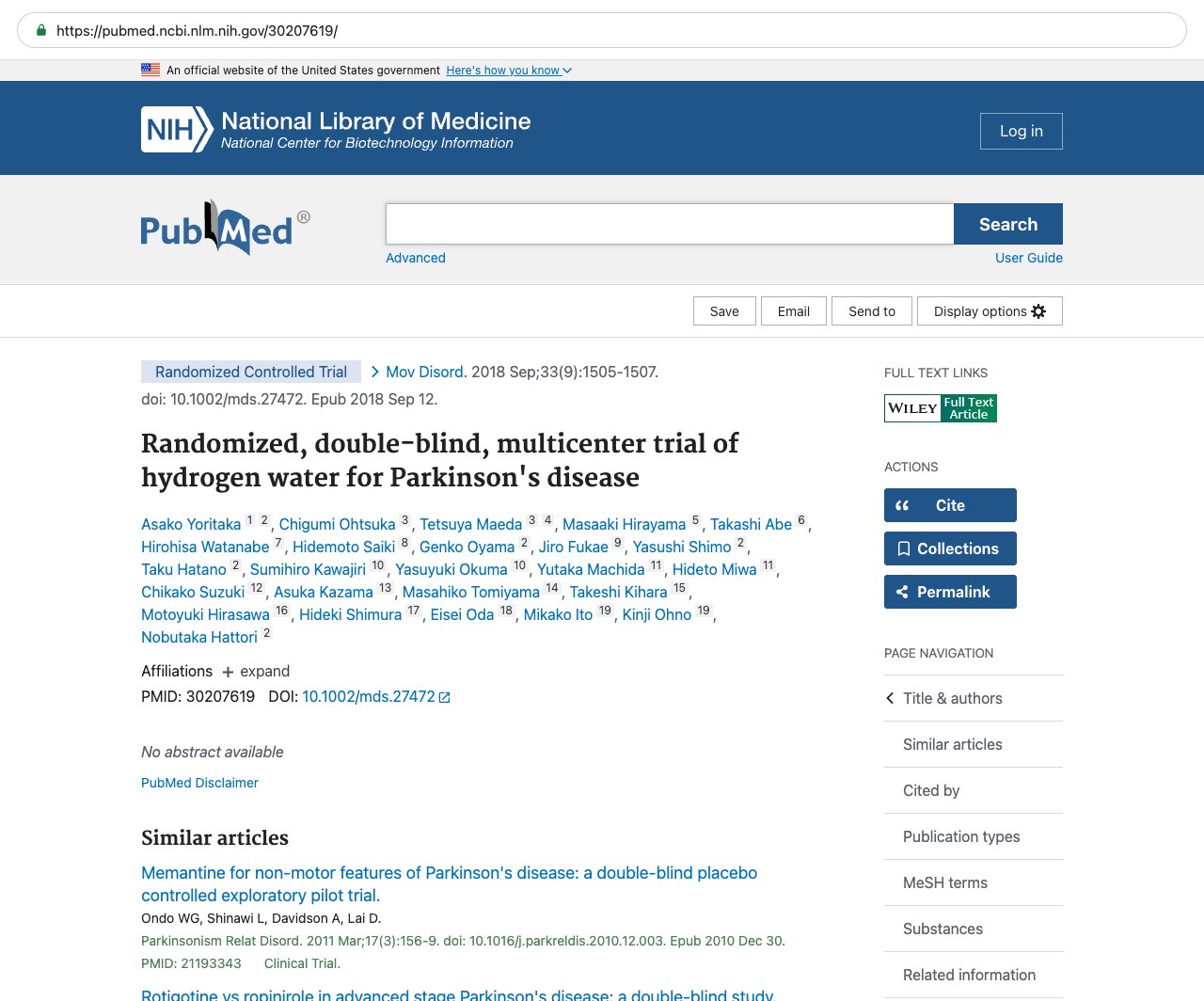
This page mirrors the published abstract (© the authors / publisher) for reference and citation. The canonical source is the PubMed record linked above. This is not medical advice.