2021 · Todorovic et al. — Hydrogen-Rich Water and Caffeine for Alertness and Brain Metabolism in Sleep-Deprived Habitual Coffee Drinkers
Super-Abstract
In 16 sleep-deprived young adults, a single drink of hydrogen-rich water (8 ppm) shortened trail-making test time compared with tap water, while reaction time, the primary outcome per full text, did not differ significantly between hydrogen-rich water and tap water. Errors on a symbol digit test were reported as lower after hydrogen-rich water or caffeine than after tap water, and both drinks raised the choline-to-creatine ratio in frontal brain regions. No participant reported side effects. (Food Science & Nutrition, 2021.)
Commentary
This trial compared a single drink of hydrogen-rich water with caffeine for alertness after a night without sleep. Sixteen apparently healthy young adults (8 men, 8 women, mean age 24.0 years) who habitually drink coffee took part in a randomised controlled crossover trial. After 24 hours of sleep deprivation and 12 hours of fasting, each received in the morning a single drink of hydrogen-rich water (8 ppm), caffeine (50 mg), hydrogen-rich water plus caffeine, or tap water as control. Per full text, each drink was 500 ml, the drinks were similar in appearance and taste, and a 7-day washout separated the periods. Outcomes were measured before and 15 minutes after the drink: alertness and attention tests, brain metabolism by magnetic resonance spectroscopy (per full text), brain oxygenation, peripheral oxygen saturation and self-reported side effects. Per full text, the primary outcome was the change in reaction time on the attention network test. The abstract does not mention blinding.
Key quotes
- „Significantly less time was needed to complete trail-making test after both HRW and HRW plus caffeine compared with the control drink (p < .05).“ — the clearest result for hydrogen-rich water compared with the control drink
- „No participants reported any side effects from any intervention.“ — self-reported safety after a single drink
- „Being generally recognized as a safe intervention, hydrogen could be thus recommended as a novel intervention that upholds attention in stressed conditions, with its metabolic footprint likely different from caffeine.“ — the authors' recommendation, based on one dose in 16 people
Our assessment
The crossover design lets each participant act as their own control, which helps in a sample of 16. Trail-making time was shorter after hydrogen-rich water than after tap water, but reaction time, the primary outcome per full text, did not differ significantly between the two. Per full text, reaction time differed only between caffeine and the two hydrogen drinks, and the mean reaction time was longer after hydrogen-rich water than after tap water. The abstract reports fewer symbol digit test errors after hydrogen-rich water, while the full-text table lists the significant difference for the number of symbols and p = 0.297 for errors. Limitations: 16 healthy young adults, a single dose, measurements only 15 minutes after drinking, many outcomes tested and no mention of blinding. Brain metabolite ratios are surrogate markers. One dose in 16 people is a thin basis for the authors' recommendation of hydrogen to maintain attention, and the findings need confirmation in larger trials.
Study design
- Type: randomised controlled crossover trial with four single-dose conditions and a 7-day washout (per full text) · n: 16 (8 men, 8 women, age 24.0 ± 3.5 years) · H₂ delivery: single drink of hydrogen-rich water (8 ppm, 500 ml per full text), alone or with 50 mg caffeine, after 24 hours of sleep deprivation
- Comparator: control drink (tap water per abstract, per full text matched to the other drinks for magnesium content) and caffeine 50 mg alone
- Result: primary outcome per full text, reaction time: significant treatment-by-time interaction, with significant differences only between caffeine and the two hydrogen drinks. Trail-making test faster after hydrogen-rich water and after hydrogen-rich water plus caffeine than after control (p < .05). Symbol digit test errors lower after hydrogen-rich water or caffeine (p < .05 per abstract, not significant in the full-text table). Choline-to-creatine ratio raised in frontal white and gray matter by hydrogen-rich water and caffeine. No side effects reported
Abstract
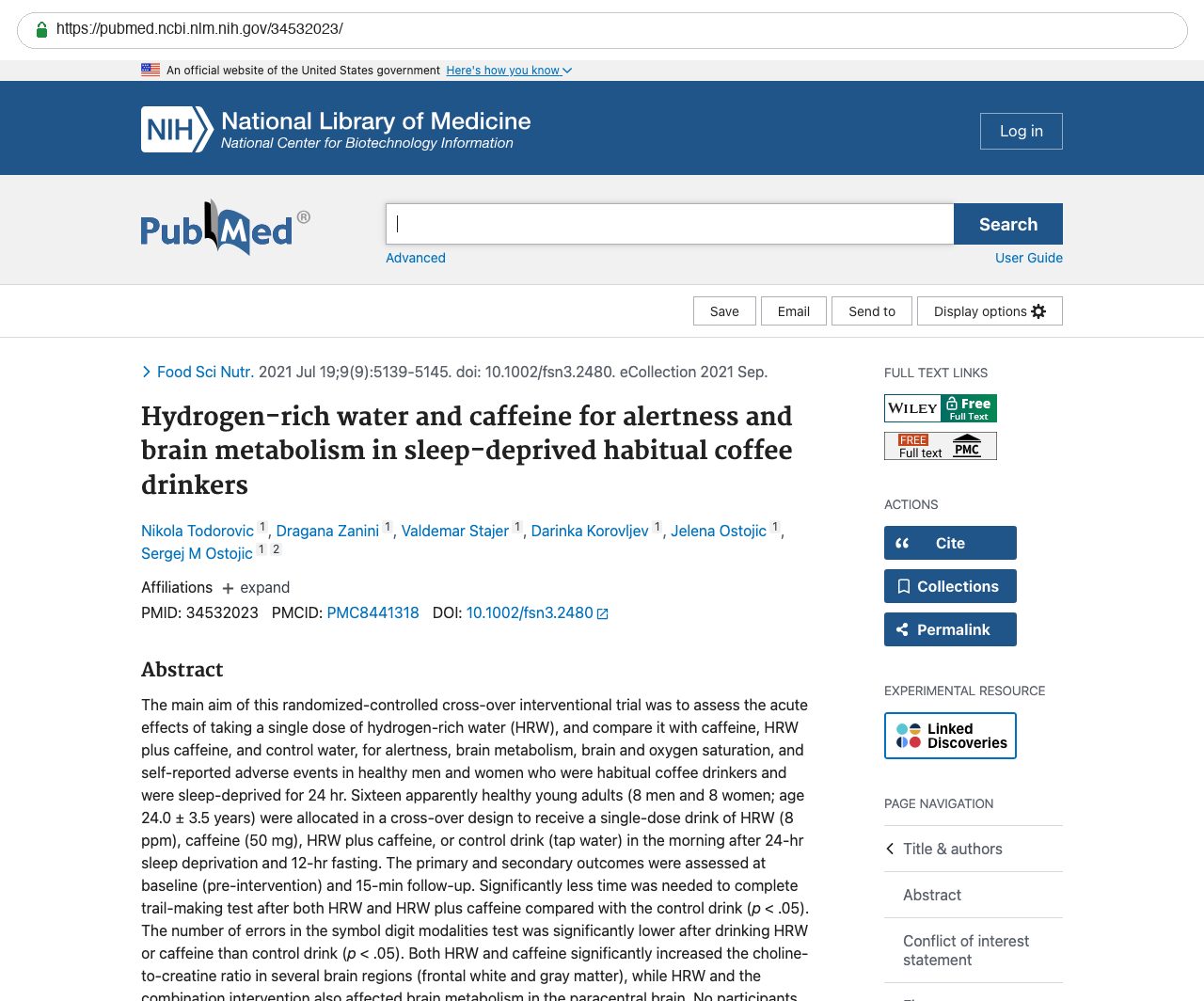
The main aim of this randomized-controlled cross-over interventional trial was to assess the acute effects of taking a single dose of hydrogen-rich water (HRW), and compare it with caffeine, HRW plus caffeine, and control water, for alertness, brain metabolism, brain and oxygen saturation, and self-reported adverse events in healthy men and women who were habitual coffee drinkers and were sleep-deprived for 24 hr. Sixteen apparently healthy young adults (8 men and 8 women; age 24.0 ± 3.5 years) were allocated in a cross-over design to receive a single-dose drink of HRW (8 ppm), caffeine (50 mg), HRW plus caffeine, or control drink (tap water) in the morning after 24-hr sleep deprivation and 12-hr fasting. The primary and secondary outcomes were assessed at baseline (pre-intervention) and 15-min follow-up. Significantly less time was needed to complete trail-making test after both HRW and HRW plus caffeine compared with the control drink (p < .05). The number of errors in the symbol digit modalities test was significantly lower after drinking HRW or caffeine than control drink (p < .05). Both HRW and caffeine significantly increased the choline-to-creatine ratio in several brain regions (frontal white and gray matter), while HRW and the combination intervention also affected brain metabolism in the paracentral brain. No participants reported any side effects from any intervention. The attention enhancement driven by HRW appears along with changes in brain metabolism. Being generally recognized as a safe intervention, hydrogen could be thus recommended as a novel intervention that upholds attention in stressed conditions, with its metabolic footprint likely different from caffeine.
Source & links
Screenshot of the PubMed page
This page mirrors the published abstract (© the authors / publisher) for reference and citation. The canonical source is the PubMed record linked above. This is not medical advice.